

A single mistake from eight or nine years ago can stay dormant until it suddenly weaponizes a new charge into a mandatory prison sentence. If you’re facing a second or third arrest, the Idaho DUI lookback period is the most dangerous factor in your case because it allows the prosecution to stack your past against your present. It’s natural to feel a sense of dread when a misdemeanor threat transforms into a potential felony. You’ve worked hard to build a life, and now a decade-old court date could be the lever the state uses to take it all away.
We understand the high stakes you’re facing and the confusion that comes with complex statutes. This article provides the clarity you need to understand how Idaho counts prior convictions, including out-of-state offenses and withheld judgments. You’ll learn the exact mandatory minimum penalties for repeat offenders and, most importantly, how an aggressive defense strategy can challenge the enhancement of your charges. Don’t let the system use your history to dictate your future. You must understand these rules to protect your freedom.
Key Takeaways
- Understand that the Idaho DUI lookback period is a 10-year window where the state weaponizes prior convictions to escalate your current penalties from misdemeanors to life-altering felonies.
- A second offense triggers a mandatory 10-day jail stay and a license suspension that only starts once you’re released.
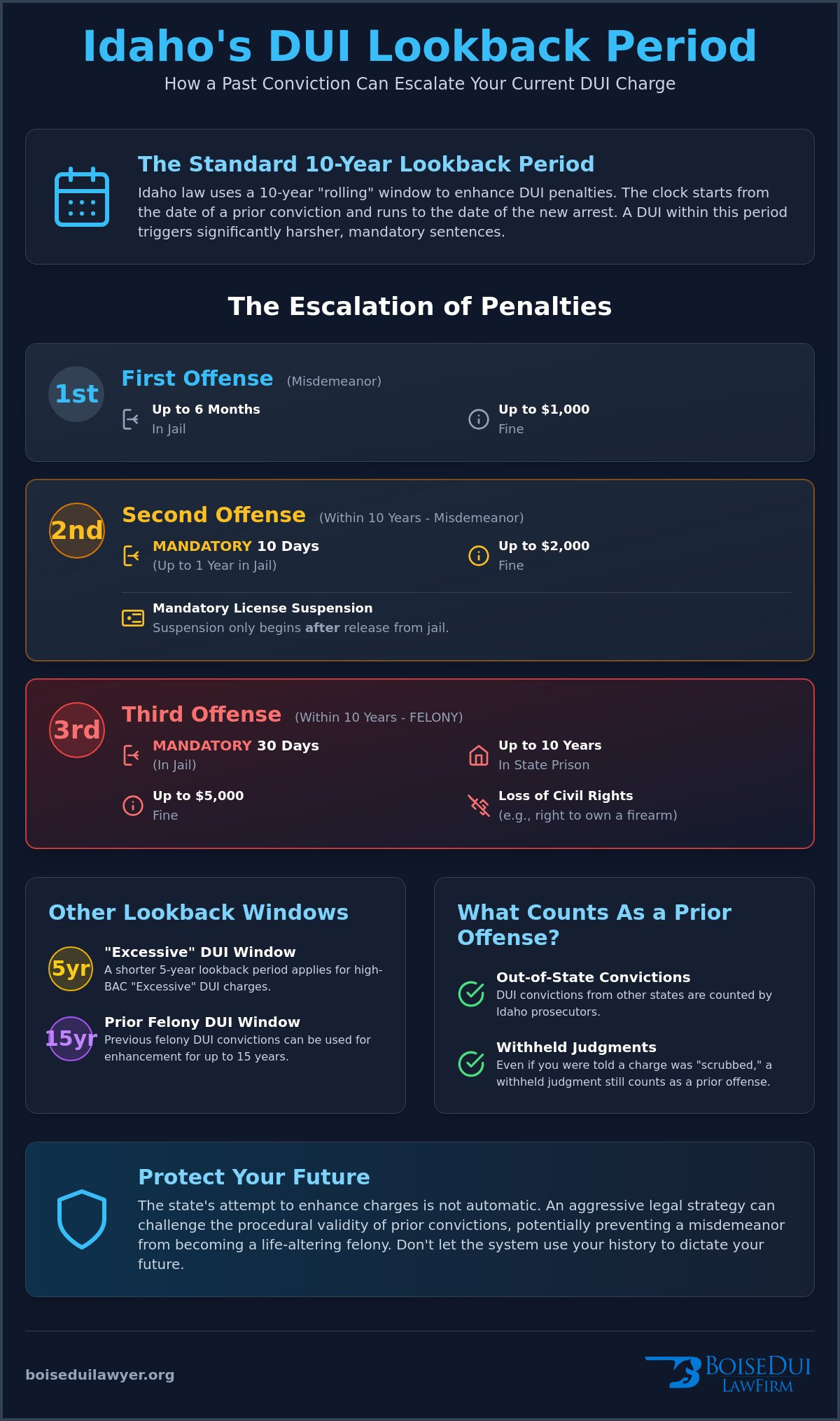
- Learn why high-BAC “Excessive” charges follow a shorter five-year window while previous felony convictions can haunt your record for up to 15 years.
- Out-of-state convictions and withheld judgments still count toward your total, even if you’re told they’ve been scrubbed.
- Discover how an aggressive legal strategy can challenge the state’s attempt to enhance your charges by attacking the procedural validity of prior convictions.
What is the Idaho DUI Lookback Period? Understanding the 10-Year Rule
The state of Idaho doesn’t view a second or third arrest as an isolated incident. Instead, the legal system uses your past to amplify your present legal jeopardy. This mechanism is known as the Idaho DUI lookback period. It serves as a statutory window that allows prosecutors to “enhance” a standard charge into something far more damaging. Under Idaho law, Driving Under the Influence (DUI) carries penalties that escalate sharply if you have prior convictions on your record. The system is built to punish what it perceives as a pattern of behavior, regardless of how much your life has changed since your last court date.
The legal authority for these enhancements is found in Idaho Code § 18-8005. This statute outlines how the state calculates prior offenses to determine mandatory minimum sentences. According to Idaho Code § 18-8005, the Idaho DUI lookback period is a ten-year timeframe, measured from the date of a prior conviction to the date of the new arrest, used to escalate the severity and mandatory penalties of the current charge. If you fall within this window, the prosecution isn’t just looking for a conviction; they’re looking to stack consequences that can include mandatory jail time, massive fines, and the permanent stigma of a felony record.
The 10-Year Standard Window
For the vast majority of cases, Idaho operates on a ten-year “rolling” window. This means the clock doesn’t reset until a full decade has passed without a conviction. If you’re arrested for a second DUI within this ten-year span, the charge remains a misdemeanor, but it triggers a mandatory minimum of 10 days in jail. The stakes peak if you’re facing a third arrest within ten years. At that point, the state automatically elevates the charge to a felony. You’re no longer looking at county jail; you’re looking at a mandatory 30 days in jail and up to 10 years in state prison. The transition from a misdemeanor to a felony is a life-altering event that can strip you of your right to own a firearm and your ability to find employment.
This professional impact is even more pronounced for those involved in international commerce. For instance, if you visit Israel Cross Border Law Firm to manage business and investment between Israel and the U.S., a felony conviction could jeopardize the security clearances and trust necessary for such high-stakes cross-border work.
Why the Lookback Period Exists
The state justifies this aggressive stacking of penalties as a tool for deterring recidivism. Prosecutors use your history to argue that previous interventions failed, which they then use to justify higher bail amounts and more restrictive pre-trial release conditions. They want the court to see you as a recurring threat rather than an individual who made a mistake. This system is designed to trap you in a cycle of escalating punishment. By understanding how these windows are calculated, you can begin to identify the strategic intervention points necessary to challenge the state’s narrative and protect your future.
The Escalation of Penalties: How Priors Change Your Sentencing
The legal consequences of a DUI in Idaho aren’t static; they’re designed to punish you more severely every time you re-enter the system. Once you fall within the Idaho DUI lookback period, the state removes the safety net of judicial leniency. While a first offense is often handled with a focus on rehabilitation, a second or third offense shifts the focus entirely toward punishment and public safety. The prosecution isn’t looking to give you a second chance; they’re looking to maximize the weight of the law against you.
The specific penalties are codified in Idaho Statutes § 18-8005, and they leave very little room for negotiation once the state proves your prior record. The jump in severity between a first and second offense is staggering. Consider the following breakdown of how the state escalates your charges:
- First Offense: Up to six months in jail and fines reaching $1,000. Most first-time offenders can avoid significant jail time through a plea.
- Second Offense (within 10 years): A mandatory minimum of 10 days in jail, with potential for a full year, and fines up to $2,000.
- Third Offense (within 10 years): This is a felony charge carrying a mandatory 30 days in jail, up to 10 years in prison, and fines as high as $5,000.
If you are staring down these mandatory minimums, speaking with a Boise DUI lawyer is the only way to evaluate if your prior conviction is actually valid for enhancement. Don’t assume the state’s math is correct; histories can be challenged and procedural errors in old cases can sometimes save your future.
Mandatory Minimums You Cannot Avoid
Judges in Idaho have their hands tied regarding repeat offenders. For a second offense within the 10-year Idaho DUI lookback period, you must serve at least 10 days. The law specifically requires that at least 48 hours of this time be served consecutively. You can’t use community service or house arrest to avoid this requirement. If the state upgrades your charge to a felony for a third offense, that mandatory minimum jumps to 30 days in the county jail or state prison. These are hard floors, not ceilings, and prosecutors often push for much more. Understanding your options to get a DUI reduced to reckless driving in Idaho can be a critical strategy for avoiding these mandatory minimums entirely.
License Suspensions and Absolute Periods
The most disruptive penalty for many is the loss of driving privileges. A first offense allows for a restricted permit after the first 30 days. However, a second offense triggers a one-year “absolute” suspension. This means there are no work permits, no school permits, and no exceptions. You’re completely off the road for 365 days. Following this period, you’ll be required to install an ignition interlock device in every vehicle you operate for at least one year. The state uses these absolute periods to effectively paralyze your ability to maintain a normal life.
The Hidden Lookback Windows: 5-Year Excessive and 15-Year Felony Rules
While many drivers focus on the standard ten-year window, Idaho law contains specific traps that can catch you completely off guard. The state doesn’t treat all alcohol concentrations or criminal histories the same way. If your case involves a high blood alcohol content (BAC) or a previous felony, the standard Idaho DUI lookback period changes. These hidden windows are designed to fast-track offenders into the felony system, often with much shorter or much longer timeframes than the public expects. You cannot afford to assume you’re safe just because your last arrest was several years ago.
The 5-Year Excessive DUI Rule
If your BAC was recorded at .20% or higher, you’re facing an “Excessive DUI.” This charge carries its own unique set of rules that are far more aggressive than a standard offense. Under Idaho law, a second Excessive DUI within a five-year period is automatically charged as a felony. This five-year window is a specialized subset of the Idaho DUI lookback period. It means that even if you don’t meet the “three in ten” criteria for a standard felony, the state can still send you to prison for a second high-BAC mistake. The penalties for an Excessive DUI are harsher from the start, and the state uses this shorter window to hammer repeat high-BAC offenders with life-altering consequences.
The 15-Year Felony Enhancement
The danger to your freedom expands exponentially once you have a felony DUI on your record. Idaho law dictates that any DUI committed within 15 years of a prior felony DUI conviction is also charged as a felony. This 15-year window is one of the longest and most punitive in the region. It applies regardless of whether your previous felony was the result of a third offense or an Aggravated DUI involving an injury. For residents in the Treasure Valley, this means a single felony conviction from your youth can haunt you well into middle age. Once you’re labeled a felon, the system treats you as a permanent threat, and the 15-year rule ensures the state has a long reach to keep you under its thumb.
It’s also critical to understand that some charges ignore the calendar entirely. If an accident occurs and another person suffers great bodily harm, the state will charge you with an Aggravated DUI. This is an immediate felony. In these cases, the prosecutor doesn’t need to look at your history or calculate a window. The injury itself bypasses all lookback rules and puts you in immediate jeopardy of up to 15 years in state prison. Whether you’re dealing with a high BAC or a prior felony, the system is rigged to escalate your charges at every opportunity.
Calculating Your Window: Out-of-State DUIs and Withheld Judgments
The math the state uses to determine your charges is often more complex than a simple calendar check. Many people believe that if their last arrest was more than a decade ago, they’re in the clear. However, the Idaho DUI lookback period is calculated with precise start and end points that can catch you in a “felony trap” even if you think your record has washed out. The state is looking for any reason to escalate your current situation, and they’ll look across state lines and into sealed records to find the leverage they need.
Conviction Date vs. Arrest Date
The most critical detail in calculating your window is knowing exactly when the clock starts. In Idaho, the lookback period is measured from the date of the prior conviction to the date of the new arrest. This is a vital distinction. If you were arrested 11 years ago but your case was delayed in the courts for 18 months before a judge signed the final order, that conviction date might still fall within the 10-year window. You can’t rely on your memory of the blue lights in the rearview mirror. You must verify the specific date the judge signed the judgment of conviction. To find this, you should search your record in Idaho’s iCourt system or obtain a certified copy of the judgment from the clerk’s office. If you’re unsure about your timeline, you should have a Boise DUI lawyer perform a comprehensive background check to ensure the state isn’t overreaching.
The Trap of the Withheld Judgment
There is a common and dangerous myth that a “Withheld Judgment” doesn’t count as a prior offense. In Idaho, a Withheld Judgment is a tool that allows a defendant to complete probation and eventually have the case dismissed, technically avoiding a permanent conviction on their public record. However, for the purposes of DUI enhancement, the law is clear: a Withheld Judgment counts as a prior conviction. You only get one Withheld Judgment for a DUI in your entire life. If you received one eight years ago and are arrested again today, the state will treat that first incident as a full strike to enhance your new charge to a second-offense misdemeanor with mandatory jail time.
The state’s reach also extends beyond Idaho’s borders. If you have a prior conviction from another state, it will count toward the Idaho DUI lookback period if that state’s law is “substantially conforming” to Idaho’s statutes. This means the legal elements of the out-of-state crime must be similar to ours. Even reduced charges, such as a “Wet Reckless” from California, can sometimes be used to enhance an Idaho charge if the underlying facts involve alcohol or drug impairment. Prosecutors are trained to hunt for these conforming priors to justify harsher penalties. You must be prepared to challenge whether those out-of-state laws actually meet Idaho’s strict legal standards for enhancement. If you’ve recently experienced a DUI arrest in Boise, Idaho, understanding the urgent deadlines and immediate steps you must take can be just as critical as knowing how your prior record will be used against you.
Defending a Repeat DUI in Boise: Strategic Intervention Points
Repeat DUI charges in Boise and Nampa are not open-and-shut cases. While the prosecution relies on the Idaho DUI lookback period to justify mandatory jail and prison sentences, their foundation depends entirely on the legal validity of your past. If that foundation is cracked, the entire enhancement can crumble. You need a defense that doesn’t just look at the new police report; it must meticulously audit your entire criminal history for errors that the state hopes you’ll ignore. Your past shouldn’t be a weapon used to destroy your future.
Challenging the Prior Conviction
Procedural errors in your original case can sometimes be used to strike a prior from your record. We look for instances where a previous judge failed to properly advise you of your rights or where you weren’t represented by competent counsel during an old plea. If a prior conviction was obtained unconstitutionally, it cannot be used to enhance a new charge. This strategy, known as a collateral attack, is a powerful tool against aggressive prosecutors. Additionally, we scrutinize out-of-state convictions with extreme care. If the other state’s law doesn’t substantially conform to Idaho’s specific requirements, it shouldn’t count toward the Idaho DUI lookback period. We fight to ensure the state isn’t using an apples-to-oranges comparison to justify a felony charge.
Mitigation and Negotiation Strategies
Strategic intervention starts the moment you’re released from custody. In Boise and Nampa courts, proactive mitigation can change the trajectory of a felony case. By voluntarily entering alcohol treatment or installing an ignition interlock device before being ordered to do so, you demonstrate a commitment to safety that can be used as leverage during negotiations. This is especially critical in “cusp” cases where a prior conviction is nearly 10 years old. An equitable defense argues that the extreme jump to a felony is disproportionate when the prior is on the verge of washing out. In some situations, the most effective path forward is to pursue a plea bargain strategy designed to get your DUI reduced to reckless driving in Idaho, which can prevent the enhancement from taking hold entirely. We position ourselves as your shield, using every available legal nuance to protect your freedom and challenge the prosecution’s narrative.
Negotiating a felony down to a misdemeanor is a high-stakes battle that requires an intimate knowledge of local prosecutorial habits. You don’t have to face this intimidating system alone. We invite you to schedule a free consultation to review your specific lookback window and determine the best path forward. Early intervention is the key to preserving your rights and your future. Don’t wait for the state to make the first move and dictate the terms of your life.
Protect Your Freedom from the Stacking System
The state of Idaho counts on you being intimidated by the 10-year rule and the threat of mandatory prison time. However, the Idaho DUI lookback period is a complex legal calculation, not an automatic sentence. We’ve seen how specific dates, out-of-state statutes, and past procedural errors can change the entire landscape of your case. You don’t have to accept the prosecution’s version of your history as the final word. Our firm brings an aggressive defense to every repeat DUI case, utilizing deep knowledge of Treasure Valley court procedures to find the leverage you need. We have extensive experience challenging the validity of prior convictions to prevent the state from unfairly enhancing your charges.
The system is fast-moving and unforgiving, but early intervention provides the best chance to secure a misdemeanor reduction or a dismissal of enhancements. You’ve worked too hard to let a decade-old mistake dismantle your life now. Take the first step toward a proactive defense. Protect your future; schedule a free DUI case evaluation in Boise today. There is always a way to fight back when you have the right shield in front of you.
Frequently Asked Questions
Does a DUI from another state count toward the Idaho lookback period?
Yes, out-of-state convictions count if the other state’s laws are substantially similar to Idaho’s statutes. Prosecutors actively check national databases for these priors to escalate your current charges. If the legal elements of the crime match, Idaho treats it as if it happened here. You must be prepared to challenge whether those specific out-of-state laws truly meet Idaho’s strict legal standards for enhancement.
What happens if my prior DUI was more than 10 years ago?
If your prior conviction falls outside the 10-year Idaho DUI lookback period, it typically won’t enhance a new misdemeanor charge. However, if that old conviction was a felony, you’re still in danger under the 15-year rule. You must verify your exact conviction date in the iCourt system rather than guessing based on the arrest year. A single day can be the difference between a misdemeanor and a felony.
Can a withheld judgment be used to enhance a new DUI charge?
Yes, a withheld judgment counts as a prior offense for the purpose of sentencing enhancements in Idaho. Even if your record shows the case was eventually dismissed after probation, the state retains that record to stack penalties against you later. You only get one withheld judgment for a DUI in your lifetime. If you’re arrested again, the system treats that first incident as a full strike.
Is a third DUI within 10 years always a felony in Idaho?
Yes, a third offense within the standard Idaho DUI lookback period is automatically charged as a felony. This carries a mandatory minimum of 30 days in jail and the potential for up to 10 years in state prison. The state doesn’t offer leniency for third-time offenders. At this stage, you’re no longer just fighting for a license; you’re fighting for your basic civil rights and your freedom.
How is the 10-year lookback period actually calculated?
The window is measured from the date the judge signed the judgment of conviction for the first offense to the date of the arrest for the second offense. Delays in your first case can actually extend your window of danger. Don’t rely on the date of your first arrest or the date you finished probation. You must check the court’s final order to know if you’re truly within the state’s reach.
Does a reckless driving charge count toward the DUI lookback?
Standard reckless driving convictions usually don’t count, but a “Wet Reckless” from another state might. If the previous charge involved alcohol or drugs and the statute conforms to Idaho’s DUI laws, the prosecution may attempt to use it as a strike. You need an aggressive defense that challenges these conforming arguments. Don’t let the state use a reduced charge to unfairly escalate your current legal jeopardy.
Can I get a restricted license if I have a second DUI within 10 years?
No, a second conviction within 10 years triggers a mandatory one-year absolute suspension. You’re barred from driving for any reason, including work, school, or medical emergencies. There are no restricted permits available during this absolute period. Once that year ends, you’ll still face mandatory ignition interlock requirements for at least another year. The state uses these absolute periods to effectively paralyze your daily life.
What is the 15-year lookback rule for felony DUIs?
If you have a prior felony DUI conviction, any subsequent DUI arrest within the next 15 years is also a felony. This rule applies even if the previous felony was for an Aggravated DUI or a third offense. The state uses this extended window to permanently label repeat offenders as felons. This 15-year window is one of the most punitive in the region and requires immediate professional intervention to challenge.