

A blood test result is not a conviction; it is merely a vulnerable data point generated by a fallible machine and a human technician. If you’re staring at a lab report that says you were over the legal limit, you likely feel the crushing weight of mandatory jail time and the pressure of Idaho’s strict implied consent laws. It’s natural to feel overwhelmed by scientific evidence that seems impossible to beat. However, you must realize that the Idaho State Lab is not immune to error. You need a proactive DUI blood test defense Idaho strategy to protect your future and your driver’s license before the clock runs out on your administrative hearing.
We’re here to show you exactly how these forensic results can be dismantled. In this guide, you’ll discover the strategic legal methods used to suppress or discredit blood alcohol evidence in Idaho courts. We’ll preview the most common flaws in the testing process, from improper blood draws to systemic lab failures, and explain how a seasoned advocate uses these technicalities to fight for a dismissal. Don’t let the prosecution’s data define your case before you’ve seen the flaws behind the science.
Key Takeaways
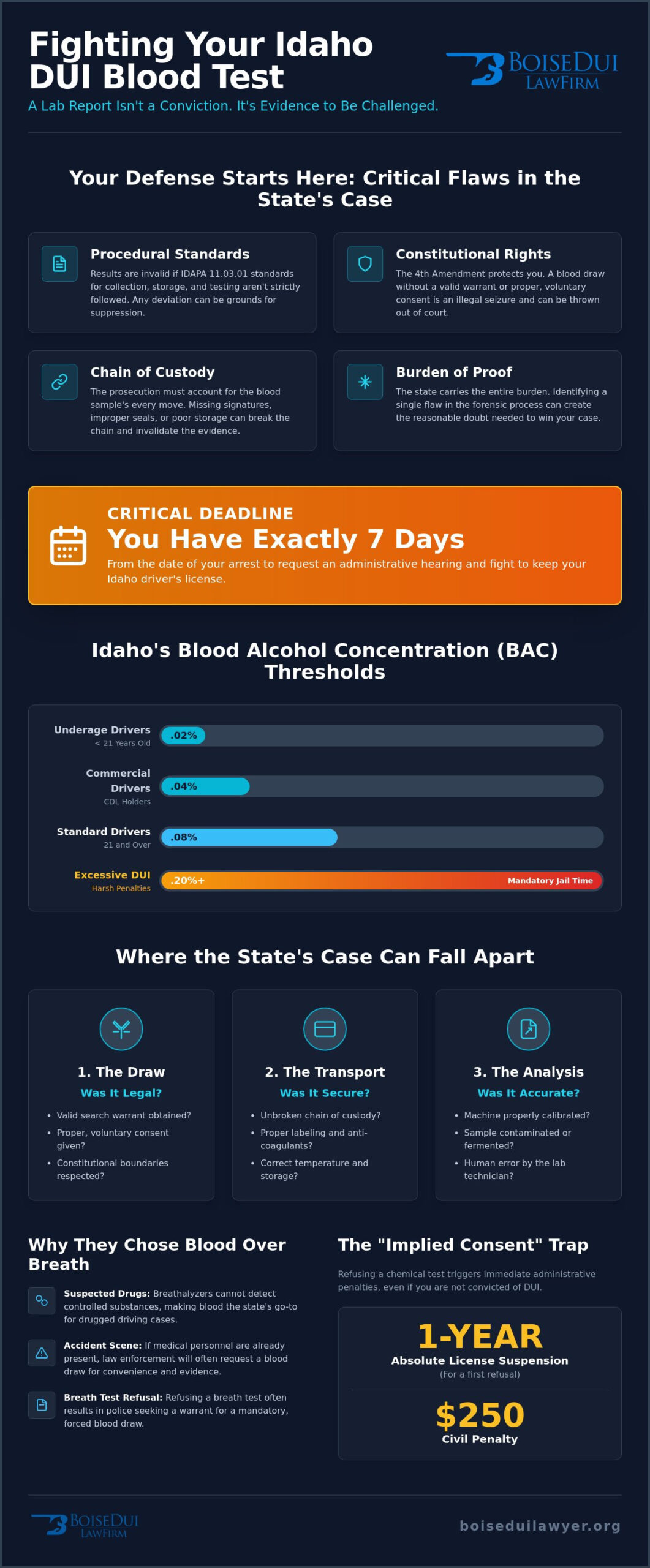
- Blood test results aren’t final; they depend on strict adherence to IDAPA 11.03.01 standards, and any deviation can invalidate the state’s evidence.
- Your 4th Amendment rights protect you against unlawful seizures, meaning a blood draw performed without a valid warrant or proper consent can be suppressed.
- A comprehensive DUI blood test defense Idaho strategy identifies “Chain of Custody” errors, like missing signatures or improper storage, to dismantle the prosecution’s case.
- You have exactly seven days from your arrest to request an administrative hearing and fight to keep your Idaho driver’s license.
- The burden of proof rests entirely on the state, and identifying a single flaw in the forensic process can create the reasonable doubt you need to win.
Understanding DUI Blood Tests in Idaho: Per Se vs. Impairment
Idaho law is unforgiving. If you’re pulled over in Boise or Meridian and your blood shows a specific concentration of alcohol, the prosecution doesn’t care if you felt perfectly sober. This is the “Per Se” standard. Under Idaho Code § 18-8004, it’s illegal to drive with a blood alcohol concentration (BAC) of .08% or higher. The state doesn’t have to prove impairment; they only have to prove the math. This makes a strong DUI blood test defense Idaho essential, because the numbers on that lab report are the primary weapon used against you. Even if you passed every field sobriety test, a “per se” result can still lead to a conviction if the forensic evidence stands unchallenged.
While breathalyzers are common at the roadside, Idaho prosecutors view blood tests as the “gold standard” of forensic evidence. They believe it’s harder to challenge than a breath sample. Because blood tests are more invasive and expensive, they’re typically reserved for high-stakes situations. If you’re facing an aggravated DUI case or a crash, expect the state to demand a vial of your blood. In Nampa and Boise courts, these results often bridge the gap between a misdemeanor and a life-altering felony charge. Understanding Blood Alcohol Content and how it’s measured is the first step in realizing that these scientific results are often based on flawed assumptions. The state wants you to believe the lab results are infallible, but they’re often the result of a rushed and error-prone process.
The Legal Thresholds in Idaho
Idaho sets different limits depending on who you are and what you’re driving. If you fall into any of these categories, the state will move aggressively to secure a conviction based solely on the laboratory data:
- Standard Drivers (21 and over): .08% BAC.
- Commercial Drivers (CDL): .04% BAC threshold in the Treasure Valley.
- Underage Drivers: Idaho’s zero-tolerance .02% limit.
If your BAC reaches .20% or higher, you face high BAC DUI Idaho “Excessive DUI” charges. These carry significantly harsher penalties, including mandatory jail time and extended license suspensions. You aren’t just fighting a ticket; you’re fighting for your freedom.
When the State Chooses Blood Over Breath
Law enforcement won’t always give you a choice. They prioritize blood draws when they suspect drugs are involved, as standard breathalyzers cannot detect controlled substances. This is common in Drugged Driving cases across the Treasure Valley. They also opt for blood after a DUI involving an accident where medical personnel are already on-site. Finally, if you refuse a breath test, officers will frequently contact a judge to secure a search warrant for a forced blood draw. You must act quickly. A DUI blood test defense Idaho specialist can examine whether that warrant was legally obtained or if the state overstepped its bounds during the seizure.
The Legality of the Draw: Warrants and Implied Consent
Idaho’s Implied Consent law creates a legal trap for the unwary. By operating a motor vehicle on Idaho roads, you’ve already “agreed” to submit to chemical testing if an officer has reasonable grounds to believe you’re driving under the influence. However, this isn’t a blank check for the state. The 4th Amendment protects you against unreasonable searches and seizures. Since a blood draw is a physical intrusion into your body, the state generally needs a warrant. Some competitors claim police don’t need a warrant in Idaho, but that’s a dangerous oversimplification. Recent Supreme Court rulings have clarified that the natural dissipation of alcohol in the bloodstream doesn’t automatically create an “emergency” that bypasses the warrant requirement. A robust DUI blood test defense Idaho often begins by questioning whether the officer respected these constitutional boundaries.
If you refuse the test, the state imposes immediate, harsh penalties. For a first refusal, you face a one-year absolute license suspension and a $250 civil penalty. These aren’t criminal punishments; they’re administrative consequences designed to coerce compliance. Even if you’re eventually found not guilty of the DUI, these civil penalties can remain, affecting your ability to work and care for your family. This is why you cannot afford to treat the administrative side of your case as a secondary concern.
The Search Warrant Requirement
In Boise and across the Treasure Valley, police officers frequently use telephonic warrants to bypass delays. They call a judge, provide a sworn statement, and receive verbal authorization for a forced blood draw. We scrutinize the “Probable Cause” used to obtain these warrants. Did the officer exaggerate the signs of impairment? Was the information stale? If the state claims “exigent circumstances” allowed them to draw blood without a warrant, we demand proof that waiting for a judge would have truly compromised the evidence. Adherence to Forensic Blood Analysis Procedures starts at the moment of the draw, and any deviation from legal protocol is a potential opening to suppress the results. We also demand to see the exact timeline. If there was a significant delay between the stop and the draw, the blood alcohol levels may not accurately reflect your state while driving.
The 7-Day Deadline to Save Your License
Time is your greatest enemy after an arrest. You have exactly seven days to request an administrative hearing to contest your license suspension. If you miss this window, the Idaho Transportation Department will automatically suspend your driving privileges, regardless of what happens in your criminal case. This hearing is a critical opportunity for a DUI defense attorney Boise to cross-examine the arresting officer and identify weaknesses in the state’s narrative. An aggressive DUI blood test defense Idaho approach at this stage can often uncover procedural errors that the prosecution would rather keep hidden. Don’t wait until your first court date to seek help; by then, your license may already be gone. If you’re feeling overwhelmed, taking immediate action is the only way to protect your freedom.
Common Flaws in Idaho DUI Blood Testing
The state relies on the illusion of scientific perfection to secure convictions. They want you to believe that once your blood is inside a vial, the resulting number is an absolute truth. This is a lie. Forensic blood testing is a complex chemical process prone to human error, equipment failure, and biological degradation. In Idaho, the strict protocols for these tests are found in IDAPA 11.03.01. These aren’t just suggestions; they’re the legal requirements the state must follow to use that evidence against you. If a technician skips a step or a lab analyst cuts a corner, the entire result becomes suspect. A comprehensive DUI blood test defense Idaho strategy focuses on exposing these procedural cracks to move for the suppression of the evidence.
One of the most frequent points of failure is the “Chain of Custody.” From the moment the needle leaves your arm to the second the sample is placed in the gas chromatograph, every hand that touches that vial must be documented. A single missing signature or an unexplained gap in the storage log can be enough to toss a case. If the state can’t prove exactly where your blood was and who had access to it, the integrity of the sample is compromised. We demand the full litigation packet to verify that the state followed Idaho’s official alcohol testing regulations. Without a perfect paper trail, the “scientific” result is nothing more than hearsay.
Blood is an organic substance that changes over time. If a sample isn’t stored at the correct temperature or if the vial lacks the proper chemicals, it can undergo a process called fermentation. Bacteria and yeast within the blood consume glucose and produce ethanol as a byproduct. This is known as “Neo-genesis.” If your blood sat in a warm police cruiser or a desk drawer for days before reaching the lab, the BAC reading might be significantly higher than it was when you were actually driving. You could be facing a felony charge for alcohol that your own blood produced after the arrest. This risk is especially acute in high BAC DUI Idaho cases, where even a modest artificial inflation of the result can push a reading past the 0.20% threshold that triggers mandatory Excessive DUI penalties.
Technical and Chemical Errors
The vial used for your draw must contain specific amounts of sodium fluoride (a preservative) and potassium oxalate (an anticoagulant). If these chemicals are expired or insufficient, the blood will clot. Clotted blood produces falsely elevated BAC results because the alcohol concentrates in the remaining liquid. Additionally, if the person drawing your blood used an alcohol-based swab to clean your skin, they may have introduced external ethanol directly into the sample. These “small” technical errors lead to life-altering consequences for drivers in Boise and Nampa.
Idaho State Lab Vulnerabilities
The Idaho State Police Forensic Services lab handles thousands of samples, often leading to backlogs and rushed work. We investigate whether the gas chromatograph used in your case was properly calibrated and if the technician was actually certified under Idaho law at the time of the test. Batch contamination is another serious risk. Labs often run multiple samples simultaneously; if a high-BAC sample leaks or is mishandled, it can “bleed” into yours. A battle-hardened DUI blood test defense Idaho looks beyond the final number to find the systemic failures that the prosecution hopes you’ll ignore.
How to Fight a DUI Blood Test: A Step-by-Step Defense
The moment you’re released from custody in Nampa or Meridian, you must shift from a defensive mindset to an offensive one. The prosecution wants you to believe that their lab report is the final word. It isn’t. In Idaho, the burden of proof rests entirely on the state. They must prove that the blood was drawn, handled, and tested with absolute precision. A successful DUI blood test defense Idaho strategy doesn’t wait for the first court date; it begins the second the needle leaves your arm. You must preserve every piece of evidence, from the names of the medical staff present to the exact time the draw occurred. If the state can’t account for every second the sample was in their possession, the foundation of their case begins to crumble.
Your primary weapon in this fight is the Motion to Suppress. This is a formal request to the judge to throw out the blood evidence entirely. If we can prove that the officer lacked probable cause for the stop, or that the blood draw violated your 4th Amendment rights, the prosecution loses its most powerful tool. Without that blood alcohol number, the state is often left with nothing but an officer’s subjective observations, which are much easier to dismantle in front of a jury. You need to act with urgency to ensure these legal loopholes don’t close before you can exploit them.
The Discovery and Analysis Phase
We don’t take the state’s summary at face value. A proactive defense requires a deep dive into the technical data that the prosecution rarely volunteers. This involves three critical steps:
- Step 1: We request the “Full Discovery” packet. This includes the gas chromatograph’s raw data, not just the final printed result. We look for “shoulder peaks” or baseline noise that indicates a flawed test.
- Step 2: We coordinate with independent forensic toxicologists to re-test the remaining sample. If the state’s result doesn’t match a private lab’s findings, the state’s credibility is destroyed.
- Step 3: We audit the Idaho State Lab’s internal maintenance logs. We check for equipment malfunctions or technician errors that occurred during the same “batch” as your test.
The Courtroom Strategy
Once we identify the flaws, we take the fight to the courtroom. We file a Motion to Suppress based on any IDAPA or constitutional violations uncovered during discovery. During the hearing, we cross-examine the phlebotomist. Did they invert the vial the required number of times? Did they use a non-alcoholic prep pad? Even minor deviations in technique can lead to a suppressed result. Finally, we present alternative medical explanations. Conditions like Gastroesophageal Reflux Disease (GERD) or diabetes can sometimes interfere with how alcohol is processed or measured in the body. If you’re ready to stop being a victim of the system and start fighting back, you need an aggressive DUI defense that understands the science of the win.
Why You Need a Battle-Hardened Boise DUI Attorney
Facing the Idaho legal system alone is a dangerous gamble. When the state presents blood alcohol evidence, they do so with the full weight of government resources and expert witnesses. You need a counter-force that is equally prepared and twice as aggressive. We act as a protective shield between you and a system designed to prioritize convictions over your individual rights. Implementing a sophisticated DUI blood test defense Idaho is not a DIY project. It requires a deep understanding of local court procedures in Ada and Canyon counties, as well as the scientific literacy to challenge the state’s forensic narrative.
The stakes escalate instantly if you’re facing felony charges. If your case involves an accident or injuries, the prosecution may pursue DUI manslaughter or aggravated DUI. In these high-stakes scenarios, the state’s blood evidence is the foundation of their attempt to take away your freedom for years. Drivers facing elevated charges should understand that a comprehensive aggravated DUI defense Idaho strategy must simultaneously challenge both the intoxication evidence and the injury allegations that elevated the charge to felony status. We don’t just look at the final BAC number; we look at the entire history of the sample. Our firm knows how to navigate the complex landscape of Idaho’s “per se” laws while simultaneously attacking the scientific validity of the state’s results. You deserve an advocate who isn’t intimidated by a lab report.
Aggressive Advocacy in the Treasure Valley
Prosecutors in Nampa, Meridian, and Boise are trained to rely on the perceived infallibility of the Idaho State Lab. We disrupt that confidence by highlighting technicalities they’d rather ignore. Whether it’s a failure to follow IDAPA standards or a breach in the chain of custody, we find the pressure points that lead to suppressed evidence. A felony DUI carries a life-long stigma that affects your employment, housing, and civil rights. Our proactive, results-oriented strategy is focused on one goal: protecting your future from the permanent damage of a criminal record. We understand the local nuances of Treasure Valley courts, giving you a strategic advantage that outside firms simply can’t match.
Taking Control of Your Case
Don’t wait for the lab results to come back before you start building your defense. By the time the state’s data is ready, critical evidence in your favor may have already vanished. You must act now to preserve your rights and your driving privileges. Remember, the 7-day deadline to request an administrative license hearing is absolute. We offer free consultations to analyze the specific details of your blood draw and identify immediate opportunities for defense. To ensure you have access to the best representation possible during this high-stakes time, we provide flexible payment plans for felony defense. Call us today to start building your DUI blood test defense Idaho and take the first step toward reclaiming your life.
Secure Your Future Against Forensic Errors
The state wants you to believe that a blood alcohol concentration lab report is an unassailable verdict. It isn’t. As we’ve detailed, everything from a missing signature in the chain of custody to the chemical balance of the preservatives in the vial can provide the grounds needed to suppress evidence. A proactive DUI blood test defense Idaho strategy focuses on these technical vulnerabilities and IDAPA violations to dismantle the prosecution’s case before it ever reaches a jury. Your 4th Amendment rights are a powerful tool; don’t let the state overlook them.
You don’t have to face the aggressive tactics of Treasure Valley prosecutors alone. Our firm provides the protective shield and aggressive trial experience you need to challenge forensic results in Boise, Nampa, and Meridian. We understand the high stakes of felony charges and the absolute urgency of the 7-day administrative deadline. Don’t let a blood test define your future. Contact Boise DUI Attorney for a FREE consultation today. With our local expertise and commitment to free case evaluations, we’re ready to scrutinize every detail of your arrest. Take the first step toward reclaiming your freedom now.
Frequently Asked Questions
Can I refuse a blood test in Idaho?
You have the physical power to refuse, but Idaho’s implied consent law makes it legally costly. A first refusal results in a one-year absolute license suspension and a $250 civil penalty. Be aware that even if you refuse, police in Boise and Nampa frequently secure telephonic warrants to perform a forced blood draw regardless of your lack of consent.
How accurate are DUI blood tests compared to breathalyzers?
While blood tests are technically more precise than roadside breathalyzers, they remain susceptible to human error and biological degradation. Factors like fermentation or improper vial mixing can create falsely elevated results. A strong DUI blood test defense Idaho strategy involves auditing the lab’s raw data to find hidden inaccuracies that a standard breath test might miss.
What is the 7-day rule for Idaho DUI cases?
The 7-day rule is the strict deadline to request an administrative hearing with the Idaho Transportation Department to contest your license suspension. This clock starts ticking the moment you’re served with the notice of suspension, usually at the time of arrest. If you fail to request this hearing within seven days, you forfeit your right to challenge the suspension, and your license will be revoked automatically.
Can a blood test be thrown out of court in Idaho?
Yes, a judge can suppress blood evidence through a Motion to Suppress if the state violated your constitutional rights or administrative rules. Common grounds for throwing out a blood test include a lack of a valid warrant, a broken chain of custody, or failure to adhere to the strict IDAPA 11.03.01 testing standards. If the evidence is suppressed, the prosecution’s case often collapses.
Do Idaho police need a warrant to take my blood for a DUI?
Generally, Idaho law enforcement must obtain a search warrant to draw your blood unless you provide clear and voluntary consent. In the Treasure Valley, officers use telephonic warrants to get rapid approval from a judge. We carefully scrutinize the “Probable Cause” statement used to get that warrant to ensure the officer didn’t overstep their legal authority.
How long does it take for Idaho DUI blood test results to come back?
Results typically take several weeks or even months to return due to significant backlogs at the Idaho State Police Forensic Services lab. In Fiscal Year 2025, the lab received 3,419 toxicology cases, the highest volume in a decade. This high workload increases the risk of technician fatigue and procedural shortcuts that can be exploited in your defense.
What happens if my blood sample was contaminated?
Contamination provides a powerful path toward a dismissal or a reduction in charges. If bacteria entered the vial or if the sample was stored in a warm environment, the blood can undergo “neo-genesis,” where it produces its own alcohol. This process makes the BAC reading appear much higher than it was when you were actually behind the wheel.
Can I get a restricted license if my blood test was over .08%?
You may be eligible for a restricted permit to drive to work or school, but only after serving a period of absolute suspension. The length of this suspension depends on your prior record and whether you refused the test. We guide you through the complex Idaho Transportation Department requirements to help you regain your driving privileges as quickly as possible.