

Most Idahoans believe a license suspension is just a bureaucratic headache until they realize that driving without privileges Idaho is a criminal misdemeanor, not a simple traffic ticket. If you are caught behind the wheel while suspended, you aren’t just looking at a fine. You’re facing a mandatory minimum of two days in jail for a first offense. The State often relies on technical notice to prove its case, but a proactive defense can dismantle their strategy before it destroys your livelihood.
It’s completely normal to feel blindsided and anxious. You might be confused about why your license was flagged in the first place or terrified that a criminal record will cost you your career. We understand the high stakes you’re facing. This article will help you understand the severe consequences of an Idaho DWP charge and, more importantly, how to defend your freedom and your future driving rights. We’ll explore the specific penalties of Idaho Code § 18-8001, the critical “knowledge” requirement the prosecution must prove, and the proven legal strategies used to avoid jail time and seek a reduction to a non-criminal infraction.
Key Takeaways
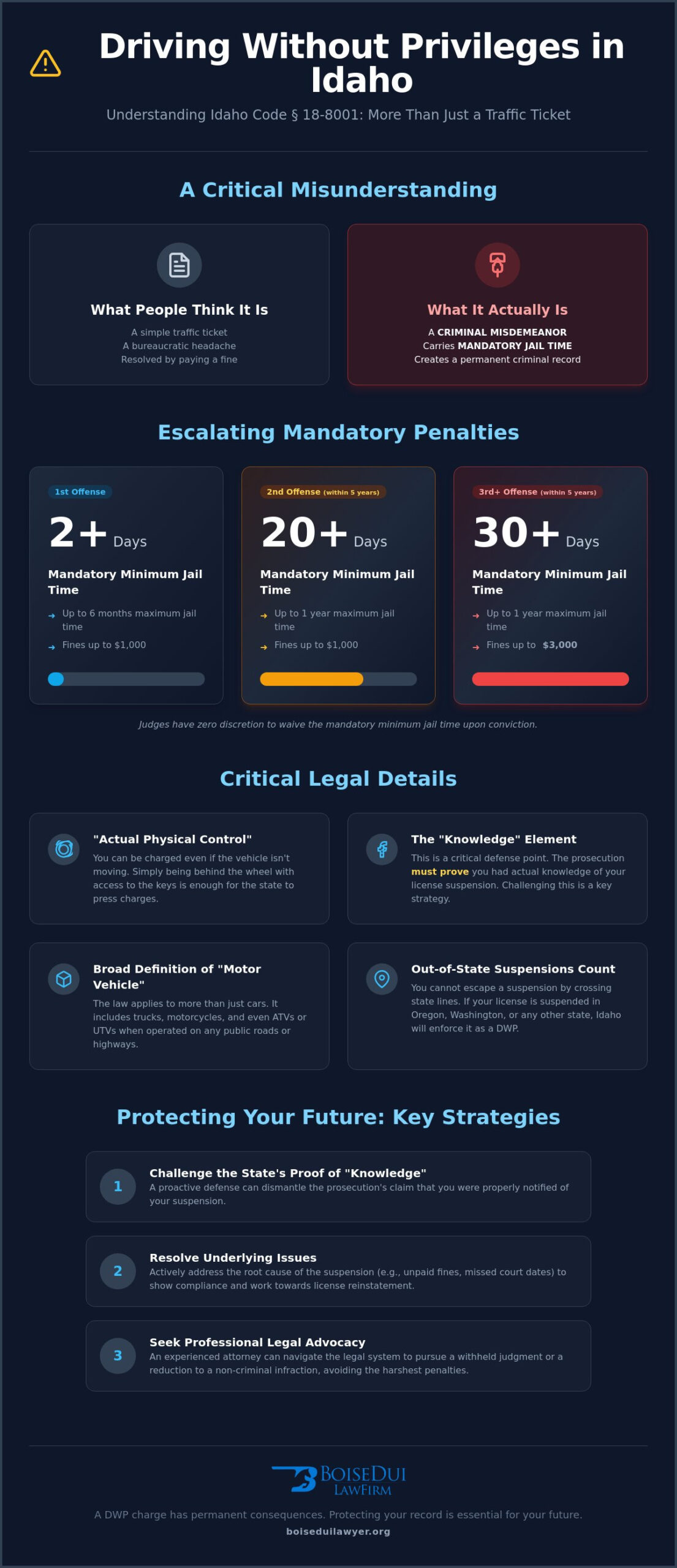
- Understand that a charge for driving without privileges Idaho is a criminal misdemeanor carrying mandatory jail time, not a minor traffic citation.
- Learn the escalating mandatory minimum sentences, which range from two days for a first offense to twenty days for repeat offenders.
- Discover how challenging the state’s ability to prove you had “knowledge” of the suspension can provide a critical opening for your defense.
- Identify how resolving underlying issues like unpaid fines or missed court dates can serve as a powerful proactive strategy to restore your rights.
- Explore how professional legal advocacy can help you pursue a withheld judgment or a reduction to a non-criminal infraction.
What is Driving Without Privileges (DWP) Under Idaho Code 18-8001?
Idaho Code 18-8001 defines a charge that many residents underestimate until they’re in handcuffs. Driving without privileges Idaho is a criminal misdemeanor, not a simple traffic infraction that you can resolve by paying a fine at the courthouse. The law is broad and unforgiving. It applies to anyone operating a vehicle while their license is suspended, revoked, or disqualified. Whether your status resulted from a DUI, an Administrative License Suspension for failing a breathalyzer, or unpaid tickets, the state treats the act of driving as a criminal offense. It’s a direct challenge to the court’s authority, and the prosecution will treat it as such.
The prosecution doesn’t just look for people speeding down I-84. The statute includes “actual physical control,” meaning the state can charge you even if the car isn’t moving. If you’re behind the wheel with the keys in your possession, you’re at risk. This law also respects out-of-state authority. If your license was suspended in Oregon or Washington, Idaho law enforcement will treat you as a suspended driver here. You cannot escape a suspension by simply crossing state lines. For those in Washington who need to resolve licensing issues through professional instruction, Seattle Driving Academy provides the necessary classes to help drivers meet legal requirements and regain their privileges.
The Legal Definition of a Motor Vehicle
Don’t assume this law only applies to your daily commuter car. Idaho courts interpret “motor vehicle” to include trucks, motorcycles, and even ATVs or UTVs when they are operated on public roads or highways. The location of the police contact is a critical factor for your defense. While driving on a public highway is a clear violation, being on strictly private property may offer a legal opening to challenge the charge. Idaho courts interpret “actual physical control” as being in a position to regulate the movement of a vehicle, regardless of whether the engine is running or the car is currently in motion.
Misdemeanor vs. Felony: Clearing the Confusion
In Idaho, a charge of driving without privileges Idaho is technically a misdemeanor, but don’t let that label mislead you. It carries what we call “felony-style” consequences, specifically mandatory jail time that a judge cannot waive. While a first-offense felony might sometimes result in probation, a first-offense DWP conviction requires at least two days behind bars. The system is designed to be punitive from the very first encounter.
Multiple convictions lead to escalating legal scrutiny and harsher mandatory minimums. Beyond the immediate threat of jail, a criminal driving record creates a permanent shadow over your life. In the Treasure Valley’s competitive job market, an employer in Boise or Meridian may see a DWP conviction as a sign of unreliability or a liability risk. This is especially true for any position involving a company vehicle or professional licensing. Protecting your record isn’t just about avoiding a cell; it’s about preserving your ability to provide for your family and keeping your future options open.
Mandatory Penalties for Driving Without Privileges in Idaho
The state of Idaho does not offer “slaps on the wrist” for those caught driving on a suspended license. If you’re convicted under Idaho Code 18-8001, the penalties are swift and non-negotiable. The legal system views driving without privileges Idaho as a direct defiance of a court or administrative order, and the statutory requirements reflect that severity. Unlike many other misdemeanors where a judge might offer probation in lieu of incarceration, DWP charges carry mandatory minimum sentences that must be served in a county jail.
- First Offense: You face a mandatory minimum of two days in jail, with a potential maximum of six months. Fines can reach $1,000.
- Second Offense (within five years): The stakes escalate to a mandatory minimum of 20 days in jail. You could spend up to one full year incarcerated and pay a $1,000 fine.
- Third or Subsequent Offense (within five years): This is treated with extreme gravity. You are looking at a mandatory minimum of 30 days in jail, up to one year, and fines reaching as high as $3,000.
Judges have zero discretion to waive the mandatory minimum jail time upon conviction. This means even if you have a clean record otherwise, the court’s hands are tied once a guilty verdict is entered. If you’re currently facing these charges, consulting with a driving without privileges attorney Idaho is your best chance at avoiding these rigid outcomes.
Additional License Suspensions
A conviction doesn’t just put you in jail; it keeps you off the road longer. For a first offense, the court is required to impose an additional license suspension of up to 180 days. These “stacked” suspensions often create a legal trap. If your license was already suspended for six months and you receive a new six-month suspension, you are now facing a year without the ability to drive legally. This often leads to a cycle of debt and repeat legal trouble as individuals struggle to get to work or care for their families. It’s critical to distinguish between a court-ordered suspension and an administrative suspension from the Idaho Transportation Department (ITD), as both have different reinstatement requirements and timelines.
Fines and Court Costs
The financial impact of a DWP charge extends far beyond the initial court fine. While the statutory fine may be up to $3,000, the “hidden” costs can be even more crippling. You will likely be required to obtain SR-22 insurance, which is a high-risk certificate that significantly inflates your monthly premiums for years. Reinstatement fees must be paid to ITD before you can legally drive again, even after your suspension period ends. When you factor in court costs and the potential loss of income from time spent in jail, the true cost of a conviction can be devastating to your household budget. Before making any decisions about your defense, it’s worth understanding the full picture of Boise DUI lawyer cost and how to evaluate the value of your defense so you can weigh your options with clear financial expectations.
The “Knowledge” Element: Challenging the State’s Case
The prosecution often behaves as if your guilt is a foregone conclusion. They have the record from the Idaho Transportation Department (ITD), they have the police report, and they assume the case is closed. However, to secure a conviction for driving without privileges Idaho, the State must prove a critical element: knowledge. They must demonstrate that you knew, or should have known, your driving privileges were suspended at the time of the stop. If they can’t prove this beyond a reasonable doubt, the criminal charge shouldn’t stand.
The State typically relies on a “mailing certificate” from the ITD to prove you were notified. This document is a procedural placeholder that claims a notice of suspension was sent to the address on file. We don’t accept this at face value. We investigate whether that letter actually reached you. If you moved and updated your address with the post office but ITD failed to update their records, or if an administrative error sent the notice to an old apartment, the State’s case begins to fracture. Challenging the validity of this notice is a primary defense tactic to shield yourself from a criminal conviction. Working with an experienced driving without privileges attorney in Idaho is essential to identifying and exploiting these procedural weaknesses before your court date.
Actual Knowledge vs. Legal Notice
Idaho law recognizes two ways you can “know” about a suspension. Actual knowledge is the most direct form of proof. If a judge looked you in the eye in a Boise courtroom and told you your license was suspended, the State has the proof it needs. Legal notice, or constructive notice, is more technical. This occurs when the ITD follows the statutory mailing process to your last known address. While Idaho law doesn’t allow for “willful ignorance”, which is deliberately avoiding mail to claim you didn’t know, the State still bears the burden of proving the notice was properly processed and sent. If the chain of communication broke down, your defense begins there.
Common Defenses Against DWP Charges
A proactive defense doesn’t wait for the prosecution to make a mistake. We look for specific legal avenues to dismantle the charge entirely. Common strategies include:
- Lack of notice: If you never received the suspension letter because of an ITD clerical error or a move, you may lack the required “knowledge” for a criminal conviction.
- Emergency necessity: In very narrow circumstances, if you were driving to save a life or respond to a genuine medical emergency where no other option existed, the law may provide a defense.
- Invalid initial stop: If the officer didn’t have a legal reason to pull you over in the first place, any evidence they gathered, including the discovery of your suspended license, could be suppressed and thrown out of court.
Don’t let the State’s confidence intimidate you. Every piece of evidence they have is subject to challenge. If the “knowledge” element is weak, the entire prosecution is vulnerable. We focus on these technicalities to protect your record and your freedom.
Resolving the Root Cause: Reinstating Your Idaho License
The most effective strategy for fighting a charge of driving without privileges Idaho isn’t just arguing in court. It’s taking immediate, proactive steps to fix the underlying suspension. Prosecutors and judges in the Treasure Valley are often more willing to negotiate when a defendant shows they have already taken responsibility for their driving status. If you can walk into your first court appearance with a valid license or proof of reinstatement in hand, your attorney has a powerful lever to move the case toward a non-criminal resolution. In many instances, resolving the root cause can lead to a misdemeanor being reduced to a simple infraction with a $150 fine, completely avoiding the mandatory jail time discussed earlier.
Most people don’t lose their license because of a single dramatic event. Instead, they fall into administrative traps. The two most common reasons for a suspension are Failure to Pay (FTP) and Failure to Appear (FTA). These aren’t just paperwork issues; they are the primary triggers for DWP arrests. Once you are flagged, the Idaho Transportation Department (ITD) requires specific steps for reinstatement, which usually includes paying a reinstatement fee and providing proof of financial responsibility. This proof often comes in the form of SR-22 insurance, a high-risk certificate you must maintain for a set period to prove you are covered.
The “Failure to Pay” Trap
A minor oversight can snowball into a criminal crisis with frightening speed. A forgotten speeding ticket in Nampa or a missed equipment violation in Caldwell can trigger an automatic suspension without you ever realizing it. If you are later pulled over in Boise, that unpaid fine transforms into a DWP arrest. This trap is even more dangerous if you have out-of-state suspensions. Idaho’s systems communicate with other jurisdictions, and a hold in another state will prevent you from being legal here. If your situation involves complex administrative hurdles or multiple citations, you need a DUI Defense Attorney Boise who understands how to navigate the ITD bureaucracy and clear your record.
Restricted Driving Permits
Can you still drive to work while your case is pending? The answer depends on the nature of your suspension and how quickly you act. Idaho does offer restricted driving permits, but the requirements are incredibly strict. These permits are typically limited to essential travel, such as driving to your place of employment, medical appointments, or court-ordered programs. You cannot simply decide to drive; you must petition the court or the ITD for these privileges. An attorney can help draft this petition and present the necessary evidence to show that a total loss of driving rights would cause an undue hardship. If you need to stay on the road to keep your job, contact a license suspension lawyer immediately to explore your options for a restricted permit.
Why You Need a Treasure Valley Defense Attorney for DWP
Prosecutors in Ada and Canyon counties don’t view driving without privileges Idaho as a minor oversight. They see it as a direct violation of a court or administrative order that warrants the mandatory jail time we’ve detailed. In Boise, Meridian, and Caldwell, the legal environment is unforgiving and the prosecution is aggressive. You need a battle-hardened advocate who acts as a shield between you and a system designed to prioritize incarceration over your personal circumstances. A primary goal in many of our cases is securing a “withheld judgment.” This legal tool allows you to avoid a permanent criminal conviction on your record if you successfully complete the terms of your sentence. It’s a critical second chance that the State rarely offers to those who walk into court without professional representation.
If you hold a Commercial Driver’s License (CDL), the situation is even more dire. Under Idaho law, CDL holders are ineligible for restricted driving privileges if their license is suspended or revoked under this chapter. A conviction doesn’t just mean a few days in jail; it likely means the end of your career and your ability to provide for your family. We focus on dismantling the State’s evidence to protect your professional standing. A consultation allows us to assess the “knowledge” evidence the State has against you and determine if they can actually prove you received proper legal notice.
Navigating Local Courts in Ada and Canyon Counties
The legal landscape shifts depending on where your citation was issued. Judges in Boise often have different sentencing philosophies and expectations than those in Nampa or Caldwell. Local representation is vital because we understand the specific tendencies of the prosecutors in each Treasure Valley jurisdiction. We know which arguments for alternative sentencing, such as work release or community service, are most likely to be accepted. Acting quickly is essential. Taking steps to resolve your license status before your first court appearance can fundamentally change the trajectory of your case.
Strategic Defense Planning
Our approach to your defense is methodical and proactive. We don’t wait for the prosecution to hand over their files; we conduct our own investigation into the Idaho Transportation Department (ITD) records. By identifying flaws in the mailing certificates or errors in the administrative process, we find the leverage needed to negotiate for a reduction to a non-criminal infraction. We are committed to protecting your rights and keeping you out of a jail cell. Don’t leave your future to chance in a complex system. Schedule your free DWP defense consultation today and start building a strategy to protect your freedom.
Take Control of Your Defense and Restore Your Rights
A charge of driving without privileges Idaho is a high-stakes legal crisis that puts your freedom and your livelihood at immediate risk. You aren’t just looking at a simple traffic fine. You’re facing mandatory time in a county jail cell and a permanent criminal record. However, a conviction is not a foregone conclusion. By aggressively challenging the State’s technical proof of legal notice and resolving the administrative root of your suspension, you can dismantle the prosecution’s case before it destroys your future.
Our Boise defense team is intimately familiar with the specific court dynamics in Ada and Canyon counties. We maintain a specialized focus on Idaho driving offenses, acting as a shield for clients against an unforgiving system. We also understand the financial stress of a criminal charge, which is why we offer flexible payment plans for criminal defense. Don’t let a DWP charge put you in jail—contact our Boise defense team for a free consultation. You have the power to change the outcome of your case. With the right strategy and a battle-hardened advocate by your side, you can move past this charge and secure your future driving rights.
Frequently Asked Questions
Is driving without privileges a felony in Idaho?
No, driving without privileges Idaho is classified as a misdemeanor, not a felony. However, don’t let that distinction lower your guard or cause you to underestimate the stakes. It carries mandatory jail time and a permanent criminal record that can damage your future employment. While it’s not a felony, the Idaho legal system treats it with a level of severity that most people associate with much higher-level crimes.
Can I go to jail for a first-time DWP charge?
Yes, a first-time conviction for driving without privileges Idaho carries a mandatory minimum of two days in jail. Idaho judges have no discretion to waive this requirement once a conviction is entered on your record. You could face up to six months in jail and a fine of $1,000. This is why a proactive defense is essential to seek a reduction or dismissal before your court date.
What is the difference between DWP and driving with an expired license?
An expired license is typically an infraction for failing to renew your document, while DWP is a criminal misdemeanor. Driving with an expired license suggests you are still eligible to drive but forgot to pay the renewal fee. DWP means the state has actively revoked or suspended your right to drive. The penalties for DWP are much harsher, including mandatory incarceration and additional license suspensions.
How do I check if my Idaho driver’s license is suspended?
You can check your status through the Idaho Transportation Department (ITD) online portal or by contacting their office directly. It’s your responsibility to ensure your mailing address is current with the ITD. If you suspect a suspension due to an unpaid ticket or a missed court date, stop driving immediately. Checking your status early allows your attorney to begin resolving the issue before you face an arrest.
Can a DWP charge be reduced to a lesser offense?
Yes, a DWP charge can often be negotiated down to a lesser offense like “invalid license” or a non-criminal infraction. This usually requires fixing the underlying cause of the suspension, such as paying off old fines or reinstating your SR-22 insurance. Prosecutors are more likely to offer these deals if you show you’ve taken immediate steps to restore your legal driving status before your first appearance.
What happens if I am caught driving without privileges while on DUI probation?
Being caught driving while on DUI probation is a legal emergency that triggers both a new criminal charge and a probation violation. You face the mandatory jail time for the new DWP plus the risk of the court imposing the original suspended jail sentence from your DUI. This situation requires immediate professional intervention to protect you from serving significant time in a county facility for violating the court’s trust.
Do I need a lawyer for a DWP citation in Boise?
While you aren’t legally required to have a lawyer, facing an aggressive prosecutor in Boise without one is a massive risk. A local defense attorney understands the technical “knowledge” defenses and the specific sentencing habits of Treasure Valley judges. We act as your shield, navigating the complex ITD bureaucracy and fighting to keep a permanent criminal conviction off your record while seeking to avoid mandatory jail time.
How long does a DWP conviction stay on my Idaho driving record?
A DWP conviction creates a permanent criminal record in Idaho that doesn’t just disappear over time. While the violation may stop affecting your insurance rates after three to five years, the misdemeanor conviction stays on your background check indefinitely. This can create long-term hurdles for employment, housing, and professional licensing. Taking proactive steps to avoid the conviction entirely is the only way to protect your long-term future and reputation.