

You followed your doctor’s orders, took your medication as prescribed, and still ended up in handcuffs. In the eyes of the law, a valid prescription is not a shield against a criminal conviction. Idaho’s drugged driving statutes are notoriously strict, and the reality is that the legality of your medicine is irrelevant if an officer decides your driving is impaired. Facing a prescription drug DUI in Idaho is a high-stakes crisis that threatens your career, your reputation, and your ability to commute through Boise and Meridian.
It feels fundamentally wrong to be treated like a criminal for a legal act, and the anxiety of potential jail time for a first-time offense is overwhelming. This guide is designed to move you from a state of uncertainty to a state of action. You’ll discover how to challenge the subjective observations of Drug Recognition Experts and learn the specific strategies used to contest blood test results. We will outline the legal definition of impairment under Idaho Code and provide the exact roadmap you need to protect your license before the strict seven-day administrative deadline expires. Your freedom is on the line, and understanding your defense starts here.
Key Takeaways
- Understand how Idaho Code § 18-8004 allows for a conviction even if your medication was legally prescribed by a physician.
- Learn the specific 12-step process Drug Recognition Experts (DRE) use to claim impairment and how these subjective tests can be challenged in court.
- Act within the strict seven-day deadline to request an Administrative License Suspension hearing or face an automatic loss of your driving privileges.
- Discover the most effective defense strategies for a prescription drug DUI Idaho charge, including contesting the legality of the initial traffic stop.
The Reality of Prescription Drug DUI Charges in Idaho
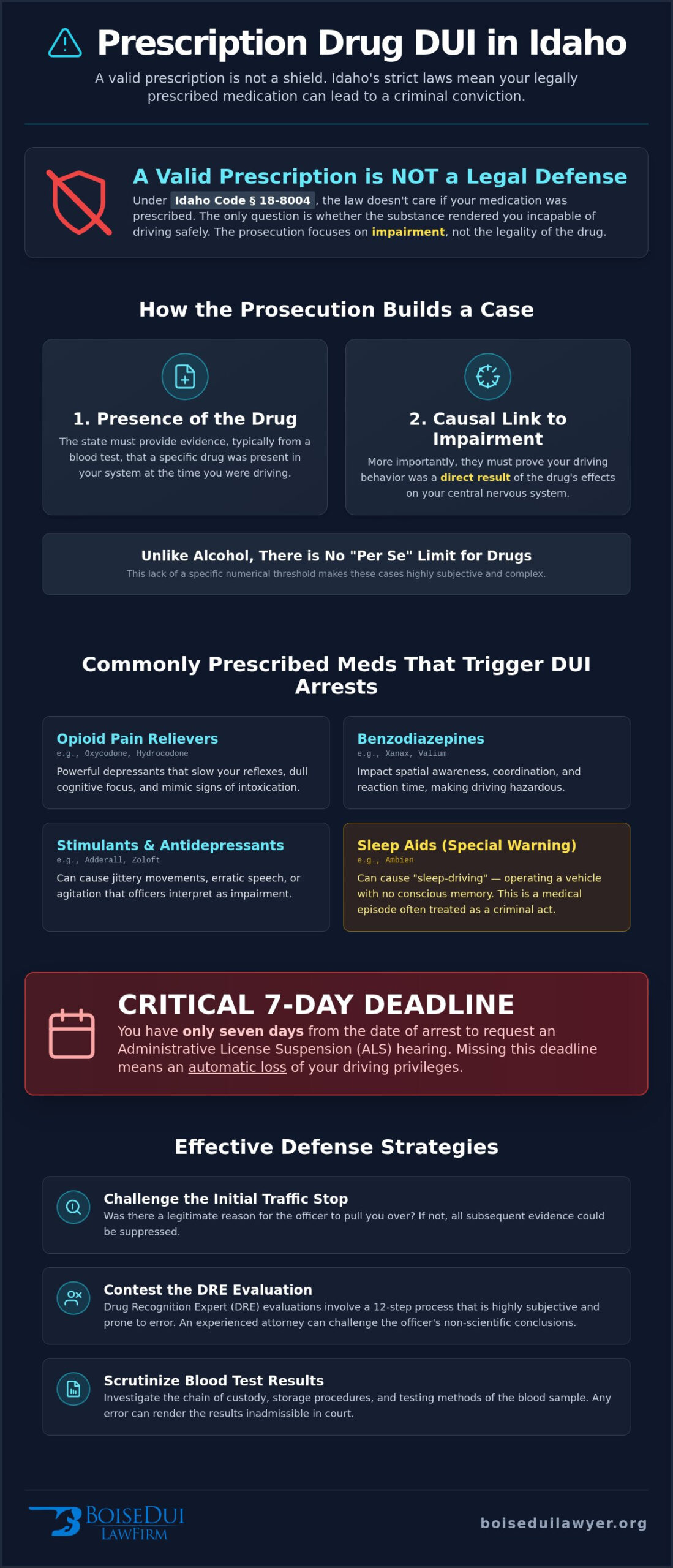
Idaho law is unforgiving. Under Idaho Code § 18-8004, it’s illegal for any person who is under the influence of alcohol, drugs, or “any other intoxicating substance” to drive or be in actual physical control of a motor vehicle. This broad language is the foundation for every Driving Under the Influence of Drugs (DUID) arrest in the state. If you believe your doctor’s signature protects you from a criminal record, you’re mistaken. In Ada County and across the Treasure Valley, a valid prescription is not a “get out of jail free” card. The prosecution focuses on one thing: your ability to operate a vehicle safely. Idaho’s reputation for zero tolerance means that even a minor traffic infraction can escalate into a high-stakes criminal case if you have medication in your system.
Legal vs. Illegal Drugs: Does the Distinction Matter?
The distinction between a bottle of pills from a pharmacy and a bag of illicit substances is virtually nonexistent in an Idaho courtroom. The state isn’t required to prove you were “high” in the recreational sense. They only need to demonstrate that the substance you consumed affected your central nervous system to a degree that you could no longer drive like a “reasonably prudent” person. This includes over-the-counter (OTC) medications that cause drowsiness or slowed reaction times. If a pharmacist’s label warns against operating heavy machinery, and you get behind the wheel in Meridian or Boise, you’re a target for a prescription drug DUI Idaho charge. The “any intoxicating substance” clause allows police to arrest you for anything from sleep aids to cough syrup if they believe your driving is compromised.
The Prosecutor’s Burden of Proof in DUID Cases
Winning a DUID case requires dismantling the prosecutor’s narrative. To secure a conviction, the state must establish two critical pillars through evidence that often relies on subjective observations. They must prove:
- Presence: Evidence must show, usually through a blood test, that the drug was present in your system while you were driving.
- Causal Link: The prosecution must prove your driving behavior was a direct result of that drug’s effects.
In Idaho courts for 2026, impairment is defined as the perceptible reduction in a driver’s ability to operate a motor vehicle with the care and caution of a sober person under similar circumstances. Unlike alcohol, which has a 0.08% “per se” limit, there is no specific numerical threshold for prescription drugs. This lack of a clear limit makes these cases incredibly complex. It also provides a strategic opening for your defense. You aren’t just a case number to the state; you’re a target. You need an aggressive advocate who understands how to challenge the causal link the prosecution is trying to build. If you are traveling between states and are uncertain how charges may differ, understanding the duii vs dui distinctions across the Treasure Valley can be critical to your overall defense strategy.
Common Medications That Trigger DUID Arrests in Boise
Many Boise drivers believe they are safe from prosecution because their medication is legal and necessary. They are wrong. Opioid pain relievers, such as Oxycodone and Hydrocodone, are frequent triggers for a prescription drug DUI Idaho. These substances are powerful depressants that slow your central nervous system; they dull your reflexes and blur your cognitive focus. To a Boise police officer, your slow response to a green light or a slightly wide turn looks like criminal impairment. Benzodiazepines, including Xanax and Valium, are equally problematic for drivers. These medications impact your spatial awareness and reaction time. Even stimulants or antidepressants can mimic the signs of intoxication, causing jittery movements or erratic speech that an officer will interpret as being under the influence.
To mitigate the risks associated with these powerful medications, professional medical oversight is highly recommended; for example, AVIAN Care offers specialized home nursing and physiotherapy to help patients manage their health and treatments responsibly.
Sleep aids like Ambien present a unique and terrifying legal nightmare. “Sleep-driving” is a documented side effect where individuals operate a vehicle with no conscious memory of the event. While this is clearly a medical episode, Idaho prosecutors often treat it as a criminal choice. If you have been arrested while under the influence of a sleep aid or any sedative, you should consult with a drugged driving defense specialist immediately to begin building your shield against these charges.
The ‘Take as Directed’ Trap
One of the most dangerous myths in the Treasure Valley is that following a doctor’s orders provides legal immunity. It does not. Under Idaho Code § 18-8004, the legal question isn’t whether you took the correct dose; it’s whether that dose made you unsafe to drive. Warning labels that advise against operating heavy machinery are used by the state as evidence of your prior knowledge and negligence. Your body’s unique metabolism also plays a critical role. If your system processes a drug slowly, you might still be impaired hours after your last dose, leading to a surprise arrest during a routine morning commute in Meridian.
Combining Medications and Alcohol
The “synergistic effect” is a prosecutor’s favorite weapon in DUID cases. When you mix even a small amount of alcohol with a legal prescription, the two substances amplify each other’s effects. You might blow a 0.02 BAC, which is far below the 0.08 limit, but if that alcohol is combined with a benzodiazepine or opioid, your impairment level could be extreme. This “poly-drug” use is a major focus for the Treasure Valley DUI Task Force. Defending against these allegations requires an authoritative understanding of toxicology and a proactive stance against the aggressive tactics used to secure convictions. You aren’t just fighting a ticket; you are fighting to preserve your future against a system that ignores medical necessity.
How Idaho Law Enforcement Detects Drug Impairment
Detection in a prescription drug DUI Idaho case is vastly different from a standard alcohol stop. Since a breathalyzer cannot detect pills or patches, police in Boise and Meridian rely on the subjective opinions of a Drug Recognition Expert (DRE). These are not medical professionals. They are police officers who have completed a short course intended to help them identify drug-induced impairment. The problem is that they often walk into an evaluation with a “confirmation bias,” looking for any physical sign to justify the arrest they have already made. They use a rigid 12-step protocol that is designed to categorize you into one of seven drug classes, even if your behavior is actually caused by stress, illness, or a physical disability.
Standard field sobriety tests, such as the Walk and Turn or the One Leg Stand, were originally validated to detect a blood alcohol concentration of 0.10% or higher. According to the National Institute on Drug Abuse, these tests are often unreliable for detecting impairment from specific medications. A person might fail a balance test due to a back injury or inner ear issue, yet a DRE will frequently attribute that failure to the presence of an intoxicating substance. You need a defense that interrogates every step of this process to expose the flaws in the officer’s logic.
Challenging the DRE Testimony
The 12-step DRE evaluation is a gauntlet of clinical and psychophysical tests. It includes a breath alcohol test, interviews, eye examinations, vital signs checks, and darkroom pupil measurements. We aggressively challenge the “scientific” status of this testimony. Officers frequently skip steps, fail to calibrate their equipment, or misinterpret common physiological responses. For example, a high pulse rate might be labeled as a sign of stimulant use when it is actually a natural reaction to the high-stakes pressure of a police interrogation. Cross-examining an officer on these technical errors is a primary way we shield our clients from unjust convictions.
The Flaws in DUI Blood Testing
When a DRE forms an opinion, they will almost always demand a blood sample. This is the primary tool for Idaho DUID prosecution, but it is far from infallible. Labs in Idaho can experience chain of custody issues or equipment contamination that taints the results. More importantly, a positive test only proves presence, not impairment. The pharmacological half-life of many medications means that metabolites can linger in your system long after the therapeutic or impairing effects have worn off, making a positive blood test a poor indicator of actual safety on the road. We look for every opportunity to suppress this evidence by highlighting these biological and procedural realities.
Protecting Your License: The 7-Day Idaho Deadline
The moment you are served with a Notice of Suspension following a prescription drug DUI Idaho arrest, a countdown begins that most drivers don’t see coming. You have exactly seven calendar days to file a written request for an Administrative License Suspension (ALS) hearing with the Idaho Transportation Department (ITD). This is not a suggestion; it is a hard deadline. If you wait eight days, your right to challenge the suspension is gone. You will face an automatic license suspension starting 30 days after you were served. This happens regardless of whether you are eventually found “not guilty” in criminal court. Understanding how a license suspension hearing Idaho works is the only way to intercept this penalty before it cripples your ability to commute to work in Boise or Meridian.
The DMV vs. The Criminal Court
You are fighting two separate wars at the same time. The criminal court determines if you go to jail or pay a fine, but the DMV controls your right to drive. These systems do not talk to each other. Winning your criminal case does not automatically reinstate your driving privileges. This is why having a drugged driving attorney Idaho is vital. An experienced advocate handles both fronts. We ensure that technicalities at the ITD don’t leave you stranded even if the prosecutor drops the charges. We act as your shield, forcing the state to prove they followed every administrative rule before they can take your keys.
Restricted Permits in the Treasure Valley
If your license is suspended, you aren’t necessarily stuck. For a first-offense prescription drug DUI, you face a suspension of 90 to 180 days. The first 30 days are an absolute suspension. No driving is allowed under any circumstances during this window. After that, you may be eligible for a restricted permit for work, school, or medical appointments in Ada or Canyon County. Navigating the ITD bureaucracy requires precision. You must pay a $245 reinstatement fee plus a $60 permit fee. In many drug-related cases, Idaho also mandates the installation of an ignition interlock device. This is a complex, expensive process that requires immediate professional intervention. Once the suspension period finally ends, you will still need to pay a $285 reinstatement fee to get your full privileges back. To start your defense and beat the 7-day clock, contact a Boise DUI attorney for a free consultation.
Defending Against Prescription Drug DUI Charges
The state’s case against you for a prescription drug DUI Idaho is built on a foundation of subjective observations and flawed science. It is not an open-and-shut case. We begin your defense by scrutinizing the initial traffic stop. If the officer lacked “reasonable suspicion” to pull you over, every piece of evidence that follows, including the DRE evaluation and the blood test results, can be suppressed. A minor swerve or a slightly delayed reaction at a stoplight isn’t always enough to justify a full-blown criminal investigation. We force the prosecution to prove that the stop was legally sound before we even address the medication in your system.
In certain high-stakes scenarios, the “Involuntary Intoxication” defense becomes a powerful tool. This defense is applicable if you consumed a substance without knowing it would cause impairment, such as taking a medication that was mislabeled by a pharmacy or experiencing an unpredictable “sleep-driving” episode from a sedative like Ambien. While difficult to prove, it challenges the very core of the state’s intent requirements. Additionally, we often use medical expert witnesses to counter the testimony of police officers. A board-certified toxicologist or pharmacologist carries significantly more weight in a courtroom than a police officer with a two-week DRE certificate. These experts can explain to a jury why your blood levels do not equal impairment in 2026.
Negotiating for a reduction to “Reckless Driving,” sometimes referred to as a “Wet Reckless,” is another strategic path. This reduction can save you from the mandatory license suspension and the permanent stigma of a DUI conviction. It requires an advocate who knows how to leverage the weaknesses in the state’s toxicology report to force a compromise.
Why You Need an Aggressive Boise DUI Advocate
Success in the Treasure Valley depends on local experience. Judges and prosecutors in Boise, Meridian, and Nampa have specific tendencies and expectations. You don’t want a lawyer who is learning the ropes on your case. A proactive strategy is essential; you cannot afford to sit back and wait for your first court date. Our criminal defense lawyer Boise Idaho builds your shield by investigating the scene, interviewing witnesses, and filing motions to suppress evidence long before you step into the courtroom. We act as a guardian for your rights and a strategic force against the prosecution.
Take Action: Free Consultation and Payment Plans
The legal system is complex and intimidating, but you don’t have to face it alone. Immediate legal intervention is the only way to protect your freedom and your driving privileges before the seven-day administrative clock runs out. We believe that a high-quality defense should be accessible to everyone in our community, which is why we offer flexible payment options tailored to your situation. Stop the spiral of anxiety and start your defense today. Contact Boise DUI Attorney now for your free consultation and let us begin fighting for your future.
Take Control of Your Future Today
A prescription drug DUI Idaho charge is a high-stakes crisis that demands immediate, authoritative intervention. You’ve learned that the legality of your medication provides no immunity under Idaho’s strict impairment laws. You also know that the subjective opinions of a Drug Recognition Expert can be challenged, and the seven-day administrative deadline is a non-negotiable window for saving your license. Waiting for your court date is a mistake that could cost you your freedom and your livelihood in the Treasure Valley. The state is already building its case against you; you must start building your shield now.
Our firm provides the aggressive, experienced drugged driving defense necessary to dismantle the prosecution’s narrative. We understand the local legal landscape in Boise and Meridian, and we are committed to acting as your guardian against an intimidating system. We make high-quality representation accessible through flexible payment plans, ensuring you don’t have to face this battle alone. Don’t let a medical necessity turn into a permanent criminal record. Secure Your Defense: Schedule a Free Prescription DUI Consultation today. You have the right to fight back, and we are here to lead that charge.
Frequently Asked Questions
Can I be charged with a DUI if I have a valid prescription for the drug?
Yes, you can be charged because Idaho law focuses on impairment rather than the legality of the substance. Under Idaho Code § 18-8004, it’s illegal to drive while under the influence of any intoxicating substance that hinders your ability to operate a vehicle safely. A doctor’s note doesn’t grant you immunity if a police officer decides your driving is compromised.
What are the penalties for a prescription drug DUI in Idaho?
A first-offense conviction is a misdemeanor that carries up to six months in jail and a fine of up to $1,000. You also face a mandatory driver’s license suspension ranging from 90 to 180 days. For a second offense within ten years, the penalties escalate to a mandatory minimum of 10 days in jail and a fine of up to $2,000.
Is there a specific legal limit for prescription drugs like there is for alcohol?
No, Idaho does not have a “per se” numerical limit for medications like the 0.08% BAC limit for alcohol. A prescription drug DUI Idaho charge is based entirely on the subjective determination of impairment. You can be arrested even if your blood levels are within a standard therapeutic range if the officer claims you aren’t driving with the caution of a sober person.
Do I have to take a blood test if a Boise officer suspects drug use?
Yes, Idaho’s implied consent law requires you to submit to a chemical test if an officer has reasonable grounds to believe you are impaired. If you refuse the test, you face an automatic one-year absolute license suspension for a first offense. This administrative penalty is separate from any criminal charges and is very difficult to overturn without immediate legal action.
How can a lawyer prove I wasn’t impaired by my medication?
We prove lack of impairment by dismantling the officer’s subjective observations and using medical experts to provide alternative explanations for your behavior. We highlight how physical conditions, stress, or environmental factors can mimic the signs of drug use. Since a blood test only proves the drug was present in your system, we focus on the lack of a causal link to your driving.
Will I lose my license immediately after a prescription drug DUI arrest?
You won’t lose it the moment you’re arrested, but you only have seven calendar days to protect it. You must file a written request for an Administrative License Suspension (ALS) hearing within that week. If you fail to act, your license will be automatically suspended 30 days after you were served with the notice, even if your criminal case hasn’t gone to court yet.
What should I do if I’m pulled over and I’m on prescription medication?
Provide your license, registration, and insurance, but do not volunteer any information about your medical history or prescriptions. You aren’t required to tell the officer what medications you take or why you take them. Politely decline to answer questions about your health and state clearly that you want to speak with an attorney before making any statements.
Can a first-offense prescription DUI be reduced to a lesser charge?
Yes, it’s often possible to negotiate a prescription drug DUI Idaho charge down to a lesser offense like Reckless Driving. This reduction is typically achieved by exposing flaws in the Drug Recognition Expert’s evaluation or the blood testing procedure. A reduction can help you avoid the most severe penalties, such as mandatory license suspensions and a permanent DUI criminal record. Drivers who frequently cross between Idaho and Oregon should also be aware of how duii vs dui charges differ across state lines, as the terminology and legal consequences can vary significantly.