
You have exactly 168 hours to stop the Idaho Transportation Department from stripping away your right to drive. If you are searching for how to save my license after DUI Idaho, you must realize that the clock started ticking the second you were handed that Notice of Suspension. Waiting for your first court date is a strategic error that costs most drivers their livelihoods. The administrative process moves independently of your criminal case, and it is utterly unforgiving to those who hesitate.
It’s natural to feel overwhelmed by the conflicting demands of the ITD and the court system. You’re likely terrified that an absolute 30-day suspension will end your career or make basic survival impossible. This guide provides the strategic roadmap you need to fight back, outlining the critical legal steps to halt a suspension and keep you behind the wheel. We will explore how to successfully navigate the ALS hearing and the specific defense strategies required to protect your future in 2026.
Key Takeaways
- Act within the non-negotiable 7-day window to request an administrative hearing, or your driving privileges will be automatically revoked.
- Distinguish between the Idaho Transportation Department’s civil suspension and the court’s criminal penalties to mount a successful defense on both fronts.
- Master the procedural defense strategies that reveal how to save my license after DUI Idaho by challenging the ITD’s administrative evidence.
- Navigate the updated 2026 mandates for Ignition Interlock Devices and learn the strict criteria for securing a Restricted Driving Permit.
- Utilize local legal expertise to pursue a withheld judgment, a critical tactic for protecting your license and long-term insurance rates.
The Dual Threat: Understanding Idaho’s DUI License Suspension System
In Idaho, a DUI arrest triggers a two-front war against your right to drive. You aren’t just facing a criminal judge in a courtroom; you are also facing the Idaho Transportation Department (ITD) in a civil arena. These two entities operate on completely different tracks with different rules, different standards of proof, and different timelines. If you want to know how to save my license after DUI Idaho, you must recognize that winning in court does not guarantee you’ll keep your license at the DMV. You have to defeat both systems to stay on the road.
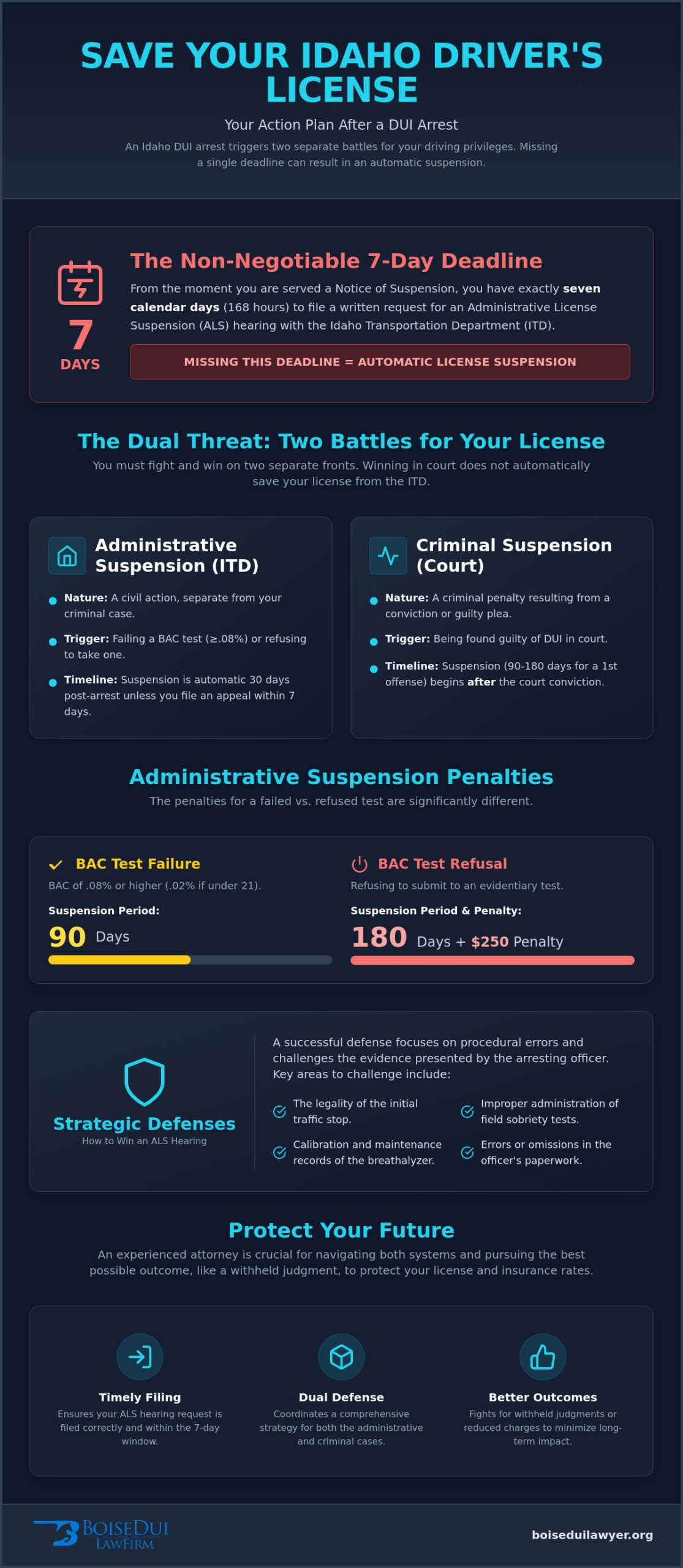
The Administrative License Suspension (ALS) process is an independent civil action triggered by a failed or refused BAC test. Because this is a civil matter rather than a criminal one, the ITD does not have to wait for a conviction to take your license. In fact, the suspension is scheduled to begin automatically 30 days after your arrest, regardless of what happens in your criminal case. Even if a judge eventually dismisses your charges or a jury finds you not guilty, that ITD suspension will remain in place unless you specifically challenged it within the first week. Understanding Idaho’s DUI License Suspension System is vital because it reveals the traps most drivers fall into when they assume the court handles everything.
The Administrative License Suspension (ALS) Explained
The ALS process starts the moment you fail a breathalyzer or refuse to take one. If your BAC is .08% or higher, or just .02% if you are under 21, the officer will serve you with a “Notice of Suspension.” This is usually a yellow piece of paper that acts as your temporary license for only 30 days. You must understand the stakes involved:
- Test Failure: A first-time failure results in a 90-day suspension.
- Test Refusal: Refusing the evidentiary test triggers a 180-day suspension and a mandatory $250 civil penalty.
- The 7-Day Rule: You have exactly seven calendar days from the date on that notice to request an administrative hearing. If you miss this deadline, your right to challenge the suspension is gone forever.
Court-Ordered Criminal Suspensions
While the ITD moves quickly, the criminal court suspension only happens if you are convicted or enter a guilty plea. For a first-offense DUI, the court will order a license suspension ranging from 90 to 180 days. It’s critical to note that the first 30 days of this court-ordered suspension are “absolute,” meaning no restricted driving permits are available for work or school during that window. These two suspensions, the ALS and the court-ordered one, can overlap or run consecutively depending on how your case is handled. Coordinating a defense for both is the only real way to figure out how to save my license after DUI Idaho and prevent a total loss of your mobility.
The 7-Day Deadline: Your Immediate Action Plan to Save Your License
The clock is the most dangerous enemy you face right after a DUI arrest. Most people assume they have weeks to figure out how to save my license after DUI Idaho, but the truth is much harsher. You have exactly 168 hours, or seven calendar days, to file a formal request for an Administrative License Suspension (ALS) hearing. If you miss this deadline by even a minute, the ITD will revoke your driving privileges on the 30th day following your arrest. There are no extensions and no exceptions for being unaware of the rule. This is seven calendar days, not business days; the count includes weekends and holidays. Understanding exactly what is at stake during this critical window is essential — learn more about the 7 day deadline DUI Idaho license rules and how to protect your driving privileges before time runs out.
Waiting for your first court appearance is a catastrophic mistake. By the time you stand before a judge in Ada or Canyon County, your right to challenge the administrative suspension will have already expired. The court has no power to overturn an ALS deadline you missed. You must treat the first week as a high-stakes rescue mission for your driving privileges, requiring immediate, precise action to stop the ITD’s momentum.
How to Properly Request an ITD Hearing
A valid hearing request must be submitted in writing to the Idaho Transportation Department in Boise. You cannot simply call and ask for a hearing. The document must include your full legal name, your driver’s license number, and the specific legal grounds for your appeal. This is where many drivers stumble. Without citing specific procedural errors or statutory violations, the ITD may deny your request as legally insufficient. We recommend using a fax machine with a printed confirmation page or sending the request via certified mail with a return receipt requested. This paper trail is your only proof that you complied with the law. Because the Boise ITD hearing officers are notoriously strict about these filings, involving a Boise DUI attorney immediately ensures your request meets every technical requirement.
What Happens During the 30-Day ‘Stay’
Once your request is successfully filed, the ITD grants a “stay” on your suspension. This keeps your license active and valid while you wait for the hearing officer to review the evidence. This stay is a critical tactical advantage. It buys you time to continue working and supporting your family while your defense team analyzes the Strategic Defenses: How to Win an Idaho ALS Hearing. During this period, we can subpoena the arresting officer’s training records, the maintenance logs for the breathalyzer used, and the dashcam footage from the stop. This window is also the ideal time to install an ignition interlock device or prepare for the worst-case scenario. Do not waste this time. Use every hour of the stay to build a wall between your life and the state’s attempt to take your mobility. If you move quickly, you can discover how to save my license after DUI Idaho before the 30-day mark ever arrives.
Strategic Defenses: How to Win an Idaho ALS Hearing
Unlike a criminal trial where the prosecution must prove your guilt beyond a reasonable doubt, the burden of proof at an ITD hearing rests entirely on you. You are essentially suing the state to get your driving privileges back. Hearing officers are not interested in your personal hardships, your clean driving record, or your absolute need to drive to your job in Meridian. They strictly evaluate whether the police followed Idaho law to the letter. If you want to know how to save my license after DUI Idaho, you must stop looking for sympathy and start looking for technical errors. Establishing that the arresting officer failed to maintain a continuous, face-to-face observation of you for at least 15 minutes prior to the breath test can completely invalidate the results, as any burp, regurgitation, or foreign object in the mouth during that window can contaminate the sample and render the BAC reading scientifically unreliable. Working with a qualified Idaho DUI license suspension lawyer gives you access to the 2026 strategic defense checklist needed to identify and exploit these procedural failures before your hearing date.
Challenging the Calibration and Maintenance Records
Every breathalyzer used by Boise Police or the Ada County Sheriff must be calibrated and maintained according to rigorous Idaho State Police (ISP) forensic lab standards. We demand the maintenance logs and performance verification records for the specific serial number used in your arrest. If those logs show the machine was “out of tolerance” or missed a scheduled check, the results are legally inadmissible. We look for patterns of failure that local officers might overlook but that a seasoned advocate can use to dismantle the state’s case. Even a minor variance in the ISP standards can be the difference between a 90-day suspension and keeping your license.
Officer Testimony and Procedural Failures
Procedural failures often occur during the chaos of the roadside stop. The officer is required to read you the “Implied Consent” advisory exactly as it is written in the Idaho statutes. If they skip a section or misrepresent the consequences of a refusal, the suspension cannot stand. Errors on the Notice of Suspension paperwork, such as incorrect dates or missing signatures, also provide grounds for dismissal. Having a Boise DUI attorney present to cross-examine the officer during this administrative hearing is a massive tactical advantage. It allows us to lock the officer into a version of events under oath, creating a transcript that can be used to impeach their testimony later during the criminal trial in Ada County court. This dual-track strategy is the most effective way to understand how to save my license after DUI Idaho while protecting your long-term record.
Restricted Licenses and Ignition Interlocks in Idaho (2026 Rules)
Idaho’s 2026 driving laws have become significantly more restrictive for anyone facing a DUI. If you are desperate to learn how to save my license after DUI Idaho, you must understand that the days of simple “work permits” without strings attached are over. Current statutes now mandate an Ignition Interlock Device (IID) for all DUI convictions, including first-time offenses. Even if you successfully win your ALS hearing, a conviction in criminal court will trigger the IID requirement for a minimum of one year. This creates a high-stakes environment where every procedural move counts toward whether you can keep your job or lose your mobility.
Most drivers are blindsided by the “hard suspension” period. In Idaho, the first 30 days of your suspension are typically absolute. During this window, no permits are available. You cannot drive to work, the grocery store, or even medical appointments. After this 30-day blackout, you may become eligible for a Restricted Driving Permit (RDP), but only if you’ve met specific criteria and secured SR-22 high-risk insurance. Navigating this intersection of DMV rules and insurance requirements is a logistical nightmare for those in the Treasure Valley without expert guidance. You must be proactive to ensure you’re ready to apply the moment that 30-day window closes.
Qualifying for a Restricted Driving Permit (RDP)
To secure an RDP, you must provide the ITD or the court with a verified, minute-by-minute schedule of your essential travel. This isn’t a general permission slip; it is a rigid legal document that limits you to specific routes and times for work, school, or medical emergencies. Certain permit types require a demonstration of “extreme hardship” before they are granted. If you deviate from your approved route, you risk a “Driving Without Privileges” charge, which carries even harsher penalties. For a deep dive into this process, read our detailed guide: How to Get a Restricted License in Idaho: A Guide to Staying on the Road.
The Reality of Ignition Interlock Requirements
The IID is more than a breathalyzer in your car; it is a constant, expensive monitor that you must pay for out of pocket. You’ll be responsible for installation costs and monthly monitoring fees that quickly add up to hundreds of dollars. While the device allows you to bypass parts of a longer suspension, it demands absolute compliance. One “failed” blow, even from something as simple as mouthwash or fermented fruit, can be reported to the ITD and result in an immediate extension of your suspension period. If you want to avoid these traps and find the fastest way back to full privileges, contact our Boise DUI defense team to start your strategy today. We know how to save my license after DUI Idaho by minimizing the time you spend under these restrictive conditions.
The Shield: How a Boise DUI Attorney Protects Your License
Fighting an Idaho DUI is not a DIY project. You are facing a coordinated effort by the state to revoke your freedom of movement and label you a criminal. To truly understand how to save my license after DUI Idaho, you must deploy a unified strategy that addresses both the ITD administrative hearing and the Ada County criminal court simultaneously. A fragmented defense is a failing defense. We act as your shield, ensuring that a mistake in one arena doesn’t lead to a catastrophe in the other. This involves more than just showing up; it requires deep tactical knowledge of how these systems intersect.
One of the most powerful tools in our arsenal is the “Withheld Judgment.” If you are eligible, this legal maneuver allows you to complete probation without a formal conviction being entered on your record. This can be the difference between a permanent stain on your driving history and a path to clearing your record, potentially helping you avoid long-term SR-22 insurance requirements. Additionally, we provide a proactive defense against “Driving Without Privileges” charges. If you are caught driving during your 30-day hard suspension, the consequences are severe, often involving mandatory jail time. We ensure you have the correct permits and legal advice to stay on the right side of the law while we fight your case. For more on selecting the right representative, see our guide on finding a Criminal Defense Lawyer in Boise Idaho: A Strategic Guide to Choosing Your Advocate.
Aggressive Advocacy in Treasure Valley Courts
Every courtroom in the Treasure Valley has its own rhythm and every judge has specific preferences. Whether your case is before a judge in Boise, Meridian, or Nampa, we tailor our approach to the local landscape. We treat the ALS hearing as more than just a license battle; it is a vital discovery tool. By cross-examining the arresting officer early in the process, we uncover weaknesses in their testimony that can be exploited in the criminal trial. This aggressive stance often leads to strategic plea bargaining, where we work to reduce a DUI charge to “Reckless Driving” or “Inattentive Driving.” These reductions carry far fewer licensing consequences and can save your career. This is the core of how to save my license after DUI Idaho: turning a defensive situation into an offensive strategy.
Taking the First Step: The Free Consultation
The most expensive mistake you can make is waiting. The 7-day clock for your ITD hearing is ticking, and every hour you hesitate is an hour the state uses to build its case against you. We offer free consultations to provide an immediate assessment of your situation and a clear path forward. Our firm is committed to transparent pricing and flexible payment plans because we believe high-level legal protection should be accessible when you need it most. Don’t let a procedural deadline dictate your future. Contact Boise DUI Attorney today for a free evaluation of your license status. We are ready to stand between you and the system.
Take Decisive Action to Protect Your Right to Drive
The state of Idaho moves with clinical speed to revoke your driving privileges, but you don’t have to face the system alone. By mastering the non-negotiable 7-day deadline and challenging procedural errors during the ALS hearing, you can effectively stop a suspension before it ever starts. Discovering how to save my license after DUI Idaho is about more than just legal theory; it’s about deploying an aggressive defense tailored for Boise, Meridian, and Eagle residents. Every hour you wait is an hour the prosecution uses to solidify its case against your mobility.
Our firm provides deep expertise in Idaho Transportation Department hearings, acting as a necessary shield for your career and your family’s stability. We understand the high stakes you’re facing, which is why we offer flexible payment plans to ensure that elite legal protection remains accessible during this crisis. You’ve worked hard for your independence, and we’re here to help you fight to keep it. Take the first step toward a proactive defense today.
Secure Your Driving Future—Request a Free DUI License Consultation Now
You have a path forward, and with the right strategy, you can successfully navigate this challenge and stay on the road.
Frequently Asked Questions
Can I still drive to work after a DUI arrest in Idaho?
You can generally continue driving for the first 30 days following your arrest. The yellow Notice of Suspension given to you by the officer acts as a temporary permit during this window. However, if you don’t take action within the first week, your right to drive will vanish once those 30 days expire. Securing an administrative hearing is the primary method for how to save my license after DUI Idaho during the initial legal process.
What happens if I missed the 7-day deadline for the ITD hearing?
Missing the 7-day deadline results in an automatic, non-negotiable suspension of your driving privileges. The Idaho Transportation Department (ITD) does not grant extensions for ignorance of the law or late filings. Once this window closes, you lose the ability to contest the administrative side of your suspension. You’ll be forced to serve the mandatory absolute suspension period before you can even apply for a restricted permit or install an interlock device.
How much does it cost to reinstate a license in Idaho after a DUI?
Reinstating your license requires paying specific administrative fees to the ITD and a $250 civil penalty if you refused an evidentiary test. While fees vary based on the specific nature of your offense, you must also provide proof of SR-22 insurance and potentially pay for an ignition interlock installation. These costs are separate from any court-ordered fines. You should verify the exact 2026 fee schedule with the ITD to ensure you have the correct funds ready.
Is an SR-22 insurance policy always required after an Idaho DUI?
Yes, an SR-22 insurance policy is a mandatory requirement for reinstating your license after any DUI-related suspension in Idaho. This certificate proves to the state that you carry the required high-risk liability coverage. You are typically required to maintain this filing for three years. If your policy lapses for even a single day, the insurance company will notify the ITD; your license will be suspended again immediately.
Can I get a restricted license if I refused the breathalyzer test?
No, you cannot obtain a restricted driving permit if you refused the evidentiary test. Idaho law is exceptionally strict regarding test refusals, imposing a one-year absolute suspension for first-time offenders. Unlike a test failure, which allows for restricted privileges after the first 30 days, a refusal leaves you with zero driving options for the full year. This makes the administrative hearing your only hope for how to save my license after DUI Idaho when a refusal is involved.
What is the difference between a civil and criminal license suspension?
A civil suspension is an administrative action by the ITD based on your BAC or test refusal, while a criminal suspension is a punishment ordered by a judge. These two processes run on parallel tracks. You can win your criminal case and still have your license suspended by the ITD. Because they are independent, you must mount a separate defense for each to ensure you don’t lose your driving privileges through a technicality.
How long does an ignition interlock device stay in my car?
An ignition interlock device (IID) must remain in your vehicle for at least one year following the end of your suspension. This is a mandatory requirement for all DUI convictions in Idaho as of 2026. If you are caught driving a vehicle without an IID during this period, you face a Driving Without Privileges charge. The one-year clock only starts once your initial suspension period has fully concluded and your driving privileges are partially restored.
Will an out-of-state license be suspended for an Idaho DUI?
Yes, an Idaho DUI will almost certainly impact your out-of-state license. Idaho will suspend your privilege to drive within its borders and then report that suspension to your home state through the Driver License Compact. Your home state’s licensing agency will then take its own administrative action, which usually involves suspending your home license. You cannot escape the consequences of an Idaho arrest by simply crossing state lines or holding a non-resident permit.