

One mistake behind the wheel shouldn’t cost you your livelihood, yet the Idaho legal system is designed to do exactly that if you don’t act within days. You’re likely feeling the suffocating pressure of a 30-day absolute suspension and the confusion of dealing with both the ITD and the courts. It’s a high-stakes situation where a single missed deadline can lead to a permanent mark on your record or a Driving Without Privileges charge. Understanding how to get restricted license Idaho residents rely on for work is the difference between moving forward and losing everything. You need a shield against a complex system that doesn’t offer second chances for technical errors.
The path back to the driver’s seat isn’t a suggestion; it’s a rigid legal process with zero margin for error. We’ve designed this guide to show you the exact steps, eligibility rules, and legal strategies required to secure a restricted permit after an Idaho DUI. From navigating the narrow 7-day window for an ALS hearing to understanding the specific requirements of Form ITD 3227, we’re providing the timeline you need. By the end of this article, you’ll know exactly how to fight for your right to drive and protect your future from further damage.
Key Takeaways
- Master the dual-track system by understanding the separate requirements for ITD administrative suspensions and criminal court-ordered penalties.
- Identify if you meet the specific eligibility criteria for essential transport, including employment needs and critical medical appointments.
- Discover exactly how to get restricted license Idaho approval by navigating the 30-day absolute no-drive period and submitting the correct state forms.
- Prepare for mandatory requirements under Idaho Code § 18-8002, including the installation and costs of an Ignition Interlock Device (IID).
- Learn how strategic legal coordination can help you avoid a devastating “Driving Without Privileges” charge while minimizing your total time off the road.
Understanding the Two Tracks: ITD vs. Idaho Criminal Courts
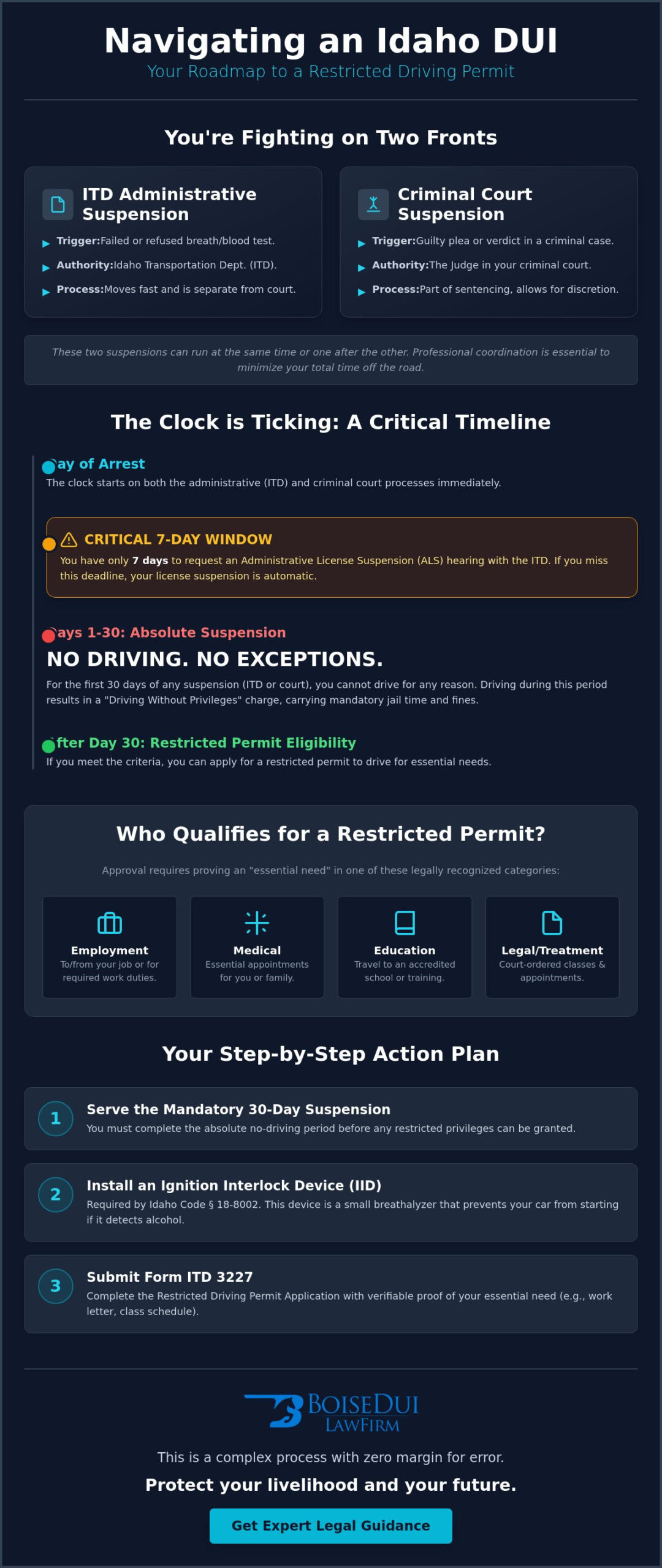
When you’re arrested for a DUI in Idaho, the clock starts ticking immediately on two separate fronts. You aren’t just facing a criminal charge in a courtroom; you’re also fighting an administrative battle with the Idaho Transportation Department (ITD). These two tracks move at different speeds and follow entirely different sets of rules. If you don’t understand how they interact, you risk a much longer period without a car than necessary. Learning how to get restricted license Idaho drivers need to keep their jobs requires a strategic approach to both the ITD and the court system. You cannot afford to ignore one while focusing on the other.
The most critical rule you must understand is the 30-day absolute suspension. Whether your suspension comes from the ITD or the court, Idaho law mandates a period where no driving is permitted under any circumstances. There are no “hardship” exceptions during this window. If you’re caught driving during these first 30 days, you face a mandatory minimum of two days in jail and a hefty fine for Driving Without Privileges. This absolute period is the mandatory waiting room before any restricted privileges can even be considered. Competitors often gloss over this, but it’s the most dangerous trap for those who feel they “must” drive to survive. If you are still in the early hours after your arrest, understanding how to save my license after DUI Idaho requires acting on the administrative track immediately before any deadlines pass.
The ALS (Administrative) Track
The Administrative License Suspension (ALS) is triggered the moment you fail or refuse a breath or blood test. This is handled entirely by the ITD, not the judge in your criminal case. You have exactly 7 days from the date of your arrest to request an ALS hearing to challenge this suspension. If you miss this deadline, your license will be suspended for 90 days automatically after the 30-day absolute period. This track moves fast and doesn’t care about your personal circumstances or your performance in court. Understanding the full consequences of the 7 day deadline DUI Idaho license rules require is essential to preserving your right to challenge the administrative suspension before it becomes permanent.
The Judicial (Criminal) Track
The judicial track is part of your sentencing after a guilty plea or a verdict in the criminal court. Unlike the ITD, a judge has the discretion to grant restricted privileges for specific needs like work, school, or medical appointments. However, this requires a separate motion filed within the specific county court where your case is heard. To move from an absolute suspension to a restricted one, you’ll almost certainly need to install an Ignition Interlock Device in your vehicle. This device acts as a guardian, ensuring you’re sober before the engine starts.
The danger lies in the overlap. These two suspensions can run concurrently (at the same time) or consecutively (one after the other). If they aren’t coordinated by a professional, you could finish your ITD suspension only to have a court-ordered suspension begin immediately after. Protecting your mobility requires synchronizing these two systems to ensure you spend the minimum amount of time off the road.
Eligibility: Who Qualifies for a Restricted Permit?
You don’t get a restricted permit just because losing your license is inconvenient. Idaho law is strict. It views driving as a privilege, not a right. To get back behind the wheel, you must demonstrate an “essential need” that fits into specific, legally recognized categories. If your reason for driving doesn’t fall into one of these buckets, your application will be denied. Understanding how to get restricted license Idaho approval starts with knowing exactly where you stand within these rules.
- Employment: You may drive to and from your place of work or perform driving duties required during your actual work hours.
- Medical: This covers essential appointments for yourself or immediate family members where no other transportation is available.
- Education: You can drive to attend an accredited school or vocational training sessions necessary for your career.
- Legal and Treatment: This includes driving to court-ordered DUI classes, probation meetings, or specific legal appointments related to your case.
The state doesn’t take your word for it. When you submit your Restricted Driving Permit Application, you must provide verifiable proof for every claim you make. If you’re unsure if your specific situation meets these high standards, a Boise DUI Attorney can evaluate your case and help you gather the necessary evidence to present a compelling argument to the state.
Proving “Essential Need”
A simple statement like “I need to work” is rarely enough for a Treasure Valley judge or an ITD hearing officer. They’ve heard it all before. To succeed, you need documentation that leaves no room for doubt. This usually means providing a formal letter from your employer on company letterhead, a certified copy of your class schedule, or documented medical referrals. If you’re claiming a family medical need, be prepared for intense scrutiny regarding why another family member or a rideshare service cannot fulfill that role. You’re fighting an uphill battle against a system that prefers you stay off the road.
Who is Disqualified?
Not everyone is eligible for a second chance. If you have prior DUI convictions within the last five to ten years, the path to a restricted permit becomes significantly more difficult, or even impossible, depending on the timing of your offenses. Commercial Driver’s License (CDL) holders face the harshest reality; federal and state rules often prohibit restricted privileges for commercial vehicles entirely. Additionally, if you’re currently serving a suspension for a separate offense, like unpaid tickets or a different criminal matter, you’re likely disqualified from receiving a restricted permit until those issues are resolved. The system is designed to penalize repeat offenders and high-risk drivers with absolute certainty.
Step-by-Step: How to Apply for Restricted Privileges
Applying for restricted privileges isn’t just a matter of paperwork; it’s a test of precision. If you submit your application one day early or miss a single fee, the system will reject you without hesitation. You must first survive the 30-day absolute suspension period mentioned previously. During this time, you should be gathering your documentation so you’re ready to strike the moment you become eligible. Knowing how to get restricted license Idaho officials to approve requires following the Rules Governing Restricted Driving Permits to the letter. Don’t leave your mobility to chance.
The process begins by downloading and completing Form ITD 3227 for administrative suspensions. If your suspension is court-ordered, you must also file a specific motion within the county where you were sentenced. You’ll need to secure an SR-22 insurance certificate from your provider, which proves you carry the state-mandated level of financial responsibility. Finally, you must install an Ignition Interlock Device (IID) if required by statute. Once these hurdles are cleared, you can submit your application along with the required fees to the ITD for processing.
Filing in Ada vs. Canyon County
Where you file matters. In Ada County, you’ll deal with the clerk’s office at the courthouse on Front Street in Boise. In Canyon County, you’ll head to the courthouse in Caldwell. Processing times vary significantly between these two jurisdictions. Judges in Caldwell often view “hardship” differently than those in Boise. In more rural parts of Canyon County, judges may be more empathetic to the lack of public transportation options compared to the urban center of Boise. You must tailor your argument to the specific culture of the local court to avoid a flat denial.
The Financial Requirements
The state demands payment at every turn. You’ll face a $60 ITD application fee just to have your request reviewed. If your suspension was administrative, you must also pay a $245 reinstatement fee. If you were found guilty in court, a separate $285 reinstatement fee applies. Do not ignore these. Failure to pay these fees can turn a temporary suspension into a permanent one. Additionally, the SR-22 insurance mandate typically lasts for three years. Any lapse in coverage during this period will reset the clock, forcing you to start the three-year requirement all over again. Managing these costs is essential to staying legal.
The Ignition Interlock Requirement (IID) Explained
Idaho Code § 18-8002 is the bedrock of the state’s zero-tolerance stance on driving after a DUI arrest. It mandates that any person convicted of or receiving a withheld judgment for a DUI must install an Ignition Interlock Device (IID) in every vehicle they operate. This isn’t a suggestion. It’s a statutory requirement that directly dictates how to get restricted license Idaho permits. Without a certificate of installation from an approved provider, your application for restricted privileges will be denied immediately. The device acts as a digital warden, requiring a clean breath sample before the engine starts and periodic retests while you’re on the move.
If you’re wondering if you can bypass this requirement, the answer is almost always no. The court views the IID as a necessary safeguard for public safety. Violations are dealt with harshly. An IID “lockout,” which occurs if the device detects alcohol or if you fail to provide a sample, is reported directly to the court or the ITD. A single violation can lead to the immediate revocation of your restricted permit and potentially new criminal charges. If you’re facing these strict requirements, you need a Boise DUI lawyer to help you navigate the installation process and protect your rights.
Mandatory Installation Rules
In 2026, the rules are more rigid than ever. Even first-time offenders are now required to install an IID for the duration of their suspension. You must coordinate the installation early, as the ITD typically requires proof of installation before they will even issue your restricted permit. In the Boise and Nampa areas, you’ll find several state-approved providers. Expect to pay between $3 and $3.80 per day for the device, which totals roughly $1,000 to $1,400 annually when factoring in installation, calibration, and removal fees. Financial assistance may be available through the Interlock & Electronic Monitoring Device Fund if a judge determines you’re unable to afford these costs.
Employer Exemptions
One of the few narrow exceptions involves company-owned vehicles. Under specific circumstances, you may be allowed to drive a work vehicle without an IID if your employer signs a waiver acknowledging your conviction and the lack of a device. However, this is a legal minefield. You must prove you do not own or control the company car, and the exemption only applies during actual work hours. Most Treasure Valley employers refuse to sign these waivers due to the massive insurance liability they create. If your job depends on driving a company truck, you must address this issue with professional legal counsel before your 30-day absolute suspension ends. Navigating these employer dynamics is a critical part of how to get restricted license Idaho drivers need to stay employed.
Why You Need a Boise DUI Lawyer to Handle Your License
The Idaho legal system does not offer participation trophies for trying to follow the rules. If you attempt to handle your license suspension alone, you are walking into a procedural minefield where one misstep can trigger a permanent loss of driving privileges. You need a shield against a system that prioritizes administrative efficiency over your ability to get to work. Understanding how to get restricted license Idaho permits is only half the battle; the other half is ensuring you don’t fall into the “DWP Trap.” This happens when drivers mistakenly believe that because they have submitted an application, they are legal to drive. Until that physical permit is in your hand, you are one traffic stop away from a Driving Without Privileges charge, which carries mandatory jail time.
Strategic timing is the most valuable asset a seasoned advocate provides. As established in earlier sections, the ITD and the criminal courts operate on separate tracks. Without professional coordination, these suspensions can be stacked consecutively, doubling your time off the road. We work to align these timelines, fighting to make them run concurrently so you can return to your normal life as quickly as possible. We don’t just fill out forms; we build a defensive perimeter around your mobility. A comprehensive understanding of how to save my license after DUI Idaho is essential to coordinating these two tracks before critical deadlines expire.
The Risk of Self-Representation
Form ITD 3227 is deceptively simple, yet it is the primary reason for automatic rejections. A single inconsistency between your stated work hours and the proof provided by your employer will lead to an immediate denial. There is no “edit” button once you submit; a botched application often extends your total suspension time because the ITD requires a waiting period before you can reapply. Additionally, prosecutors in Ada and Canyon County frequently oppose restricted permit requests during sentencing. They may argue that your BAC level or the circumstances of your arrest make you a danger to the community, regardless of your employment needs. You need a battle-hardened advocate to counter these arguments before a judge.
How We Protect Your Privileges
Our intervention begins the moment you call. We prioritize the 7-day ITD hearing deadline, ensuring your right to challenge the administrative suspension is preserved. We don’t settle for the bare minimum. While the state prefers to limit you strictly to work and back, we negotiate aggressively for broader driving windows. This includes essential errands like grocery shopping, transporting children to daycare, and attending medical appointments. We understand that your life doesn’t stop just because of a legal hurdle. Don’t leave your future to chance or administrative whim. Schedule a Free Consultation to Save Your License and let us fight to keep you on the road.
Take Control of Your Path Forward
The window of opportunity to protect your driving privileges is incredibly narrow. You’ve seen that navigating the dual-track system requires extreme precision, from meeting the 7-day ALS hearing deadline to managing the mandatory Ignition Interlock Device requirements. Understanding how to get restricted license Idaho officials will actually approve is the only way to safeguard your livelihood and family obligations. The state’s administrative and judicial hurdles are designed to be difficult; don’t let a minor procedural error turn a temporary setback into a permanent crisis.
Our firm serves as a shield against this complex and intimidating system. We bring deep experience in Ada and Canyon County courts to every case, ensuring your defense is both proactive and strategic. We offer free initial consultations to evaluate your specific needs and provide flexible payment plans to keep your defense affordable. Don’t lose your job over a DUI-Contact our Boise defense team now. You don’t have to face this alone. We’re ready to fight for your future and help you reclaim your independence on the road.
Frequently Asked Questions
How long does it take to get a restricted license in Idaho?
You must wait at least 30 days during the mandatory absolute suspension period before your restricted permit can become active. Once this period expires and you submit your completed application, processing times by the ITD can vary; however, you should prepare for several weeks of administrative review. Coordinating your paperwork early ensures you aren’t waiting longer than necessary once the 30-day window closes.
Can I drive to the grocery store on a restricted license?
Standard restricted permits issued by the ITD are limited strictly to employment, education, medical needs, and court-ordered obligations. Driving to the grocery store is generally prohibited unless your attorney specifically negotiates for these essential life needs in a court-ordered restricted permit. Never assume you have permission to drive for errands that aren’t explicitly listed on your physical permit.
What happens if I get caught driving outside my restricted hours?
If you’re caught driving outside your approved hours or for an unapproved purpose, you face a Driving Without Privileges (DWP) charge. This is a serious criminal offense in Idaho that carries a mandatory minimum of two days in jail and a fine of up to $1,000 for a first offense. Additionally, your restricted permit will be revoked immediately, and your total suspension time will likely be extended.
Do I need SR-22 insurance for a restricted permit in Idaho?
Yes, you must provide an SR-22 insurance certificate to the ITD before they will issue a restricted permit. This certificate serves as proof of financial responsibility and must be maintained for three years following a DUI suspension. If your insurance lapses for even one day, your carrier will notify the ITD, and your license or permit will be suspended again immediately.
Is an ignition interlock always required for a restricted license?
Under current Idaho law, an ignition interlock device is mandatory for all individuals seeking a restricted permit after a DUI conviction. This includes first-time offenders. You must install the device at your own expense and provide a certificate of installation to the ITD. There are almost no exceptions to this rule, as the state views the IID as a non-negotiable safety requirement for staying on the road.
Can I get a restricted license for a second-offense DUI?
No, individuals facing a second DUI conviction within a 10-year period are generally ineligible for restricted driving privileges. Idaho law mandates a one-year absolute license suspension for a second offense, meaning you cannot drive for any reason during that time. This highlights the severity of repeat offenses and the importance of an aggressive legal defense to avoid these life-altering consequences.
How much does it cost to get my license back after a DUI in Boise?
Reinstating your license involves several mandatory state fees. You must pay a $60 application fee for the restricted permit itself. Once your full suspension period ends, you’ll face a $245 administrative reinstatement fee for an ALS suspension or a $285 fee if the suspension was court-ordered. These costs are separate from IID installation, SR-22 premiums, and any legal representation fees.
What is the 7-day deadline for Idaho license hearings?
You have exactly 7 days from the date of your arrest to request an Administrative License Suspension (ALS) hearing with the ITD. If you miss this deadline, you forfeit your right to challenge the administrative suspension, and your license will be suspended automatically after 30 days. This is one of the most critical steps in learning how to get restricted license Idaho drivers must master to avoid long-term loss of mobility.