

You’ve spent years building your reputation on the road, but a single traffic stop in Idaho can dismantle your entire livelihood in less than seven days. Many drivers mistakenly believe that a first offense or a citation in their personal vehicle won’t trigger a total career shutdown. The reality is far more clinical and unforgiving. You’re likely feeling the crushing weight of uncertainty, wondering if you can still provide for your family or if there’s any way to secure a restricted permit to keep working while your case is pending.
This guide breaks down the exact CDL DUI penalties Idaho enforces in 2026 and outlines the high-stakes maneuvers required to shield your license from a mandatory one-year disqualification. We’ll examine the critical differences between Idaho Transportation Department administrative hearings and criminal court proceedings. You’ll also discover why federal FMCSA rules make a restricted commercial license impossible and why your defense must begin immediately to meet the strict ITD filing deadlines. If you want to stop a permanent career disqualification before it starts, you need to understand the complex system currently working against you.
Key Takeaways
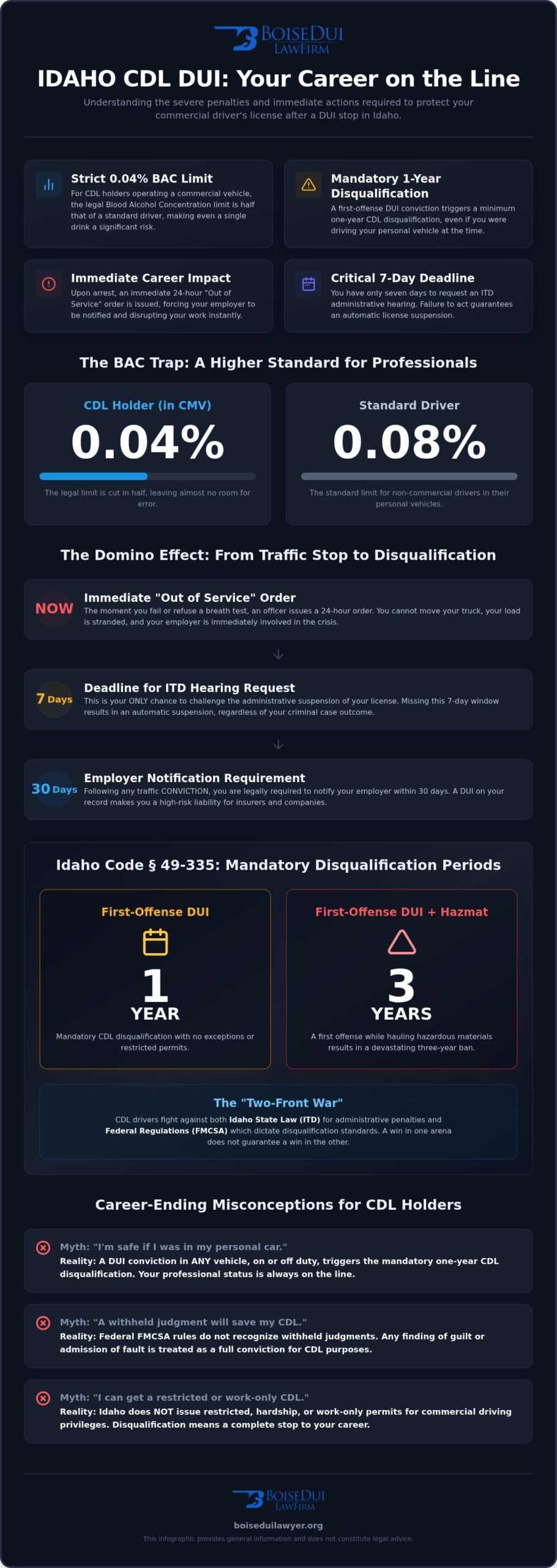
- Recognize that Idaho enforces a strict 0.04% BAC limit for commercial drivers, making even a single drink a threat to your professional standing.
- Understand that CDL DUI penalties Idaho laws mandate a minimum one-year disqualification of your driving privileges, regardless of whether you were in a personal or commercial vehicle.
- Identify the immediate 24-hour “out of service” order that occurs upon arrest and how it alerts your employer to your legal situation.
- Prioritize the seven-day deadline to request an ITD administrative hearing, as failing to act within this window guarantees an automatic license suspension.
- Explore how a specialized defense can challenge the validity of chemical tests and the legality of the traffic stop to protect your long-term career.
The High Stakes of an Idaho CDL DUI: Why Your Career is on the Line
If you hold a Commercial Driver’s License (CDL), the legal system treats you as a professional with a higher burden of responsibility. You aren’t just another driver on the road; you’re operating heavy machinery that requires precision and sobriety. Because of this, CDL DUI penalties Idaho courts enforce are designed to be swift and severe. A single mistake in Nampa or Boise doesn’t just result in a fine. It triggers a chain reaction that can lead to a nationwide ban on your ability to work. Understanding the gravity of these stakes is the first step in mounting a defense that actually protects your future.
Commercial vs. Personal Vehicle: The 0.04% vs. 0.08% Trap
Most drivers believe they have a safety margin until they hit a 0.08% Blood Alcohol Concentration (BAC). For you, that margin is cut in half. If you’re operating a Commercial Motor Vehicle (CMV), the legal limit is a strict 0.04%. Under Idaho Code 49-104, a CMV is defined as any vehicle with a gross weight rating over 26,001 pounds, those designed to transport 16 or more people, or any vehicle carrying hazardous materials. It’s also vital to remember that by maintaining your commercial privileges in 2026, you’ve already provided implied consent to undergo chemical testing if an officer suspects you’re driving under the influence.
The ‘Out of Service’ Order and Employer Notification
The damage to your career starts the moment the blue lights stop flashing. If you fail a breath test or refuse to blow, the officer will issue an immediate 24-hour “Out of Service” order. You’re finished for the day. You cannot move the truck, and your employer will likely have to send another driver to recover the load. This creates an immediate professional crisis. Furthermore, you’re legally required to notify your employer within 30 days of any traffic conviction. In the world of commercial trucking, insurance companies often dictate employment. Even if you avoid jail time, a recorded DUI arrest makes you a high-risk asset that many companies simply won’t insure.
One of the most dangerous misconceptions involves “withheld judgments.” In Idaho, a judge might allow a first-time offender to have their conviction dismissed after a period of probation. While this works for standard drivers, federal FMCSA rules do not recognize it. For the purposes of CDL DUI penalties Idaho enforcement, any “finding of guilt” or “admission of fault” is treated as a conviction. This means a legal deal that saves a normal license will still trigger a mandatory one-year disqualification of your CDL. You’re fighting a two-front war against state law and federal regulations, and you cannot afford to lose on either side.
Decoding Idaho Code 49-335: Mandatory CDL Disqualification Periods
Idaho’s legal framework for commercial drivers isn’t just a local matter. It is a rigid intersection of state statutes and federal mandates. Under Idaho Code § 49-335, the Idaho Transportation Department (ITD) is required to enforce disqualification periods that mirror federal 49 CFR 383.51 regulations. If Idaho fails to enforce these standards, the state risks losing millions in federal highway funding. This means the prosecutor and the judge have almost zero discretion when it comes to your commercial driving privileges. If you are convicted of a first-offense DUI, the law demands a mandatory one-year disqualification. There is no middle ground.
The stakes escalate even further if you were hauling hazardous materials at the time of your stop. In these cases, a first-offense conviction triggers a three-year disqualification. This isn’t just a longer wait; it’s a career-killer that often makes a driver permanently unemployable in high-paying specialized sectors. Understanding the full scope of CDL DUI penalties Idaho requires looking beyond the courtroom and into the administrative machinery of the ITD. Every major offense on your record acts as a step toward a permanent ban.
The One-Year Disqualification: No Exceptions, No Restricted Permits
The most devastating realization for many drivers is that Idaho does not issue restricted or “work-only” CDLs. While a standard driver might get a permit to drive to the grocery store or their office, you don’t have that luxury. A disqualification means you are completely barred from operating any commercial motor vehicle for the duration of the penalty. It’s vital to distinguish between terms here. A suspension typically affects your personal driving privileges, while a disqualification is a specific federal and state action that strips away your right to operate a CMV. If you’re facing this threat, you should consult a Boise DUI attorney to explore every possible avenue for a dismissal or charge reduction.
Lifetime Disqualification and the 10-Year Reinstatement Rule
A second DUI conviction is what the industry calls the “death penalty” for a commercial career. Under Idaho law, a second major offense results in a lifetime disqualification. This applies even if the first offense happened decades ago or in another state. While there is a narrow provision that allows a driver to petition for reinstatement after 10 years, it is far from a guarantee. The ITD and federal authorities require rigorous proof of rehabilitation; even then, the approval rate is historically low. Relying on a 10-year reinstatement plan is not a strategy. It’s a gamble with your future. You must fight the second charge with everything you have to avoid the permanent loss of your livelihood.
Personal Vehicle DUIs: The ‘Off-Duty’ Misconception
One of the most dangerous myths in the trucking industry is the belief that what happens in your personal pickup truck stays separate from your professional rig. You might assume that because you weren’t “on the clock” or operating a commercial vehicle, your livelihood is shielded. This is a catastrophic misunderstanding of the law. The legal system doesn’t see a wall between your private life and your commercial livelihood. While the criminal threshold for a DUI in your personal vehicle remains 0.08% BAC, a conviction at this level triggers the exact same CDL DUI penalties Idaho imposes for on-duty violations. Federal law is clear: any DUI conviction is a “major offense,” and the consequences follow the driver, not the vehicle.
Stop pretending your off-duty time is a legal vacuum. If you’re convicted of driving under the influence in your own car, you’ll face a mandatory one-year disqualification of your commercial privileges. Saying “I wasn’t working” isn’t a valid defense in an Idaho courtroom or at an ITD hearing. The Federal Motor Carrier Safety Administration (FMCSA) demands that states hold CDL holders to a higher standard at all times, 24 hours a day, 365 days a year. If you can’t be trusted to drive sober in a sedan, the government assumes you can’t be trusted with an 80,000-pound trailer.
How the ITD Tracks Your Private Driving Record
The Idaho Transportation Department doesn’t rely on self-reporting or luck to find out about your personal DUI. They use the Commercial Driver’s License Information System (CDLIS), a nationwide database that shares your driving history across all 50 states. If you’re arrested for a DUI in Oregon or Nevada while on vacation, that information is transmitted to the ITD almost instantly. Once the notification hits their system, the administrative machinery starts moving. You can expect a disqualification notice in your mailbox shortly after, often before your first court date for the criminal charge has even arrived.
Standard DUI Penalties vs. CDL Disqualification
When you’re arrested in Ada or Canyon County, you’re fighting two separate battles. In criminal court, you face standard penalties that include up to six months in jail, heavy fines, and mandatory attendance at victim impact panels. While a skilled attorney might help you keep your standard Class D license through a restricted permit, that permit won’t touch your CDL. You could technically have the right to drive your personal car to the grocery store while being legally barred from touching a commercial steering wheel. If you’re caught trying to bypass this and get behind the wheel of a rig, you’ll need a driving without privileges attorney Idaho to handle the secondary criminal charges that will likely end your career for good.
Got a DUI in Nampa or Boise? What’s Next: A 4-Step Action Plan
The shock of a roadside arrest in the Treasure Valley can be paralyzing, but your career doesn’t have the luxury of a recovery period. The clock is already running against your livelihood. To mitigate the CDL DUI penalties Idaho authorities are currently preparing to enforce, you must transition from a state of uncertainty to a state of aggressive defense. Follow this tactical four-step plan to stabilize your situation and protect your professional future.
- Step 1: The 7-Day Deadline. You have exactly seven days from the date of your notice of suspension to request an administrative hearing with the Idaho Transportation Department (ITD). This is a rigid deadline. If you fail to file the request and pay the required fee, your license will be disqualified automatically.
- Step 2: Secure Specialized Counsel. A general practice lawyer who handles divorces or simple wills isn’t equipped for this fight. You need an advocate who understands the specific intersection of Idaho statutes and federal FMCSA regulations.
- Step 3: Document the Stop. Immediately preserve your electronic logbooks, save any dashcam footage, and record the exact weather conditions at the time of the stop. These details often provide the foundation for a successful motion to suppress evidence.
- Step 4: Evaluate the Breathalyzer. Idaho law enforcement frequently uses Alco-Sensor III or IV units. These devices require strict calibration and maintenance schedules. If the logs show a lapse in service, the results may be inadmissible in court.
The Critical 7-Day ITD Administrative Hearing
Do not confuse your criminal court date with your ITD hearing. They are entirely separate tracks. The administrative hearing is a civil proceeding where the burden of proof is lower, making it notoriously difficult to win without a strategic approach. If you miss this window, the ITD will issue an absolute disqualification that no criminal judge can overturn later. Winning here is your first, and often best, chance to keep your commercial privileges intact while the criminal case proceeds. If you are ready to fight back, you should request a license suspension hearing consultation immediately.
Preparing for Your First Court Appearance in Ada or Canyon County
Your arraignment in Boise or Caldwell is the formal start of the criminal process. At this stage, the judge will read the charges and set the conditions of your release. It is also the moment when your employer’s safety manager will likely become aware of the situation. Be extremely careful with what you disclose to your dispatcher; anything you say can be used against you in court or lead to immediate termination. Securing a DUI defense attorney Boise before this appearance ensures that your rights are protected during early negotiations with the prosecution. A proactive defense starts with a professional shield between you and the state.
Defensive Strategies: How a Boise DUI Lawyer Protects Your Livelihood
Survival in the face of an Idaho DUI requires more than just showing up to court. It demands an aggressive, technical assault on the prosecution’s case. When your livelihood is at risk, you need a defense that functions as a shield against the state’s machinery. CDL DUI penalties Idaho prosecutors seek to impose are often based on evidence that isn’t as solid as it appears. By scrutinizing the specific details of your stop in Nampa or Boise, a specialized attorney can identify the cracks in the state’s narrative. This proactive stance is the only way to move from a position of vulnerability to one of strength.
The first line of defense often involves challenging “reasonable suspicion.” Did the officer have a valid, legal reason to pull over your commercial rig? Operating a heavy vehicle requires constant micro-adjustments, which an inexperienced officer might mistake for impaired weaving. If the initial stop was illegal, every piece of evidence gathered afterward, including breath or blood results, could be suppressed. We look for procedural failures, equipment malfunctions, and lapses in judgment that the police hope you won’t notice.
Technical Challenges to Breath and Blood Evidence
Breathalyzers and blood tests are not infallible. We frequently utilize the “rising blood alcohol” defense, which argues that your BAC was below the legal limit while you were actually driving but rose during the time it took to transport you to the station. This is particularly relevant for long-haul drivers who may have been stopped far from a testing facility. Additionally, Idaho law enforcement must strictly adhere to a 15-minute observation period before administering a breath test. If the officer was distracted, filling out paperwork, or failed to maintain continuous visual contact, the test results may be thrown out. Idaho breath testing equipment must undergo periodic performance verifications and strict maintenance protocols as mandated by state forensic standards to ensure the results are scientifically valid.
The Power of Aggressive Negotiation
Prosecutors in Ada and Canyon County are focused on convictions, but they are also aware of the risks of taking a weak case to trial. If we can demonstrate significant flaws in their forensic evidence or the legality of the stop, we create leverage. This leverage is essential when pushing for a reduction to a non-alcohol-related charge, such as reckless driving. While federal “anti-masking” rules make this a complex maneuver for CDL holders, a reduction is often the only path to avoiding the most catastrophic CDL DUI penalties Idaho law allows. Protective advocacy starts with a phone call to an expert who understands the high stakes of your commercial career. Don’t let a single mistake dictate your future; start building your defense today.
Take Command of Your Defense and Protect Your Livelihood
The CDL DUI penalties Idaho enforces in 2026 are designed to be swift and permanent, but you don’t have to face the Idaho Transportation Department alone. You now understand that the seven-day deadline for an administrative hearing is the most critical window in your case. You also know that federal regulations make “withheld judgments” and restricted permits a non-factor for commercial drivers. The state is already moving to disqualify your license, so your response must be immediate and strategic to prevent a total career shutdown.
Our firm provides specialized CDL defense expertise and emergency seven-day ITD hearing support to stop a disqualification before it starts. We recognize the financial stress this situation creates for Treasure Valley drivers, which is why we offer flexible payment plans. Position yourself behind a battle-hardened advocate who knows how to challenge the state’s evidence and protect your right to work. It’s time to move from a state of uncertainty to a state of action.
Secure Your Career: Schedule a Free CDL DUI Consultation Now
Your career is worth the fight, and the right legal strategy can make all the difference in keeping you on the road where you belong.
Frequently Asked Questions
Can I get a restricted CDL to keep working after a DUI in Idaho?
No, you cannot obtain a restricted or “work-only” CDL in Idaho following a DUI arrest or conviction. While standard drivers might qualify for a permit to reach their job, federal regulations strictly prohibit states from issuing any limited commercial privileges during a disqualification. If your CDL is pulled, you’re off the road entirely. You must fight the underlying charge or the ITD suspension to keep your livelihood intact.
What is the BAC limit for CDL holders in their personal vehicle?
The criminal limit in your personal car is 0.08% BAC, but as a professional, you’re never truly off the hook. Any conviction for operating a personal vehicle under the influence triggers the same one-year CDL DUI penalties Idaho law mandates for on-duty offenses. You don’t get a “free pass” just because you weren’t in your rig; the state views your sobriety as a 24/7 professional requirement.
How long does a DUI stay on my commercial driving record in Idaho?
A DUI conviction remains on your commercial driving record for life in the eyes of federal regulators and the CDLIS database. While the points might eventually fall off your standard license, the “major offense” tag stays. This permanent mark makes you a high-risk asset for insurance companies. Most reputable carriers will refuse to cover you for at least five to seven years following a conviction, effectively blacklisting you from the industry.
Does a ‘Withheld Judgment’ save my CDL from disqualification?
A withheld judgment will not save your commercial career. While this legal maneuver can prevent a conviction from appearing on your personal record after successful probation, the FMCSA ignores it. Federal law defines a conviction as any “finding of guilt” or “admission of fault.” Consequently, the Idaho Transportation Department must disqualify your CDL even if the local magistrate grants you a withheld judgment in criminal court.
What happens if I refuse the breathalyzer test as a CDL holder?
Refusing a breathalyzer or blood test results in an automatic one-year disqualification of your CDL for a first offense. Under Idaho’s implied consent laws, you agreed to these tests when you accepted your license. A refusal is treated with the same severity as a failed test but often leaves your attorney with fewer technical avenues for defense. If you’ve already refused, you have only seven days to challenge the resulting suspension.
Can I still get a CDL if I have a past DUI conviction in Idaho?
You can still apply for a CDL with a past DUI, provided your disqualification period has ended and your driving privileges are fully reinstated. However, the hurdle isn’t just the law; it’s the market. Most trucking companies in the Treasure Valley have internal safety policies that bar hiring anyone with a DUI in the last three to ten years. Your past mistake is visible to every recruiter via the CDLIS system.
Will my employer find out about my DUI arrest before I am convicted?
Your employer will likely find out almost immediately, especially if you were issued a 24-hour out-of-service order at the roadside. Even for off-duty arrests, insurance companies run periodic MVR checks that will flag the pending suspension. You’re also legally required to notify your employer within 30 days of any conviction. Attempting to hide the arrest often leads to immediate termination for a violation of company policy and safety protocols.
Do I need a lawyer for the ITD administrative hearing?
You aren’t legally required to have an attorney for an ITD hearing, but going alone is a massive risk. These hearings are highly technical and focus on specific administrative procedures rather than “fairness.” A specialized lawyer knows how to cross-examine the arresting officer and identify flaws in the 15-minute observation period. Without professional intervention, your chances of winning an administrative challenge are statistically slim.