

A DUI arrest in Idaho isn’t a final judgment; it’s the opening salvo in a high-stakes battle for your future. You might feel like the system has already decided your fate, but a conviction is never a foregone conclusion. If you are paralyzed by the fear of losing your job or the anxiety of a mandatory license suspension, you need to understand that the prosecution’s case is rarely as airtight as they want you to believe. Our primary objective is to get DUI reduced to reckless driving Idaho, effectively shielding your criminal record from the most devastating consequences of a drunk driving charge.
We understand the gravity of your situation and the urgent need to protect your livelihood. This 2026 legal strategy guide provides the exact criteria and defense tactics used to successfully plea bargain a DUI down to a “wet reckless” or standard reckless driving charge. You’ll discover how to leverage technical errors in breathalyzer calibration and exploit the critical seven-day window for your administrative hearing. By analyzing the latest Idaho statutes and prosecutorial trends, we outline the roadmap to minimizing your fines, avoiding jail time, and ensuring you stay behind the wheel where you belong.
Key Takeaways
- Identify the strategic advantages of a “wet reckless” plea and how it functions as a shield for your permanent criminal record and future employment.
- Compare the specific penalties between charges to understand how a successful reduction preserves your driving privileges and reduces mandatory license suspension times.
- Evaluate the critical eligibility factors, such as a BAC near the legal limit and the absence of accidents, required to get DUI reduced to reckless driving Idaho.
- Master the tactical approach to defense, including the strategic use of motions to suppress evidence and a rigorous analysis of police bodycam footage.
- Recognize why high-level professional advocacy is non-negotiable when facing a prosecution system designed to secure convictions rather than offer fair reductions.
Facing a DUI in Boise? Why a Reduction to Reckless Driving is Your Best Move
An Idaho DUI charge carries a weight that can crush your professional reputation and personal freedom. If you’ve been arrested in Boise or the surrounding Treasure Valley, your immediate priority isn’t just “beating” the case; it’s mitigating the long-term damage. For many, the most viable path to salvage their future is to get DUI reduced to reckless driving Idaho. This strategic pivot, often called a “wet reckless” plea, replaces the heavy-handed penalties of a DUI with a charge that carries significantly less social and legal stigma.
While a total dismissal is the ideal goal, prosecutors rarely drop charges entirely without a fight. Attempting to force a dismissal often leads to a high-stakes trial where a single mistake results in a mandatory DUI conviction. A reduction to reckless driving represents a controlled outcome. It ensures you avoid the specific “DUI” label on background checks, which is often the primary reason people lose their jobs or housing opportunities. The window for these negotiations is narrow; the most effective deals are often struck before the case gains momentum in the court system.
The Difference Between a Conviction and a Compromise
Technically, Idaho law doesn’t contain a specific “wet reckless” statute. Instead, it’s a procedural compromise where the state agrees to amend the charge to reckless driving in exchange for a guilty plea. To understand why this works, you must look at the legal definition of reckless driving, which focuses on the manner of driving rather than chemical impairment. A DUI conviction stays on your record as a red flag for employers and insurance companies for years. In contrast, reckless driving, while still a serious misdemeanor, doesn’t trigger the same automatic “high-risk” exclusions that a drunk driving conviction does.
Why Prosecutors in Treasure Valley Consider Reductions
Prosecutors in Ada and Canyon County are currently managing overwhelming caseloads. They don’t want every misdemeanor to go to trial, as it drains resources and risks an embarrassing loss in front of a jury. If your defense can highlight a “risk of loss” for the state, such as a questionable traffic stop or a BAC near the .08 limit, the prosecutor becomes much more willing to negotiate. Your clean prior record and proactive steps, like early alcohol evaluations, provide the leverage needed to convince them that a reduction serves the interests of justice without the need for a full DUI conviction. You need to act before the prosecution hardens their stance; every day you wait is a day they build a stronger case against you.
Comparing the Consequences: DUI vs. Reckless Driving in Idaho
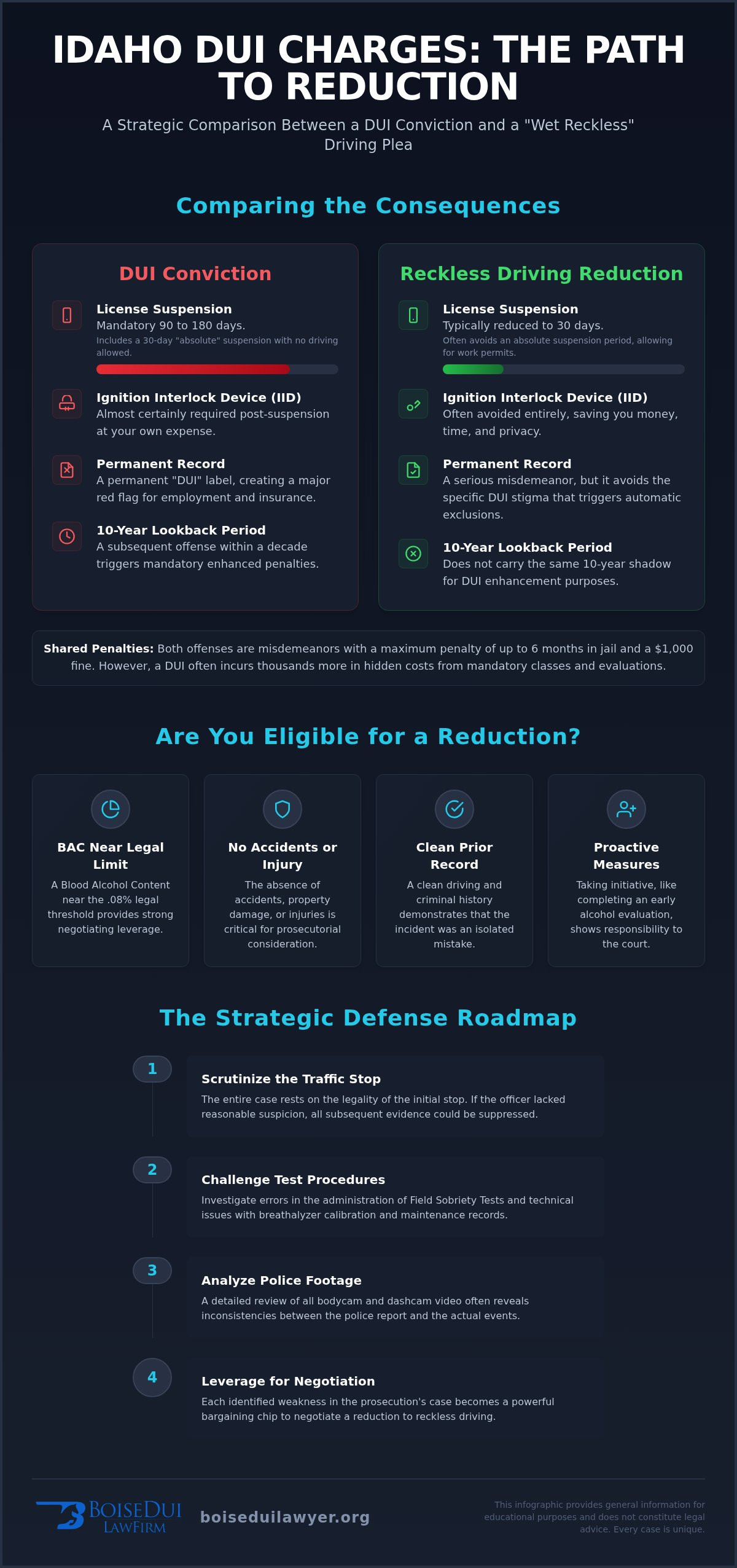
Facing a DUI charge under Idaho Code § 18-8004 is far more than a simple traffic ticket. While both a DUI and reckless driving are classified as misdemeanors in Idaho, the administrative and financial fallout differs wildly. If you manage to get DUI reduced to reckless driving Idaho, you are essentially trading a life-altering conviction for a manageable setback. Both offenses carry a maximum of six months in jail and fines up to $1,000; however, the hidden costs of a DUI conviction often triple the actual court-ordered fine through mandatory alcohol evaluations and victim impact panels.
License suspension is where the divide becomes most apparent. A first-offense DUI triggers a mandatory 90 to 180-day suspension. The first 30 days are absolute, meaning no driving for any reason, including work. Reckless driving, by contrast, typically results in a 30-day suspension. Perhaps more importantly, a DUI conviction in 2026 almost certainly requires the installation of an Ignition Interlock Device (IID). This invasive technology is costly and embarrassing. Negotiating for a reckless driving charge often bypasses the IID requirement entirely, preserving your privacy and your paycheck.
Jail Time, Fines, and Your Criminal Record
While the jail ceiling is the same for both offenses, the social “lookback” is the real danger. The Idaho DUI lookback period lasts ten years. This means any subsequent alcohol-related offense within a decade will be charged as a second offense with mandatory jail time. Reckless driving doesn’t carry this same ten-year shadow. On your driving record, a DUI adds more points and stays visible to employers longer than a reckless driving conviction. If you’re unsure about your specific risk level, a professional case evaluation can clarify the stakes for your specific driving record.
Insurance Rates and SR-22 Requirements
Your insurance company views a DUI as a catastrophic risk. Premiums often double or triple immediately upon conviction, and some carriers will drop your coverage altogether. While reckless driving is still a high-point offense, insurance companies generally treat it with less severity than an impairment-based crime. You should be prepared for the reality that an SR-22 certificate, proving high-risk financial responsibility, may still be required even with a reckless driving plea. However, the duration and cost of that requirement are often less burdensome than the decade-long financial drain of a DUI conviction. You must act quickly to secure a reduction before your insurance carrier receives notice of a conviction.
Is Your Case Eligible? Factors That Lead to a DUI Reduction
Not every DUI case qualifies for a plea bargain. To get DUI reduced to reckless driving Idaho, your case must present specific weaknesses that make the prosecutor hesitant to face a jury. The primary candidates for reduction are first-time offenders with a Blood Alcohol Content (BAC) between .08% and .10%. In this “borderline” range, the inherent margin of error in breathalyzer technology becomes a massive liability for the state. If your arrest involved no property damage, no injuries, and you were cooperative with law enforcement, you’ve already cleared the first hurdles toward a favorable deal.
Your conduct during the initial encounter creates the narrative for your entire case. A prosecutor is much more likely to offer a compromise to someone who followed the DUI arrest Boise Idaho survival protocols rather than someone who was combative or made incriminating statements on bodycam. Calm behavior doesn’t just look better to a judge; it makes it significantly harder for the officer to justify the “impairment” narrative in their written report. If the police report describes you as polite and steady, the state’s case for “incapable of safely driving” begins to crumble.
Technical Flaws in the State’s Evidence
We look for cracks in the state’s foundation. Did the officer wait the mandatory 15-minute observation period before the breath test? If they didn’t, the results are legally vulnerable. Field Sobriety Tests (FSTs) are notoriously subjective and often administered incorrectly on the uneven shoulders of Treasure Valley roads. If the initial stop lacked “reasonable suspicion”, meaning the officer had no valid legal reason to pull you over, we can move to suppress all evidence gathered afterward. This creates the ultimate leverage in negotiations.
The “Inattentive Driving” Alternative
Sometimes, an even better outcome than reckless driving is achievable. Under Idaho Code § 49-1401, inattentive driving is a lesser offense that carries smaller fines (up to $300) and shorter potential jail time (90 days) compared to reckless driving. It’s often the “Gold Standard” for a plea bargain because it lacks the aggressive “willful or wanton” stigma of a reckless charge. While reckless driving suggests a deliberate disregard for safety, inattentive driving implies a simple lapse in focus. Securing this reduction requires a meticulous attack on the state’s proof of impairment, forcing them to accept a charge that won’t haunt your career for a decade.
The Strategy: How to Negotiate a DUI Down to Reckless Driving
Negotiating a charge reduction is not a request for mercy; it is a calculated legal offensive. To get DUI reduced to reckless driving Idaho, you must present the prosecutor with a version of reality where a conviction at trial is no longer a certainty. We begin by conducting a microscopic “Deep Dive” into the police bodycam and dashcam footage. We look for the exact moment the officer’s written narrative deviates from the recorded reality. If the report claims you were “unsteady on your feet” but the video shows you standing perfectly still, the state’s credibility begins to fracture.
Once we identify these discrepancies, we move to Step 2: filing a Motion to Suppress. If your constitutional rights were violated during the stop or the arrest, we fight to have that evidence thrown out. This creates the ultimate leverage. We then compile a “Mitigation Packet” that humanizes you to the Ada or Canyon County Prosecutor. This packet highlights your professional standing, family responsibilities, and character references. Formal plea negotiations follow, where we present the compromise as the most efficient and just resolution. Finally, we present this agreed-upon compromise to the judge for sentencing approval, ensuring the “DUI” label is permanently avoided.
Challenging the Breath and Blood Results
Science is not infallible, and neither are the labs processing your samples. A rigorous DUI blood test defense can reveal lab contamination, improper storage temperatures, or a broken chain of custody that renders the results useless. We also analyze the “Rising BAC” defense. If your alcohol was still being absorbed into your system during the stop, your BAC may have been under the legal limit while you were actually driving. Additionally, medical conditions like Gastroesophageal Reflux Disease (GERD) can cause “mouth alcohol” to spike breathalyzer readings, creating a falsely high result that we can aggressively challenge in court.
Building a Proactive Mitigation Defense
A proactive defense starts the moment you leave the police station. Completing an alcohol evaluation early demonstrates “good faith” to the court and the prosecutor. It signals that you take the matter seriously and are not a recurring threat to public safety. Maintaining a completely clean record between your arrest and your court dates is essential. A seasoned Boise DUI attorney knows exactly how to package your life story, turning you from a case number into a person worth a second chance. If you are ready to start building your defense, contact our firm today for a strategic assessment of your case.
Why Expert Advocacy is Non-Negotiable for a Reduction
The prosecutor is not your friend. Their primary objective is to secure a DUI conviction, not to help you find a middle ground. If you walk into court alone, you are signaling to the state that you lack the resources to challenge their evidence. Attempting to represent yourself, or going “Pro Se,” almost never results in a charge reduction. Prosecutors know that a defendant without counsel is unlikely to file a Motion to Suppress or correctly identify procedural errors. They have no incentive to offer a compromise when they don’t fear a legal challenge. To get DUI reduced to reckless driving Idaho, you need a shield between you and a system designed to maximize penalties.
Hiring an affordable DUI attorney Boise isn’t just a legal expense; it’s a financial preservation strategy. While the upfront cost of a high-level defense might seem daunting, it often pays for itself through the mitigation of court fines and the avoidance of massive insurance premium spikes. Beyond the money, the value of local relationships in the courtrooms of Boise, Meridian, Nampa, and Caldwell cannot be overstated. A defense lawyer who knows the specific tendencies of local prosecutors and judges can anticipate their moves and strike deals that an outsider would never even know were on the table.
Navigating the Treasure Valley Court System
The legal landscape shifts when you cross the border between Ada and Canyon County. Ada County courts are notoriously high-volume and procedural, while Canyon County may approach plea deals with different priorities. Knowing which judge is presiding over your case is critical. Some judges have specific sentencing patterns or are more receptive to mitigation packets than others. Our firm’s deep familiarity with local law enforcement procedures in the Treasure Valley allows us to spot the exact moment an officer deviated from standard protocol, creating the opening we need for a reduction.
Immediate Action: The 7-Day Deadline
Time is your greatest enemy after a DUI arrest. You have exactly seven days from the date of your arrest to request an administrative hearing with the Idaho Transportation Department (ITD). If you miss this deadline, your license is automatically suspended, regardless of what happens in your criminal case. This hearing is a powerful tool. It allows us to cross-examine the arresting officer under oath before your first court date. We use this testimony to “test” the state’s case and find the weaknesses necessary to negotiate a reduction. Don’t wait for your arraignment to seek help. Call for a free consultation today to ensure your rights are protected from the very beginning.
Take Control of Your Legal Future Today
A DUI charge in Idaho is a serious threat, but it’s an accusation you can fight. By identifying technical flaws in the state’s evidence and presenting a compelling mitigation packet, you shift the leverage back to your side. This strategic defense is the most effective way to get DUI reduced to reckless driving Idaho, protecting your professional reputation and your ability to provide for your family. We provide aggressive representation across Ada and Canyon Counties, focusing on charge reductions and dismissals that keep your record clean.
We believe high-level defense should be accessible; that’s why we offer flexible payment plans to fit your budget. The decisions you make in the hours and days following an arrest will dictate your quality of life for the next decade. Don’t let one mistake define your future. Schedule your free consultation with a Boise DUI Attorney now. You don’t have to face the Treasure Valley court system alone. We are here to act as your shield and your advocate, ensuring you emerge from this crisis with your freedom and your future intact.
Frequently Asked Questions
Can I get a DUI reduced to reckless driving for a first offense in Idaho?
Yes, first-time offenders are the primary candidates for this specific reduction. If your BAC was near the .08% limit and you have a clean prior criminal history, you’re in a strong position to negotiate. Prosecutors often prefer this compromise to avoid the resource drain and uncertainty of a jury trial. You must act immediately to challenge the state’s evidence before the prosecution hardens their stance against you.
What is a “wet reckless” and does Idaho have it?
Idaho doesn’t have a formal “wet reckless” statute on the books like some other states do. Instead, the term describes a procedural outcome where a DUI charge is amended to reckless driving through a plea bargain. It’s effectively a DUI charge that has been stripped of its alcohol-related label. While you still face misdemeanor penalties, you avoid the long-term social stigma and mandatory interlock requirements of a DUI.
Will a reckless driving plea save my driver’s license?
A reduction significantly shortens your suspension period but rarely eliminates it entirely. A standard DUI conviction triggers a 90 to 180-day suspension, while a reckless driving conviction typically results in a 30-day suspension. The real victory is often avoiding the mandatory Ignition Interlock Device (IID). This allows you to regain full, unrestricted driving privileges for your job and family much sooner than a DUI conviction would allow.
Do I still have to go to jail if my DUI is reduced to reckless driving?
Jail time is much less likely with a reduction, though both charges technically allow for up to six months in custody. Judges in the Treasure Valley often favor probation or community service over jail for reckless driving pleas. If you successfully get DUI reduced to reckless driving Idaho, your attorney can frequently negotiate for suspended jail time. This means you stay out of custody as long as you follow court orders.
How much does it cost to hire a lawyer to negotiate a DUI reduction?
Legal fees depend on the complexity of your case and the specific evidence that needs to be challenged. While we don’t quote specific prices, high-level defense is a critical investment in your professional future. A successful reduction can save you thousands of dollars in long-term insurance hikes and mandatory court fees. Many firms provide payment plans to ensure you have access to an advocate who can shield your record.
Will a reckless driving conviction show up on my background check for a job?
Yes, it will appear as a misdemeanor conviction on your criminal record. However, employers generally view reckless driving with far less severity than a DUI. Many corporate policies have “zero tolerance” rules for alcohol-related crimes but allow for traffic-related misdemeanors. This distinction is often the only way to preserve your current professional licenses or qualify for new career opportunities that require a background check.
Can an aggravated DUI be reduced to reckless driving?
Securing a reduction for an aggravated DUI is exceptionally difficult because it’s a felony involving serious injury. To move the needle in these cases, your defense must uncover massive constitutional violations or fundamental flaws in the state’s chemical testing. Prosecutors are under heavy pressure to secure felony convictions in these scenarios. You need a battle-hardened advocate who isn’t intimidated by the high stakes of a felony prosecution to find any path toward a compromise.
Does a reckless driving plea count as a “prior” if I get another DUI later?
No, a reckless driving conviction does not count as a “prior” for the purposes of enhancing a future DUI charge. In Idaho, DUI penalties escalate significantly for second and third offenses within a ten-year window. Because your charge was reduced to reckless driving, it doesn’t trigger those mandatory minimum jail sentences if you face another arrest later. This effectively resets the clock and protects you from the harshest recidivist penalties.