
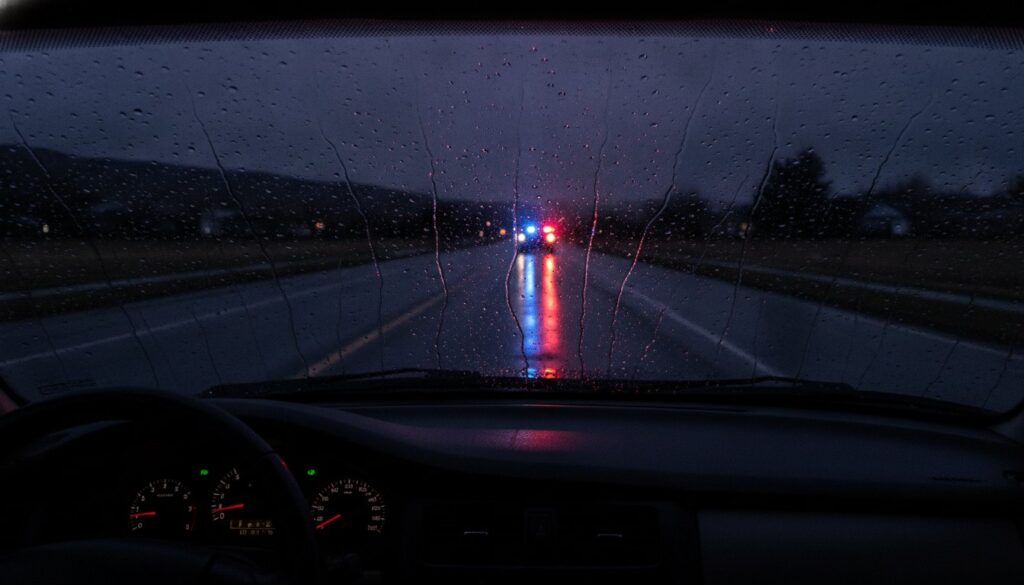
In Idaho, the flashing lights of a DUI checkpoint aren’t just a nuisance; they’re a direct violation of your state constitutional rights. While many other states permit these roadblocks, the Idaho Supreme Court has made it clear that stopping you without individualized suspicion is illegal. However, knowing your DUI checkpoint rights Idaho is only half the battle when law enforcement uses aggressive saturation patrols to mimic the same high-pressure environment. You shouldn’t have to feel like a criminal just for driving home, yet the system is designed to catch you off guard and force a mistake.
We understand the paralyzing anxiety that hits when a simple traffic stop turns into a high-stakes interrogation. This guide promises to reveal the truth about Idaho’s roadside laws and provide the mental checklist you need to remain silent and protected during any encounter. We’ll examine the specific rulings that keep checkpoints off our roads, explain the immediate risks of refusing a breathalyzer, and detail why you have exactly seven days to save your driver’s license from an administrative suspension. It’s time to stop guessing about your future and start building a proactive defense against an intimidating legal system.
Key Takeaways
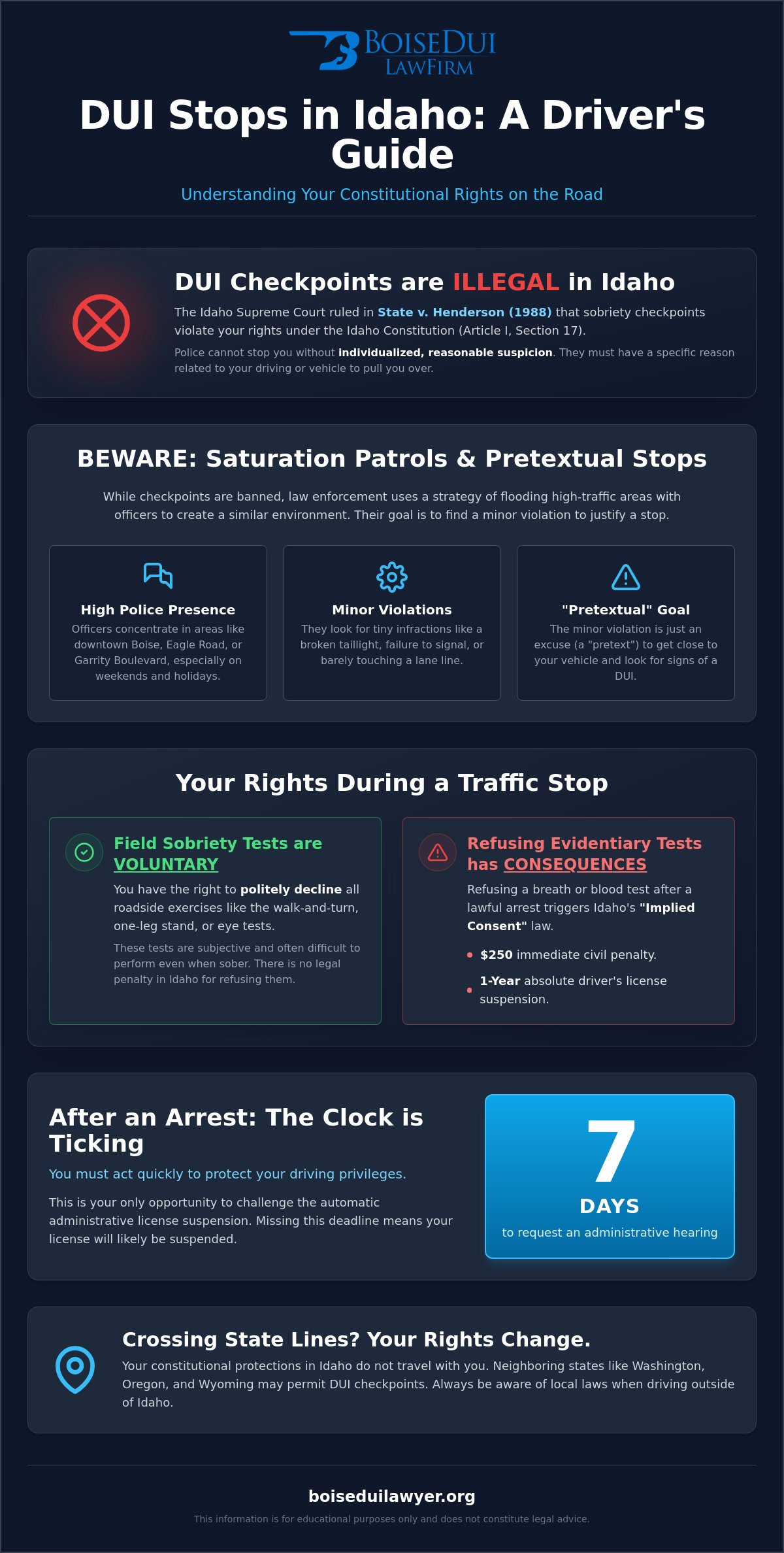
- Sobriety checkpoints are unconstitutional under the Idaho Constitution, meaning police cannot legally stop you without specific, individualized suspicion.
- Understanding your DUI checkpoint rights Idaho is critical because law enforcement still uses high-visibility saturation patrols to mimic the pressure of a roadblock.
- Field Sobriety Tests are entirely voluntary in Idaho, and you have the right to politely decline these subjective roadside exercises without legal penalty.
- Refusing an evidentiary breath or blood test triggers the Implied Consent law, resulting in an immediate $250 fine and a one-year license suspension.
- You must act within seven days of your arrest to request an administrative hearing, which is often the only way to prevent an automatic license suspension.
Are DUI Checkpoints Legal in Idaho? The Constitutional Reality
Idaho stands as a bastion of privacy in a country where many states allow the police to stop you without cause. If you’re wondering about your DUI checkpoint rights Idaho, the answer is definitive. Sobriety checkpoints are unconstitutional in the Gem State. While the U.S. Supreme Court ruled in Michigan Dept. of State Police v. Sitz that these stops are a “minimal intrusion” on drivers, the Idaho Supreme Court took a much firmer stance. In the landmark 1988 case State v. Henderson, the court determined that roadblocks violate Article I, Section 17 of the Idaho Constitution.
This means that in Idaho, law enforcement cannot simply set up a line of orange cones and stop every car to sniff for alcohol. Every single stop must be predicated on reasonable suspicion or probable cause. If an officer pulls you over, they must be able to articulate a specific reason for that stop. They might cite a broken taillight, a failure to signal, or swerving within a lane. They cannot rely on a random dragnet. Understanding the status of Sobriety Checkpoints in the U.S. helps illustrate just how unique Idaho’s protections are compared to the national average. You have a right to be left alone unless you’ve actually done something to warrant police attention.
Idaho’s Stance on Unreasonable Search and Seizure
The Idaho Supreme Court prioritizes your individual privacy over the state’s interest in “efficient” policing. Under Article I, Section 17, any seizure of a person without individualized suspicion is considered unreasonable. This is your most powerful shield. If you’re caught in a stop that lacks this foundation, the “Exclusionary Rule” comes into play. This legal doctrine prevents the prosecution from using any evidence gathered during an illegal stop. If the stop is bad, the breathalyzer results and officer observations often vanish from the case. We use this rule to dismantle the prosecution’s narrative from the ground up.
Checkpoints in Bordering States
Your rights don’t have a passport. If you drive across the border into Washington, Oregon, or Wyoming, you enter jurisdictions where the legal landscape shifts beneath your tires. While Idaho remains a “no-checkpoint” state, neighboring states have different interpretations of their own constitutions. Never assume your Idaho protections follow you on a road trip. Crossing state lines means you must adhere to local statutes. These might include the very checkpoints that are banned here at home. Knowing the local rules before you cross the border is the only way to stay protected. One mile can make the difference between a constitutional right and a legal nightmare.
Saturation Patrols: Why You Might Still See “Checkpoints”
You are driving through Downtown Boise on a Saturday night and see five patrol cars within three blocks. It looks like a trap. It feels like a roadblock. While we have established that roadblocks are illegal here, law enforcement uses a high-intensity alternative called a “saturation patrol.” During these operations, agencies like the Boise Police Department or the Ada County Sheriff flood specific zones with extra officers. Their goal is simple. They want to create a dense net of surveillance that makes it nearly impossible to drive through a high-traffic area without being observed by a cruiser.
Saturation patrols differ from illegal roadblocks in one critical way: the officer must still find a legal reason to pull you over. They cannot stop every car. Instead, they wait for the slightest deviation from perfect driving. In Meridian, you might see this heavy presence along Eagle Road. In Nampa, patrols often concentrate near Garrity Boulevard or the downtown entertainment districts. Exercising your DUI checkpoint rights Idaho starts with recognizing that while the roadblock is banned, the police are still actively hunting for “pretextual” reasons to initiate a stop.
The “Pretextual Stop” Strategy
A pretextual stop occurs when an officer uses a minor equipment or traffic violation as an excuse to investigate a more serious crime, like a DUI. They aren’t actually concerned about your flickering license plate light or your failure to signal for exactly 100 feet. They want to get close enough to your window to look for bloodshot eyes or the smell of alcohol. You will see these patrols surge during high-risk windows, such as:
- The 4th of July weekend and New Year’s Eve.
- Boise State University home game days.
- Late-night hours on Friday and Saturday in the Treasure Valley.
Your Rights During a Pretextual Stop
The officer must have “reasonable suspicion” that a crime or traffic violation occurred before they hit the lights. If they stop you simply because you were “leaving a bar area” without any other infraction, the stop is likely unconstitutional. You have the right to remain silent and the right to refuse a search of your vehicle. It’s helpful to review a guide on how to Know Your Rights at a Traffic Stop to ensure you don’t inadvertently waive your protections. If the initial reason for the stop was weak, we can challenge that suspicion in court to have your case dismissed. Understanding how to fight a DUI in Idaho requires a deep dive into the legality of that first interaction. If you have been arrested during a saturation patrol, you need a proactive strategy for DUI defense in Boise to protect your license and your freedom.
Your Rights at an Idaho Traffic Stop: A Driver’s Essential Checklist
When the red and blue lights appear in your rearview mirror, your adrenaline spikes. This is the moment where your future is decided. While you now know that actual roadblocks are prohibited based on the Idaho Supreme Court on DUI checkpoints, a saturation patrol stop feels just as high-stakes. You must remain calm. You must be precise. Your behavior during the first sixty seconds often dictates whether you go home or go to jail. Use this checklist to navigate the encounter without compromising your defense.
- Pull over safely: Signal immediately and find a secure spot. Turn off the engine and turn on your interior light if it’s dark.
- Keep hands visible: Place your hands at the ten and two positions on the steering wheel. Do not reach for your glove box until the officer asks for your documents.
- Provide required documents: You are legally required to provide your driver’s license, vehicle registration, and proof of insurance. Have these ready to avoid looking like you’re fumbling.
- Record the stop: Idaho is a one-party consent state. You can record the interaction on your phone as long as it doesn’t interfere with the officer’s duties.
- Decline searches: If an officer asks to “look around” your vehicle, you should always refuse.
Understanding your DUI checkpoint rights Idaho means knowing that the police are looking for any reason to expand a simple traffic stop into a full criminal investigation. They are watching your fine motor skills as you reach for your wallet. They are sniffing the air for alcohol or marijuana. Every move you make is being recorded on a body camera and will be used as evidence against you. Don’t give them more than the law requires.
The Right to Remain Silent
Officers are trained to build rapport through seemingly casual questions. They’ll ask “Where are you coming from?” or “Had a few drinks tonight?” These aren’t friendly inquiries. They are evidence-gathering tools designed to get you to admit to consumption or establish a timeline of your evening. You don’t have to answer. Polite silence is your best weapon. Simply state: “I am exercising my right to remain silent and I would like to speak with my attorney.” Once you say this, stop talking. Even “polite conversation” can be twisted into a confession of impairment.
Vehicle Search Protections
Unless an officer sees something in “plain view,” like an open beer can or a pipe, they generally need a warrant or your consent to search your car. Never give that consent. You can be firm without being combative. Say, “I do not consent to any searches of my person or my property.” If they proceed with a search anyway, do not physically resist. Your lawyer will challenge the legality of that search in court later. If you’ve been targeted in a Treasure Valley patrol, you need an aggressive Boise DUI attorney to audit the officer’s conduct and protect your constitutional shield.
Field Sobriety and Breathalyzer Tests: To Refuse or Comply?
Once an officer has initiated a stop during a saturation patrol, their primary objective shifts toward gathering physical evidence of impairment. This is the stage where most drivers unknowingly sabotage their own defense. While your DUI checkpoint rights Idaho protect you from being stopped without cause, they also grant you the power to decline specific roadside tests that are designed for you to fail. You are not a circus performer. You don’t have to prove your sobriety through physical feats on the side of a busy highway.
Field Sobriety Tests (FSTs) are entirely voluntary in the state of Idaho. Many drivers believe that refusing these tests will result in an automatic license suspension or an admission of guilt. This is a misconception that law enforcement often allows to persist. In reality, these tests are highly subjective and rely entirely on the officer’s personal interpretation of your performance. By agreeing to participate, you are essentially providing the prosecution with a narrative of “clues” that they will use to justify your arrest and conviction. Understanding how a field sobriety test challenge Idaho defense can expose the flaws in these subjective exercises is critical to protecting yourself after a roadside stop.
Challenging Field Sobriety Test Results
The “Standardized” Field Sobriety Tests consist of the Horizontal Gaze Nystagmus (eye test), the Walk and Turn, and the One-Leg Stand. These tests are only considered reliable when administered under perfect conditions according to strict National Highway Traffic Safety Administration (NHTSA) protocols. Any deviation from these specific instructions by the officer can be used to invalidate the results in court. We frequently see cases where results are skewed by:
- Medical conditions or old injuries that affect balance and coordination.
- Uneven road surfaces, gravel, or poor lighting in the Treasure Valley.
- Environmental factors like wind, passing traffic, or extreme Idaho weather.
- Anxiety and the natural “fight or flight” response during a high-pressure stop.
If you have already performed these tests, a field sobriety test challenge Idaho strategy can identify these flaws to weaken the state’s case.
Breathalyzer Refusal and the 2026 Penalties
While FSTs are voluntary, Idaho’s “Implied Consent” law creates a different set of rules for chemical testing. By operating a vehicle in Idaho, you have already legally consented to an evidentiary test of your breath, blood, or urine if you are arrested for a DUI. Refusing this test after an arrest carries immediate and severe administrative consequences. For a first-time refusal in 2026, you face a mandatory $250 fine and a one-year seizure and suspension of your driver’s license. A second refusal within ten years results in a two-year suspension.
It is vital to distinguish between the roadside Portable Breath Test (PBT) and the evidentiary breath test at the station. The PBT is often used as a preliminary tool to establish probable cause for an arrest, while the evidentiary test provides the data used in court. If you are struggling with the decision of breathalyzer refusal Idaho, you must weigh the criminal defense benefits against the certainty of losing your license. If you have been arrested and are facing a refusal penalty, you need to speak with a Boise DUI attorney immediately to protect your right to drive.
Protecting Your Future After a Boise DUI Encounter
The flashing lights are gone and the handcuffs have been removed, but the state has already begun its move against you. An arrest in the Treasure Valley triggers a dual-track legal battle that moves with terrifying speed. While you have already exercised your DUI checkpoint rights Idaho by refusing voluntary tests or remaining silent, the focus now shifts to dismantling the prosecution’s case. You are no longer just a driver on the side of the road. You are a defendant in a system that is designed to secure a conviction. You need a shield.
Our defense strategy begins with a forensic review of the initial encounter. We scrutinize every second of the dashcam and bodycam footage to find the crack in the officer’s narrative. Did they actually have reasonable suspicion to pull you over, or was this an illegal “checkpoint-style” stop disguised as a saturation patrol? In Ada and Canyon County, judges hold law enforcement to strict constitutional standards. If the officer’s footage reveals a lack of probable cause or a violation of your rights under the Idaho Constitution, we move to suppress the evidence and fight for a full dismissal.
The 7-Day DMV Hearing Deadline
The most urgent threat to your lifestyle isn’t the courtroom; it’s the Idaho Transportation Department. From the moment you are served with a notice of suspension, you have exactly seven days to request an administrative hearing. If you miss this window, your license will be suspended automatically. This process is entirely separate from your criminal case. We use these hearings as a strategic advantage, subpoenaing the arresting officer to testify under oath before the criminal trial even begins. This allows us to lock in their story and identify inconsistencies early. Reviewing the Idaho DUI sentencing guidelines will show you exactly what is at stake if this administrative battle is lost. Securing a free consultation with a DUI lawyer in Boise immediately after your arrest is the most effective way to ensure this seven-day deadline is met and your driving privileges are protected.
Why a Local Advocate Matters
Navigating the court systems in Boise, Meridian, and Nampa requires more than just legal knowledge. It requires an intimate familiarity with local law enforcement patterns and the specific tendencies of Treasure Valley prosecutors. We know which officers frequently skip steps in their FST protocols and which judges are most protective of a driver’s DUI checkpoint rights Idaho. You don’t have to face this intimidating system alone or unprepared.
We provide a battle-hardened defense for first-time offenders and those facing aggravated charges. Our firm is dedicated to protecting your driving privileges and your reputation through aggressive advocacy and strategic litigation. Contact Boise DUI Attorney today to schedule a consultation. We offer flexible payment plan options to ensure that a high-level defense is accessible when you need it most. The clock is ticking on your seven-day window. Don’t let the state take your freedom without a fight.
Secure Your Defense and Your Future
Idaho law provides some of the strongest privacy protections in the country, but those protections only work if you know how to use them. While we’ve established that sobriety roadblocks are unconstitutional, the reality of saturation patrols means you must remain vigilant every time you get behind the wheel. Understanding your DUI checkpoint rights Idaho is your first line of defense against an overreaching system. You have the power to remain silent and the right to refuse voluntary field sobriety tests, but the window to protect your driver’s license closes faster than you think.
If you’ve already been stopped or arrested, the next seven days are the most critical of your life. We provide an aggressive defense for clients in Ada and Canyon County courts, specifically targeting illegal stops and procedural errors to get charges reduced or dismissed. You don’t have to navigate this high-stakes environment alone. Our team offers payment plans for all clients to ensure you have access to the protective shield you deserve. Protect your rights; schedule a free DUI consultation with our Boise defense team today. You can still take control of your situation and move forward with confidence.
Frequently Asked Questions
Are DUI checkpoints legal in Idaho in 2026?
No, sobriety checkpoints are unconstitutional in Idaho. The Idaho Supreme Court established in 1988 that these roadblocks violate the state constitution’s protection against unreasonable searches and seizures. Police in the Treasure Valley cannot stop your vehicle without individualized suspicion that a crime or traffic violation has occurred. This makes Idaho one of the few states where your privacy rights are strictly protected against random dragnets.
What happens if I encounter a roadblock in Boise?
If you encounter a roadblock intended for sobriety checks, your constitutional rights are likely being violated. You should remain calm and provide your required identifying documents, but you should also document the encounter if it’s safe to do so. Any evidence gathered during an illegal roadblock can often be suppressed in court. Because the initial stop lacked legal justification, the entire case against you may be eligible for dismissal.
Do I have to answer police questions at a saturation patrol stop?
You are not legally required to answer questions about your destination, your activities, or your alcohol consumption. While you must provide your driver’s license, vehicle registration, and proof of insurance, you can politely decline to answer further questions. Simply state that you are exercising your right to remain silent. This prevents the officer from using your own words or any perceived speech patterns as evidence of impairment.
Can I refuse a field sobriety test in Idaho without losing my license?
Yes, you can refuse to perform field sobriety tests without an automatic license suspension. These roadside exercises, such as the one-leg stand or the walk-and-turn, are entirely voluntary in Idaho. Declining these tests protects your DUI checkpoint rights Idaho by preventing the officer from gathering subjective observations. Unlike the evidentiary breath test at the station, there is no administrative penalty for refusing these physical coordination exercises.
Is a breathalyzer refusal an automatic crime in Idaho?
Refusing an evidentiary breath test is not a separate criminal charge, but it triggers immediate and severe civil penalties. Under the Implied Consent law, a first-time refusal results in a $250 fine and a mandatory one-year license suspension. While refusing the test may limit the physical evidence the state has against you, the administrative consequences are certain. You must weigh the lack of a BAC reading against the guaranteed loss of your driving privileges.
How long do I have to fight a license suspension after a DUI arrest?
You have exactly seven days from the date of your arrest to request an administrative hearing with the Idaho Transportation Department. If you fail to act within this narrow window, your license will be suspended automatically. This process is independent of your criminal court case. It’s the only opportunity you have to challenge the suspension and keep your ability to drive while your case moves through the system. Speaking with a free consultation DUI lawyer in Boise as soon as possible after your arrest ensures you don’t miss this critical deadline.
Can a DUI charge be dismissed if the stop was illegal?
Yes, a DUI charge can be dismissed if the officer lacked a legal reason to pull you over. If the initial stop was unconstitutional, all evidence obtained afterward is considered “fruit of the poisonous tree.” This includes breathalyzer results, field sobriety test performance and the officer’s roadside observations, and officer observations. We use the exclusionary rule to move for the suppression of this evidence, which frequently leaves the prosecution with no case to pursue.
What is the difference between a sobriety checkpoint and a saturation patrol?
The primary difference is the requirement for individualized suspicion. A sobriety checkpoint stops every vehicle or a specific sequence of vehicles without any evidence of wrongdoing, which is illegal in Idaho. A saturation patrol involves a high concentration of officers in one area who look for actual traffic violations to initiate a stop. While saturation patrols are legal, the officer must still have a valid reason, such as a broken taillight or speeding, to pull you over.