

A single traffic stop in Idaho can instantly transform from a stressful encounter into a life-altering legal crisis. You might believe that the Idaho DUI sentencing guidelines are set in stone, but the “standard” penalties requested by the state are often just a starting point for an aggressive defense. If you’re paralyzed by the fear of losing your job due to mandatory jail time or confused by how the 10-year lookback rule affects your current charge, you aren’t alone. The system is designed to be intimidating; however, it isn’t invincible.
We understand the gravity of your situation and the high-stakes pressure of facing a potential felony or an “Excessive” DUI designation. This guide promises to help you navigate these complexities, showing you exactly how a proactive defense strategy can influence judicial sentencing. You’ll gain a clear understanding of the tiered penalty system, discover mitigating factors that could reduce your sentence, and learn the actionable steps you must take before your first court appearance to shield your rights and your livelihood. The clock is already running on your defense, and understanding the road ahead is your first step toward protection.
Key Takeaways
- Distinguish between Standard, Excessive, and Aggravated DUI charges to pinpoint exactly which statutory penalties the prosecution is targeting.
- Master the Idaho DUI sentencing guidelines to navigate mandatory minimums and avoid the maximum prison sentences associated with repeat offenses.
- Prepare for mandatory alcohol evaluations and Victim Impact Panels with a strategy that positions you as a proactive individual rather than a statistic.
- Pinpoint the specific mitigating factors, from professional stability to clean criminal histories, that can sway judicial discretion in your favor.
- Secure your right to drive by initiating a license suspension hearing within the strict seven-day administrative deadline following your arrest.
The Foundation of Idaho DUI Sentencing: Statutes and Tiers
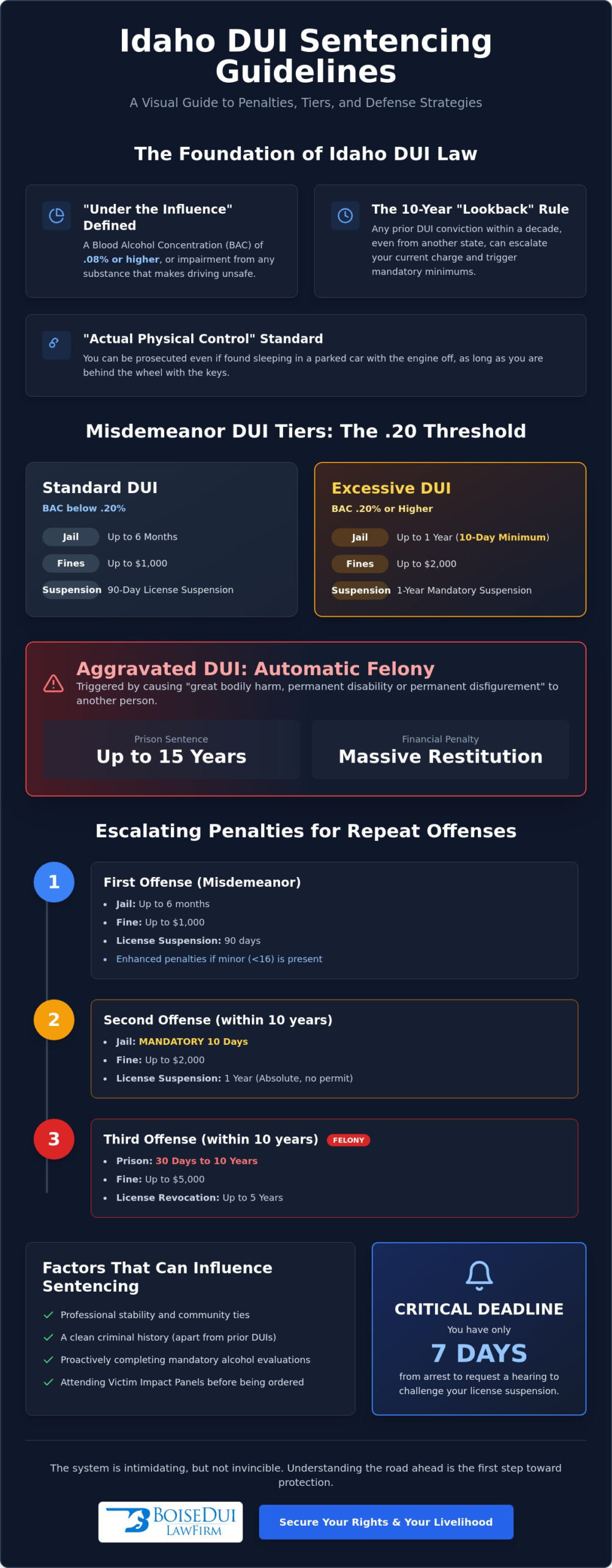
Idaho’s legal system doesn’t treat every DUI with the same brush. Under Idaho Code § 18-8004, the state defines being “under the influence” as having a blood alcohol concentration (BAC) of .08% or higher, or being impaired by any substance that makes driving unsafe. While DUI laws in the United States vary significantly, Idaho is notoriously aggressive. One of the most punishing aspects of the Idaho DUI sentencing guidelines is the 10-year “lookback” period. This means any prior conviction within a decade, even from another state, can be used to escalate your current charge to a mandatory minimum jail sentence or a felony.
Don’t assume you’re safe just because the car wasn’t moving when the police arrived. Idaho utilizes an “Actual Physical Control” standard. If you’re behind the wheel with the keys in your possession, even if you’re sleeping in a parked car with the engine off, the state can prosecute you. This broad definition creates a massive sentencing risk for individuals who thought they were making a responsible choice by staying off the road. It’s a trap that many fall into, and it requires an immediate, strategic response to avoid the harshest penalties.
Standard vs. Excessive DUI: The .20 Threshold
The math of your sentencing changes fundamentally the moment your BAC hits .20%. This is the “Excessive” threshold, and it’s where the prosecution’s aggression spikes. If you cross this line, the state effectively doubles the weight of its hammer. For a first-time offender, a standard DUI carries a maximum of six months in jail. An Excessive DUI pushes that maximum to a full year. The administrative penalties are equally devastating. Instead of a 90-day license suspension, you face a mandatory one-year suspension with no restricted driving privileges allowed. You’re facing a total loss of mobility that can dismantle your career and family life.
Aggravated DUI: When Sentencing Becomes a Felony
Sentencing moves into the realm of the Idaho State Penitentiary when a case is classified as “Aggravated” under Idaho Code § 18-8006. This occurs if you cause “great bodily harm, permanent disability or permanent disfigurement” to another person while driving under the influence. This is an automatic felony. The stakes are no longer just about fines or local jail; you face up to 15 years in prison. Beyond the loss of freedom, the Idaho DUI sentencing guidelines for aggravated cases often include massive restitution payments to victims. This financial and legal burden can follow you for decades, making a proactive defense your only shield against a life-altering conviction.
Tiered Penalty Guidelines: Misdemeanor vs. Felony DUI
Idaho’s tiered system ensures that the more often you enter the legal process, the more the state attempts to dismantle your life. For a first-time misdemeanor conviction under Idaho Code § 18-8004, you face up to six months in jail and fines reaching $1,000. While a judge has some discretion regarding jail time for first-time offenders, the mandatory 90-day license suspension is non-negotiable. If you were transporting a minor under the age of 16 during the incident, Idaho Code § 18-8004A triggers enhanced penalties, potentially doubling your jail exposure and fines even if you have a perfectly clean record.
The pressure intensifies significantly with a second offense within a decade. This isn’t just a steeper fine; it’s a mandatory 10-day jail sentence that a judge cannot waive by law. You also face a one-year absolute license suspension with no possibility of a restricted permit. By the time you reach a third offense within 10 years, the state classifies you as a felon. You are no longer looking at county jail. You are looking at a minimum of 30 days in custody and up to 10 years in the Idaho State Penitentiary, accompanied by a $5,000 fine and a five-year license revocation. These Idaho DUI sentencing guidelines are designed to be punitive, not rehabilitative.
The 10-Year Lookback Rule Explained
Idaho’s “lookback” period is a mathematical trap for the unwary. The courts calculate this 10-year window from the date of your previous conviction to the date of your current arrest. This distinction is vital because a delayed conviction from years ago could still pull you into a higher sentencing tier today. If you had a DUI in another state, don’t expect it to stay there. Idaho prosecutors actively seek out-of-state records to escalate your current charges. If you are unsure how a prior incident affects your current standing, consulting a Boise DUI attorney is the only way to verify your actual exposure.
High BAC and Repeat Offender Enhancements
Judges in Idaho are bound by statutory mandatory minimums that strip away their ability to be lenient. If your BAC was .20% or higher, you are immediately pushed into the “Excessive” category, which carries harsher penalties than a standard second-offense DUI. For 2026, the law remains clear: a second Excessive DUI conviction within a 10-year window is an automatic felony, carrying a mandatory 30-day jail sentence and up to five years of prison time. These enhancements are designed to punish repeat offenders with maximum severity, leaving no room for error in your defense strategy.
Mandatory Sentencing Requirements Beyond Jail and Fines
Jail sentences and high-dollar fines dominate the headlines, but the administrative requirements of the Idaho DUI sentencing guidelines often cause the most long-term disruption to your daily life. You cannot simply pay a fine and walk away. The state demands total compliance with a series of intrusive mandates that are both time-consuming and expensive. If you fail to complete even one of these requirements, you risk a probation violation and an immediate return to custody.
Every person convicted of a DUI in Idaho must undergo a mandatory alcohol evaluation. This isn’t a formality. A state-certified evaluator will probe into your personal history, drinking habits, and mental health. Their final report is the primary blueprint a judge uses to order treatment. You’ll also be required to attend a Victim Impact Panel (VIP). This is a logistical and emotional hurdle where you listen to the stories of those whose lives were destroyed by impaired driving. It’s a mandatory box you must check before your case can be fully resolved.
Additionally, Idaho law requires an Ignition Interlock Device (IID) for all DUI convictions, including first offenses. This device must be installed in any vehicle you drive for at least one year after your license is reinstated. Under Idaho’s compliance-based removal rule, the clock only stops when you prove you can use the device without violations. Any failed breath test or missed calibration can restart your one-year requirement, keeping you under state surveillance indefinitely.
Alcohol Evaluation and Recommended Treatment
Judges rely heavily on the evaluator’s recommendation when deciding your fate. Level I treatment usually involves 10 to 15 hours of education focused on the risks of impaired driving. Level II is much more rigorous, involving intensive outpatient programs that can last several months. Don’t wait for a court order to begin this process. Enrolling in recommended treatment early is a powerful tactical move. It proves to the court that you’re taking accountability, which can shift the judge’s perspective toward leniency during sentencing.
The Financial Anatomy of an Idaho DUI Sentence
The statutory fine is only the beginning of your financial exposure. Expect to pay several hundred dollars in court costs and administrative fees that are tacked onto every conviction. If the police performed a blood draw or if emergency services responded to a crash, the court will likely order you to pay restitution for those specific costs. You’ll also face the long-term fallout of SR-22 insurance. This high-risk certificate must be maintained for three years, and the resulting premium hikes often cost more than the original court fine itself.
Factors That Influence Judicial Discretion in Idaho
While the Idaho DUI sentencing guidelines provide a rigid framework of mandatory minimums, they do not strip a judge of all power. In the courtrooms of Boise, Nampa, and Caldwell, sentencing is often a battle over the “human element.” A judge looks beyond the police report to determine if you are a threat to public safety or a responsible citizen who made a singular, devastating mistake. Your defense must focus on shifting this judicial perspective before the gavel falls. Failing to present a proactive narrative leaves your fate entirely in the hands of a prosecution that is paid to seek the maximum penalty.
The transition from a “standard” sentence to a maximum one often hinges on specific aggravating factors. If your arrest involved reckless driving, excessive speeds, or a lack of cooperation with law enforcement, the judge will likely lean toward the harsher end of the spectrum. Conversely, mitigating factors can serve as your strongest shield. Judges value employment stability and deep community ties. If you take the initiative to consult with a Boise DUI specialist and enroll in alcohol education or AA meetings before your first court date, you demonstrate a level of accountability that judges find compelling.
Aggravating vs. Mitigating Factors
An accident changes everything. If property was damaged or another person was even slightly injured, the judge’s focus shifts immediately toward jail time as a means of restitution and punishment. Refusal cases also carry a heavy weight; judges often view a refusal to provide a breath sample as an attempt to hide a high BAC, which can lead to less leniency during sentencing. To counter this, character letters from employers or community leaders are vital. They provide the court with a reason to see you as more than just a case number, highlighting your value to the Treasure Valley community.
The Role of Probation in DUI Sentencing
Most DUI sentences include a “suspended” jail term. This is a sword hanging over your head. If the judge sentences you to 180 days but suspends 178 of them, you only serve two days in custody, provided you successfully complete probation. Supervised probation is intensive, requiring random alcohol testing and strict travel restrictions. Unsupervised probation is less restrictive but still requires you to remain law-abiding. Any violation, such as a positive UA or a new criminal charge, triggers the suspended sentence, and you will likely be ordered to serve the remainder of your time behind bars without further negotiation.
In rare cases, you may be eligible for a “Withheld Judgment.” This is a powerful, one-time tactical tool that allows you to plead guilty without a permanent conviction entering your record. If you complete all terms of your probation, the case is dismissed. However, if you fail, the conviction is entered, and the full weight of the original sentence is applied. This is why a “Rule 11” plea agreement is often necessary; it creates a binding contract that ensures the judge cannot impose a harsher sentence than what was negotiated between your defense and the prosecutor.
Navigating the Sentencing Process with a Boise DUI Attorney
The moment the handcuffs click, a countdown begins. You have exactly seven days from the date of your arrest to request an administrative hearing with the Idaho Transportation Department to contest your license suspension. If you miss this narrow window, your driving privileges are suspended automatically, regardless of what happens in your criminal case. This is why immediate intervention is mandatory. An aggressive defense doesn’t just wait for a sentencing hearing; it starts by attacking the state’s ability to even bring you before a judge.
Strategic Defense: Dismantling the Prosecution’s Case
The prosecution relies on the assumption that their evidence is flawless. We know better. We start by scrutinizing the “probable cause” for your initial traffic stop. If the officer lacked a legal reason to pull you over, every piece of evidence gathered afterward, including breath tests and admissions, can be suppressed. We also investigate the calibration records of the breathalyzer and the specific conditions under which your Field Sobriety Tests were conducted. A technical error or a deviation from standard training can lead to a full dismissal, ensuring the Idaho DUI sentencing guidelines never even touch your life. Understanding how to fight a DUI in Idaho through these procedural challenges is essential to building a case that protects your future.
When a dismissal isn’t an option, we pivot to strategic negotiation to ensure the Idaho DUI sentencing guidelines don’t dictate your future. In many Ada and Canyon County cases, we can leverage weaknesses in the state’s evidence to secure a “Wet Reckless” charge. This is a reckless driving conviction that acknowledges alcohol involvement but bypasses the mandatory minimums associated with a standard DUI. It can save your license and prevent the mandatory installation of an ignition interlock device, preserving your ability to commute and provide for your family.
Preparing for the sentencing hearing itself requires a meticulous approach. Your physical appearance and your statement to the court aren’t superficial details; they’re tactical tools. You must project accountability and stability. We guide you on exactly what to wear, how to address the court, and what to say to the judge to emphasize your commitment to the community and your professional responsibilities. This preparation turns a high-stakes moment of judgment into an opportunity for a more favorable outcome.
Securing Your Future in the Treasure Valley
Local experience is your greatest asset in this fight. The judges and prosecutors in Boise and Nampa have specific patterns and expectations. We use our intimate knowledge of these local courts to protect your employment and your reputation while you fulfill any remaining requirements. You don’t have to face this intimidating system alone. Secure your aggressive defense; schedule your free consultation today.
Take Control of Your Legal Future
Idaho’s legal system is designed to be efficient at issuing convictions, but it isn’t always fair to the individual. You’ve seen how the Idaho DUI sentencing guidelines operate through a rigid hierarchy of tiers and mandatory minimums; however, you’ve also learned that judicial discretion remains a powerful variable. Whether you’re facing a first offense or a high-stakes felony charge, the difference between a life-altering sentence and a manageable outcome often rests on the quality of your advocacy.
Don’t let a “standard” penalty define your next decade. You need a defense that understands the nuances of Ada and Canyon County courts and isn’t afraid to challenge the prosecution’s evidence directly. Our firm provides a specialized focus on Treasure Valley DUI defense, bringing a battle-hardened approach to every license hearing and sentencing appearance. We fight aggressively for charge reductions and dismissals because we know exactly what’s at stake for your family and your career.
Protect your rights and your future; contact Boise DUI Attorney for a free consultation.
You have the power to influence the path ahead. Take the first step toward reclaiming your life today.
Frequently Asked Questions
Is jail time mandatory for a first DUI in Idaho?
Jail time isn’t a statutory mandatory minimum for a standard first-offense DUI, but judges have the authority to sentence you to up to six months in custody. Many judges in the Treasure Valley lean toward at least 48 hours of jail time to emphasize the gravity of the offense. Your attorney’s primary goal is often to negotiate a suspended sentence, allowing you to avoid time behind bars by successfully completing probation.
What is the difference between a Standard DUI and an Excessive DUI?
The distinction is based entirely on your Blood Alcohol Concentration (BAC) at the time of testing. A Standard DUI applies if your BAC is between .08% and .199%, while an Excessive DUI is triggered if your BAC reaches .20% or higher. Under the Idaho DUI sentencing guidelines, an Excessive charge is treated with significantly more severity, doubling the potential jail time and requiring a mandatory one-year absolute license suspension with no restricted driving privileges.
How long does a DUI stay on your record for sentencing purposes in Idaho?
Idaho utilizes a 10-year “lookback” period to determine if a new arrest qualifies as a repeat offense. Any DUI conviction within the last decade, including out-of-state convictions, will be used to escalate your current penalties to a second or third-offense tier. While the conviction remains on your criminal record permanently, it loses its ability to enhance a new charge once ten years have passed from the date of the original conviction.
Can I get a DUI reduced to reckless driving in Boise?
You can potentially have a DUI reduced to a “Wet Reckless” or a standard reckless driving charge through aggressive legal negotiation. This outcome usually requires identifying critical flaws in the prosecution’s case, such as an illegal traffic stop or improperly administered field sobriety tests. A reduction is a major victory because it bypasses the mandatory DUI license suspensions and the expensive ignition interlock requirements that follow a conviction.
What happens if I refuse the breathalyzer test at the station?
Refusing a chemical test triggers an immediate administrative penalty that is separate from your criminal court case. Under Idaho’s implied consent law, a refusal results in a mandatory one-year absolute license suspension and a $250 civil penalty. The prosecution can also use your refusal as evidence of “consciousness of guilt” in your criminal trial, which often makes judges less inclined to offer leniency during the sentencing phase.
Will I lose my job if I am convicted of a DUI in Idaho?
Employment termination isn’t a direct legal penalty, but the secondary effects of a conviction can make maintaining your job impossible. If your role requires driving, a commercial driver’s license (CDL), or a clean background check, your employer may have grounds to fire you. We prioritize securing restricted driving permits whenever possible to ensure you can continue commuting to work and fulfilling your professional obligations while your case is pending.
How much does an Ignition Interlock Device cost per month?
The monthly cost of an Ignition Interlock Device (IID) depends on the vendor you choose and the specific technology required for your vehicle. You’ll be responsible for an initial installation fee, followed by monthly lease payments and mandatory calibration fees. These recurring costs are your personal financial responsibility and must be maintained for at least one year following the reinstatement of your driving privileges.
Can I travel outside of Idaho while on DUI probation?
You generally need written permission from your probation officer or a court order to travel outside the state while on supervised probation. Standard probation terms in Ada and Canyon counties often include restrictions on leaving the jurisdiction to ensure you are available for random alcohol testing. If you are placed on unsupervised probation, travel is usually permitted as long as you remain law-abiding and fulfill all other court-ordered requirements.