

An Idaho DUI arrest is not an automatic conviction; it is a high-stakes procedural battle where the state already has a head start. If you are currently searching for how to fight a DUI in Idaho, you must understand that the clock is your fiercest enemy. With over 10,000 DUI arrests in Idaho annually, the system is a well-oiled machine designed to move quickly. You are likely facing intense anxiety over potential jail time, heavy fines, and the looming 7-day deadline to request an administrative hearing. It’s a heavy burden to carry alone, but you don’t have to face it without a shield.
This guide delivers the specific legal strategies and procedural challenges necessary to dismantle the prosecution’s case and shield your future. You’ll discover how to identify flaws in field sobriety tests, challenge the validity of the initial traffic stop, and navigate the complex dual-track legal system. Whether your goal is a dismissal or a reduction to reckless driving, we provide the roadmap to help you retain your driving privileges and regain control of your life. By understanding the technicalities of the law, you can move from a state of uncertainty to a position of strength.
Key Takeaways
- Act within the critical seven day window to request an Idaho Transportation Department hearing or face automatic license suspension.
- Discover how to fight a DUI in Idaho by identifying Fourth Amendment violations and a lack of reasonable suspicion during the initial traffic stop.
- Uncover technical flaws in field sobriety tests and breathalyzer calibration standards that can render state evidence inadmissible in court.
- Explore defense pathways like negotiating for a wet reckless reduction or utilizing Idaho’s withheld judgment option to protect your criminal record.
- Leverage local legal expertise to navigate the specific procedural quirks of Ada and Canyon County courtrooms for a more favorable outcome.
Immediate Steps: Why the First 7 Days Determine Your Future
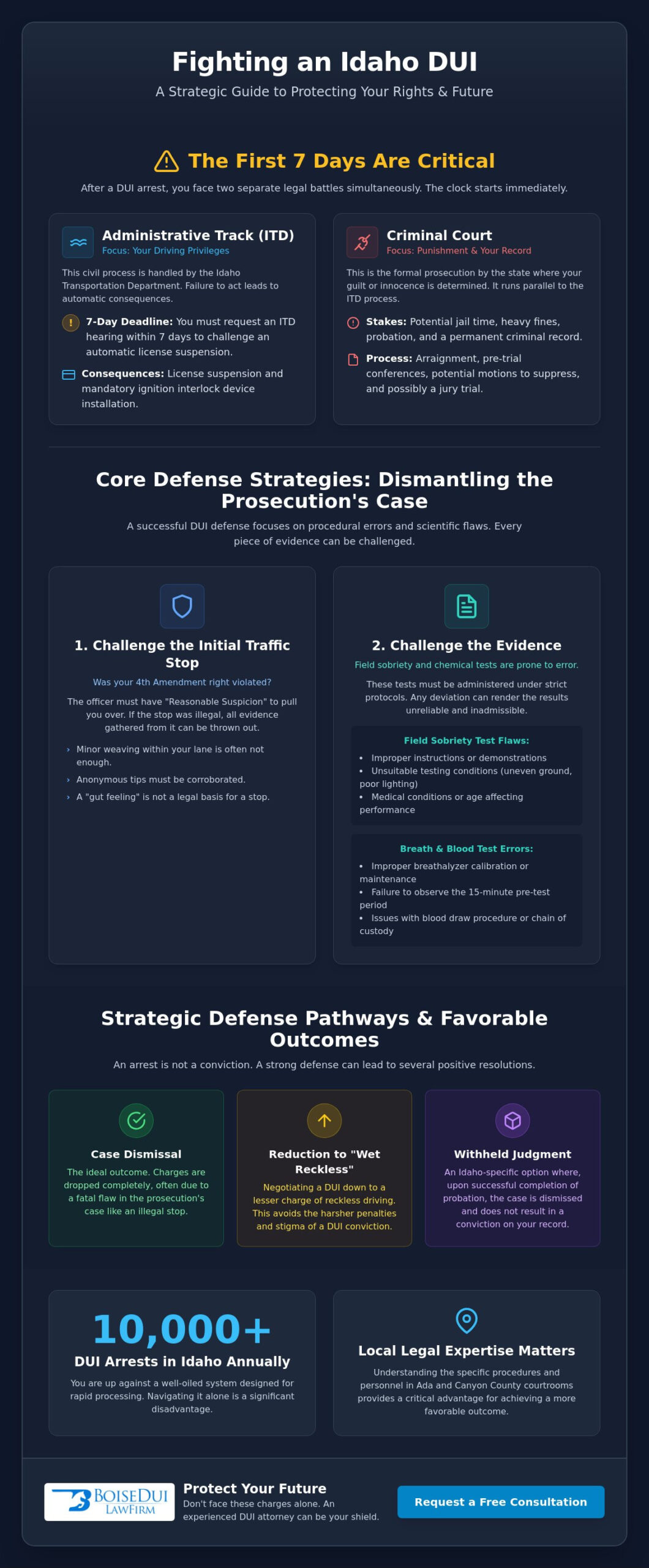
You have exactly 168 hours. That is the reality of an Idaho DUI arrest. From the second the officer hands you a “Notice of Suspension,” your right to drive is on the chopping block. Most drivers mistakenly believe they can wait until their first court appearance to defend themselves. That delay is often fatal to their defense. Understanding how to fight a DUI in Idaho starts with acknowledging that you are fighting two separate wars at once. If you fail to request an administrative hearing within seven days of your arrest, the Idaho Transportation Department (ITD) will automatically suspend your license. It doesn’t matter if you’re eventually found innocent in criminal court. The suspension is a civil penalty that triggers regardless of your guilt.
Your first move must be to secure your Notice of Suspension and document every detail of the stop while it’s fresh. Did the officer read your rights? Was the weather clear? Did they wait the required 15 minutes before the breath test? These details are the foundation of your defense. You’re dealing with a complex legal landscape surrounding Driving Under the Influence (DUI), and the state isn’t required to help you navigate it. You need a shield. You need a proactive strategy that begins the moment you leave the station. Secure legal counsel immediately to ensure your hearing request is filed correctly and on time.
The ITD Administrative Hearing Explained
The ITD hearing is a civil proceeding, entirely separate from your criminal trial in Boise or Caldwell. This isn’t about whether you’re a “good person.” It’s a technical review of the arrest process. We use this hearing as a powerful discovery tool. It allows us to cross-examine the arresting officer under oath before the criminal trial even begins. We focus on specific grounds: Did the officer have legal cause to stop you? Did they follow Idaho State Police standards for the breath test? If the state fails on even one procedural point, we can often stop the suspension in its tracks.
Criminal Penalties vs. Administrative Consequences
Idaho operates on a dual-track system. The criminal track handles jail time, fines, and permanent records. The administrative track, managed by the ITD, handles your driving privileges and ignition interlock requirements. It’s a common, painful surprise for defendants to have their criminal charges reduced or dismissed, only to find their license is still suspended by the ITD.
- Criminal Court: Focuses on punishment, including up to six months in jail and $1,000 in fines for a first offense.
- Administrative (ITD): Focuses on public safety through license revocation and mandatory interlock devices.
Winning one track doesn’t guarantee victory in the other. You must fight both simultaneously to protect your future and your freedom.
Challenging the Initial Stop: Was Your 4th Amendment Right Violated?
The Fourth Amendment protects you against unreasonable searches and seizures. In the context of a traffic stop, this means a police officer cannot pull you over based on a mere whim or a “gut feeling.” To legally initiate a stop, law enforcement must possess “Reasonable Suspicion” that a crime or traffic violation has occurred. If the stop itself is illegal, any evidence gathered afterward, including breathalyzer results or field sobriety tests, may be deemed inadmissible in court. This is a cornerstone of how to fight a DUI in Idaho effectively. If we can prove the officer lacked a valid reason to stop your vehicle, the entire case against you could collapse.
One of the most common battlegrounds involves “weaving.” Idaho law distinguishes between weaving within a lane and actually crossing the fog line or center line. Simply touching a line or drifting slightly within your own lane does not always provide sufficient legal grounds for a stop. We meticulously review dashcam and bodycam footage to verify the officer’s claims. If the footage contradicts the written report, we file a “Motion to Suppress.” This legal maneuver asks the judge to throw out all evidence obtained during the unlawful stop. Often, an experienced Boise DUI Attorney can identify these constitutional breaches that an untrained eye would miss.
Reasonable Suspicion vs. Probable Cause
Reasonable suspicion is the relatively low legal bar required for an officer to briefly detain you and investigate. Probable cause is the significantly higher standard required to actually place you under arrest or search your vehicle. While reasonable suspicion allows an officer to ask for your license and registration, it does not give them a blank check to ignore your rights. A police officer’s subjective “hunch” that a driver might be impaired is legally insufficient to justify a traffic stop under Idaho law.
Analyzing the Officer’s Observations
Officers frequently use boilerplate language in their reports, citing “slurred speech,” “odors of alcohol,” or “bloodshot eyes.” These observations are highly subjective and often non-conclusive. We look for environmental factors that offer alternative explanations for your behavior.
- Wind and Road Conditions: High winds or uneven pavement can cause a vehicle to appear unstable.
- Physical Fatigue: Red eyes and slow responses are often the result of exhaustion or allergies rather than intoxication.
- Inconsistencies: We compare the “Officer’s Sworn Statement” against the video evidence to find discrepancies that undermine the prosecution’s credibility.
Anonymous tips also face heavy scrutiny. If a caller reported “erratic driving” but the officer did not personally witness a violation, the stop might be unconstitutional. We fight to ensure the state is held to its burden of proof from the very first second of the encounter.
Dismantling the Evidence: Breath, Blood, and Sobriety Tests
Once you have been pulled over, the officer’s goal shifts to building a case for your arrest. They rely on technical evidence that often feels indisputable. It isn’t. When considering how to fight a DUI in Idaho, you must realize that breathalyzers, blood draws, and roadside exercises are prone to human and mechanical error. These results are not the final word on your guilt. They are simply data points that we can challenge, suppress, and ultimately defeat by exposing the technical failures behind them.
One of the most common procedural failures involves the 15-minute observation period. Idaho law requires officers to monitor a suspect continuously for 15 minutes before administering a breath test. They must ensure you don’t burp, vomit, or place anything in your mouth that could contaminate the sample. If the officer was busy filling out paperwork or checking their phone, that test result is legally compromised. Similarly, medical conditions like Gastroesophageal Reflux Disease (GERD), diabetes, or a high-protein keto diet can introduce “mouth alcohol” or ketones into the machine. This leads to a false-positive reading that has nothing to do with impairment.
Blood tests are often viewed as the gold standard, but they’re only as reliable as the people handling them. We scrutinize the chain of custody from the moment the needle enters your arm to the moment the vial reaches the lab. If the sample wasn’t refrigerated properly or if the preservative-to-blood ratio was incorrect, the results are scientifically tainted. We don’t accept the state’s numbers at face value; we tear them apart.
The Three Standardized Field Sobriety Tests
Officers use three specific tests to build probable cause: the Horizontal Gaze Nystagmus (HGN), the Walk and Turn, and the One-Leg Stand. The HGN test looks for involuntary eye twitching, but dozens of medical conditions or even simple fatigue can cause the same effect. The physical tests are even more flawed. If you have a back injury, inner ear issues, or are simply wearing heavy work boots, you’ve already been set up to fail. These are “divided attention” tasks designed to be difficult even for the most sober individuals.
Challenging Breathalyzer Accuracy
Idaho State Police (ISP) standards mandate strict maintenance and calibration for all breath testing equipment. If the Alco-Sensor used in your arrest hasn’t been logged or calibrated according to the required schedule, the results shouldn’t stand in court. We also look at the machine’s inherent margin of error. This is especially critical in “Excessive DUI” cases where a 0.20 reading triggers enhanced penalties. A 0.08 reading on an Idaho breathalyzer is merely a machine’s mathematical estimate, not an immutable scientific fact. We use these technicalities to turn the state’s evidence against them.
Strategic Defense Pathways: Reduction, Dismissal, and Trials
The prosecution’s goal is simple: secure a conviction as quickly as possible. Your goal must be the opposite. When you’re learning how to fight a DUI in Idaho, you have to look beyond the initial charges to find a strategic exit. This isn’t just about what happened on the side of the road; it’s about what we can prove in a courtroom. We don’t wait for the state to make a move. We proactively seek out evidentiary weaknesses that force the prosecutor to reconsider their position. Whether we’re pushing for a full dismissal or a significant reduction, every action is a calculated step toward protecting your future.
One of the most effective pathways is negotiating for a “Wet Reckless.” This is technically a reckless driving charge that acknowledges alcohol involvement. While it still carries penalties, it lacks the devastating long-term stigma and mandatory license revocations of a DUI conviction. For those with a clean record, Idaho’s “Withheld Judgment” is another powerful tool. If the court grants this, and you successfully complete your probation, the conviction is never officially entered on your record. It’s a vital lifeline for professionals whose careers depend on a clean background check.
The stakes shift dramatically if you are facing an “Excessive DUI.” In Idaho, a blood-alcohol concentration (BAC) of .20 or higher triggers much harsher mandatory penalties, including double the potential jail time and a mandatory one-year license suspension. In these high-stakes scenarios, we often bring in expert witnesses to challenge the very science the state relies on. If the state’s case is built on flawed data, taking the case to trial may be the only way to ensure justice. You need to consult with a battle-hardened attorney who isn’t afraid to stand before a jury to protect your rights.
Plea Bargaining and Reductions
Prosecutors are more likely to negotiate when they know their evidence won’t hold up under scrutiny. We highlight every procedural error, from the initial stop to the final breath test, to create leverage. Factors like a lack of prior criminal history and your cooperation during the arrest can also play a role. A reduction to reckless driving can save your job, your insurance rates, and your reputation.
The Discovery Process
Success is found in the details. We demand the full “Police Report” and the “Maintenance Logs” for every device used in your arrest. We don’t just look at the numbers; we review the specific printouts from the Intoxilyzer 5000 or 9000 for technical anomalies that suggest a malfunction. By using the preliminary hearing to lock in officer testimony under oath, we prevent the state from changing its story later. This methodical approach ensures that no stone is left unturned in your defense.
The Advantage of a Specialized Boise DUI Attorney
A general practice lawyer might handle a divorce on Monday and a contract dispute on Tuesday. That is not the advocate you want when your freedom is on the line. When you are determining how to fight a DUI in Idaho, you need a specialist who understands that this is a technical, scientific, and procedural battle. A specialist identifies the microscopic errors in breathalyzer logs or the specific biases of a local prosecutor that a generalist will simply overlook. We don’t just handle cases; we dismantle the state’s narrative piece by piece. Knowing how to select the right DUI defense attorney in Boise is itself a critical strategic decision that can determine the outcome of your case. You need a battle-hardened advocate who treats your defense as a high-stakes mission rather than a routine file.
Navigating the courtrooms in Ada County and Canyon County requires more than just legal knowledge. It requires an intimate understanding of local judicial tendencies. Every judge and prosecutor in the Boise and Caldwell areas has a unique approach to DUI sentencing and plea negotiations. Our local relationships allow us to anticipate the opposition’s moves before they make them. We provide a necessary shield against a system that is often indifferent to your personal stakes. This proactive stance is what separates a standard defense from a strategic victory.
Beyond the courtroom, we manage the exhausting logistics of the Idaho Transportation Department. From coordinating the installation of an ignition interlock device to navigating the requirements for a restricted license, we handle the paperwork so you don’t have to. We even guide you through the $285 reinstatement fee process to ensure you’re back on the road legally as soon as possible. Our firm manages the complex dual-track system so you can focus on your family and your career.
Protecting Your Future in the Treasure Valley
A DUI conviction in Boise or the surrounding Treasure Valley can be a career-killer. It impacts professional licenses, spikes insurance rates, and creates a permanent barrier to many employment opportunities, particularly those requiring a polygraph test Boise Idaho for security or sensitive positions. We approach every case with an aggressive posture, treating your defense as a mission to preserve your reputation. Our firm specifically focuses on identifying the procedural failures that lead to dismissals. The value of a free consultation lies in our ability to find the “holes” in the state’s case that an untrained eye would miss.
Take Action Today
The clock is ticking. You have already seen how the 7-day ITD deadline can strip you of your driving privileges before you ever see a judge. Don’t wait for your first court date to begin your defense. When you meet with us, bring your Notice of Suspension and any paperwork provided during your arrest. We need to see every detail to build your shield. Contact our firm today for a comprehensive case evaluation. Your future is too valuable to leave to chance, and the state is already moving against you.
Secure Your Future Against Idaho DUI Charges
The state of Idaho has already begun its case against you. From the moment you were handed that notice of suspension, the legal system started moving toward a conviction. You’ve learned that the first seven days are critical for saving your license and that every piece of evidence, from the initial stop to the breathalyzer result, is vulnerable to a strategic challenge. Understanding how to fight a DUI in Idaho is about identifying these procedural cracks and forcing the prosecution to prove every detail of their claims. You have rights, but they only protect you if you exercise them.
You don’t have to navigate this intimidating system alone. Our firm provides specialized expertise in Treasure Valley DUI courts to act as your shield. We offer free initial consultations to evaluate the holes in the state’s case and provide flexible payment plan options to ensure you have the defense you deserve. Fight your Idaho DUI charges today; schedule your free consultation with a battle-hardened Boise DUI Attorney.
Your life doesn’t have to be defined by a single incident. Take the first step toward a dismissal or reduction and reclaim your peace of mind today.
Frequently Asked Questions
Can I fight a DUI in Idaho if I failed the breathalyzer?
Yes, a failed breathalyzer is not a guaranteed conviction. We challenge the machine’s calibration, the officer’s training, and the mandatory 15-minute observation period to suppress these results. If you are wondering how to fight a DUI in Idaho after a high reading, remember that machines are merely tools prone to error. We look for technical anomalies in maintenance logs to invalidate the state’s evidence before it reaches a jury.
How much does a DUI lawyer cost in Boise?
Legal fees for DUI defense depend on the severity of the charges and the required level of litigation. A case involving an aggravated DUI or a jury trial requires significantly more resources than a standard first-offense negotiation. While we don’t provide fixed pricing here, we offer flexible payment plans to ensure you have access to a battle-hardened advocate. Protecting your future is an investment in your freedom and career.
What happens if I refuse the breathalyzer test in Idaho?
Refusing a chemical test triggers an immediate one-year license suspension under Idaho’s implied consent law. This is a civil penalty that applies regardless of whether you are eventually found guilty of the criminal charge. You have the right to request a refusal hearing within seven days, but the legal bar is high. Breathalyzer refusal in Idaho often complicates the administrative track while potentially depriving the prosecution of BAC evidence in your criminal case.
Can I get a restricted license to drive to work after a DUI arrest?
You may be eligible for a restricted driving permit after serving an initial period of absolute suspension. For a first-time failed test, this absolute suspension typically lasts 30 days. Afterward, you must provide proof of financial responsibility and install an ignition interlock device. This permit allows you to maintain your employment and care for your family while the legal process unfolds in the Treasure Valley courts.
What is an ‘Excessive DUI’ in Idaho and how is it different?
An excessive DUI is defined as operating a vehicle with a BAC of .20% or higher. This charge carries significantly harsher penalties than a standard DUI, including a mandatory minimum of 48 hours in jail and a mandatory one-year license suspension. If you are facing these enhanced charges, the strategy for how to fight a DUI in Idaho becomes even more critical due to the rigid mandatory sentencing requirements involved.
Will I go to jail for a first-offense DUI in Boise?
Idaho law allows for up to six months of jail time for a first-offense DUI, though judges often suspend this time in favor of probation. Whether you serve time depends on the specific facts of your arrest and the effectiveness of your defense posture. In many local cases, first-time offenders may qualify for work release or community service instead of traditional incarceration, provided their attorney negotiates effectively.
How long does a DUI case take to resolve in Idaho courts?
Most Idaho DUI cases take between three and six months to reach a final resolution. The exact timeline depends on the complexity of the evidence, the schedule of the specific court in Ada or Canyon County, and whether the case proceeds to a jury trial. We use this time to conduct thorough discovery, ensuring that every piece of state evidence is scrutinized before you make a final decision.
Can a DUI be expunged from my record in Idaho?
Idaho does not have a traditional expungement statute for DUI convictions; they remain on your record permanently. However, a “Withheld Judgment” allows you to avoid a formal conviction if you successfully complete all terms of your probation. This is a one-time opportunity that must be requested at sentencing. It serves as a vital shield for your professional future and is only available to those who qualify under specific legal criteria.