

An arrest for a first offense DUI in Idaho is a disorienting and terrifying experience. In a matter of hours, your world is turned upside down. You are facing the immediate threat of jail, the loss of your driver’s license, and the beginning of a complex legal battle you are not prepared to fight. The questions are overwhelming: What happens now? Will I go to jail? How will I get to work? This is not just a traffic ticket; it is a serious criminal charge with consequences that can impact your job, your finances, and your future for years to come.
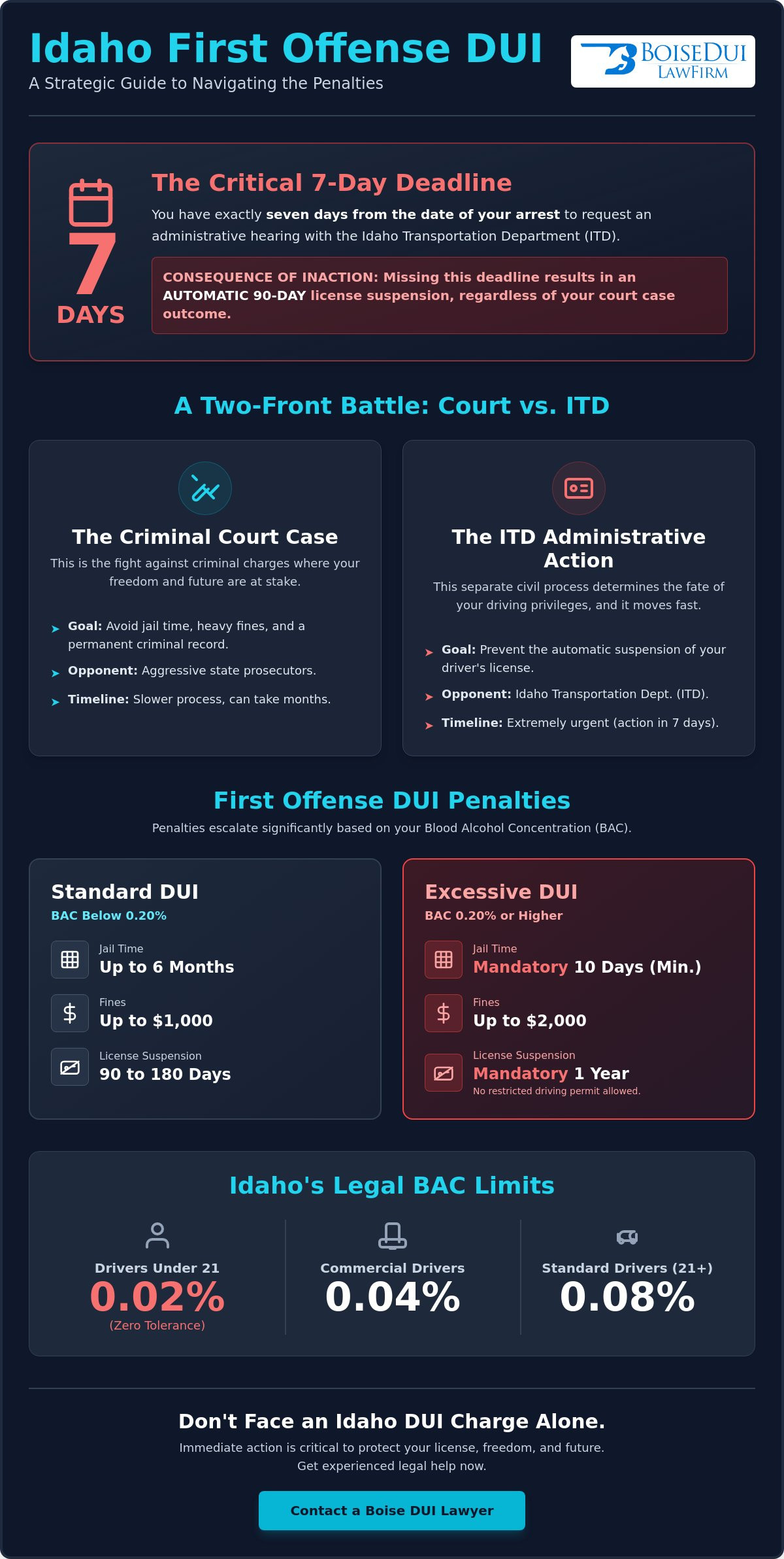
You must understand one thing immediately: an Idaho DUI is a two-front war. You are simultaneously fighting a criminal case in court and an administrative battle with the Idaho Transportation Department (ITD) for your driving privileges. The clock on the administrative front starts ticking the moment you are arrested, giving you only seven days to act. This guide provides the critical information you need to understand the penalties, navigate the license rules, and begin building a powerful defense for your first offense DUI in Idaho.
Understanding the Immediate Impact of a First DUI Charge in Idaho
The first 24 hours following a DUI arrest are a blur of confusion, anxiety, and fear. However, the actions you take—or fail to take—in the first week will have a profound impact on the outcome of your case. Idaho prosecutors and judges treat even a first offense with extreme gravity, and the system is designed to move quickly, often to your detriment.
- Defining a First-Offense DUI: Under Idaho Code § 18-8004, you can be charged with Driving Under the Influence (DUI) if you are in actual physical control of a motor vehicle with a Blood Alcohol Content (BAC) of 0.08% or higher. For commercial drivers, the limit is 0.04%, and for drivers under 21, it is 0.02%. Importantly, you can also be charged if you are simply “under the influence” of alcohol, drugs, or other intoxicating substances, even if your BAC is below the legal limit.
- The Immediate Aftermath: After your arrest, you will likely be booked into jail, have your vehicle impounded, and have your physical driver’s license confiscated by the police. You will be issued a temporary driving permit and a notice of administrative license suspension. This notice is not just a piece of paper; it is the starting gun for the most time-sensitive part of your case.
- Why a First Offense is a Serious Matter: While a first offense DUI is typically a misdemeanor, it carries mandatory penalties, including potential jail time and a guaranteed license suspension. Prosecutors in the Treasure Valley are under pressure to secure convictions and rarely dismiss these charges without a fight. They view a first offense as an opportunity to “teach a lesson” and deter future behavior.
- The Critical 7-Day Deadline: This is the single most important timeline you face. From the date you are served with the notice of suspension, you have only seven calendar days to request a hearing with the Idaho Transportation Department to challenge the automatic suspension of your license. Missing this deadline means your license will be suspended, regardless of what happens in your criminal case.
The Legal Definition of Driving Under the Influence
The core of a DUI charge in Idaho rests on two primary standards. The most common is the “per se” violation, which is based purely on your chemical test results.
- The 0.08% BAC Threshold: For most adult drivers, having a Blood Alcohol Content (BAC) of 0.08% or greater is, by itself, illegal. The prosecutor does not need to prove you were driving erratically or appeared intoxicated; the number alone is enough to charge you.
- The “Under the Influence” Standard: You can also be convicted of a DUI if your ability to drive was impaired by alcohol, drugs, or any other intoxicating substance, regardless of your BAC. If an officer testifies that you failed field sobriety tests, had slurred speech, or showed other signs of impairment, a prosecutor can pursue a conviction even with a low or non-existent BAC reading.
- Zero Tolerance for Underage Drivers: Idaho has a strict zero-tolerance policy for drivers under the age of 21. If you are underage, a BAC of just 0.02% to 0.079% will result in an infraction with a mandatory license suspension and a fine. A BAC of 0.08% or higher will result in the same criminal DUI charge an adult would face.
The 7-Day Rule: Why You Must Act Immediately
The moment a police officer serves you with a Notice of Administrative License Suspension, a separate case begins with the Idaho Transportation Department (ITD). This is a civil matter, completely independent of your criminal court proceedings.
- The ITD Administrative Suspension: This suspension is triggered by either failing a chemical test (blowing 0.08% or higher) or refusing to take one. The suspension is automatic unless you formally challenge it.
- How to Request a Hearing: To contest the suspension, you or your attorney must file a written request for a hearing with the ITD within seven days of receiving the notice. This is a strict, non-negotiable deadline.
- The Danger of Missing the Deadline: If you fail to request a hearing in time, your license will be automatically suspended on the 30th day after your arrest. For a first offense, this is typically a 90-day suspension, with the first 30 days being an “absolute” suspension where no driving is permitted for any reason. By taking swift action, you preserve your right to fight for your driving privileges.
Penalties for a First Offense DUI in Idaho: Jail Time, Fines, and Long-Term Costs
The consequences of a conviction for a first offense DUI in Idaho extend far beyond a single night in jail. The statutory penalties are significant, and the collateral costs can be financially devastating. It is a mistake to underestimate what is at stake.
- Statutory Maximums: A standard first-offense DUI is a misdemeanor punishable by up to six months in jail, a fine of up to $1,000, or both. While the maximum sentence is rare, some jail time is often imposed.
- Mandatory License Suspension: A criminal conviction will result in a license suspension of 90 to 180 days. The first 30 days are absolute, meaning you cannot drive at all. After that, you may be eligible for a restricted permit to drive to work or school. This is separate from the administrative suspension and the penalties run consecutively if you lose both.
- Alcohol Evaluation and Treatment: You will be required to undergo a comprehensive alcohol evaluation at your own expense. The court will then order you to complete any recommended education courses or treatment programs, which can last for several months. You will also have to attend a victim impact panel.
- Excessive DUI: If your BAC was 0.20% or higher, the charge is elevated to an “Excessive DUI.” This carries mandatory minimum penalties, including 10 days in jail (with a maximum of one year), a fine of up to $2,000, and a one-year license suspension after your release from jail.
Mandatory Sentencing Requirements in Treasure Valley Courts
Judges in Ada County (Boise, Meridian) and Canyon County (Nampa, Caldwell) have specific expectations for DUI sentencing. While they have some discretion, certain requirements are standard for a first-time offender.
- Typical Sentencing: Even for a standard first offense, judges in Boise and Meridian often require a short period of jail time (e.g., 24-48 hours) or an equivalent amount of community service. The remainder of a jail sentence is typically suspended, pending successful completion of probation.
- Supervised Probation: You can expect to be placed on supervised probation for one to two years. During this time, you must report to a probation officer, submit to random drug and alcohol testing, pay all fines and fees, and violate no laws. Any misstep can result in the court imposing your suspended jail sentence.
- Ignition Interlock Device (IID): For any first-offense DUI conviction, Idaho law mandates the installation of an Ignition Interlock Device in any vehicle you operate. This device is a car-mounted breathalyzer that you must blow into before starting the engine. You are responsible for all installation and monthly monitoring fees for a period of one year.
Hidden Costs: The “Real” Price of a DUI
The court-ordered fines are only the beginning. The true financial impact of a first offense DUI can easily reach thousands of dollars and affect your budget for years.
- SR-22 Insurance: After a DUI, the ITD will require you to file an SR-22 certificate, which is proof of high-risk auto insurance. This will cause your insurance premiums to skyrocket, often doubling or tripling, for at least three years.
- Fees and Expenses: Beyond the fine, you will have to pay for court costs, probation supervision fees, the alcohol evaluation, DUI classes, IID installation and rental, and license reinstatement fees. These can easily add up to over $2,000.
- Professional and Employment Impact: A DUI conviction creates a permanent criminal record that is visible to potential employers, landlords, and professional licensing boards. For those who drive for a living or require a security clearance, a DUI can be a career-ending event.
The Two-Front Battle: Criminal Court vs. the Idaho DMV
One of the most confusing aspects for anyone facing a first offense DUI in Idaho is understanding that they are fighting two separate legal battles at the same time. The outcome of one does not control the outcome of the other. A successful defense requires a strategy that addresses both arenas simultaneously.
- Criminal Charge vs. Administrative Suspension: The criminal charge is handled in court, where a prosecutor must prove you are guilty “beyond a reasonable doubt.” The administrative suspension is handled by the ITD, where the standard of proof is much lower—a “preponderance of the evidence,” meaning it is just more likely than not that the officer had grounds to suspend your license.
- Winning in Court Isn’t Enough: You can have your criminal DUI charge dismissed or be found not guilty at trial, but still lose your license through the administrative process. The ITD hearing often happens long before your court case is resolved, and its outcome is binding.
- Different Burdens of Proof: The high standard of “beyond a reasonable doubt” in criminal court provides more opportunities for a skilled defense attorney to challenge the evidence. In the administrative hearing, the hearing officer often gives significant weight to the police report, making it a more difficult battle to win.
- Coordinating a Dual Defense: A strategic defense involves using the administrative hearing as an opportunity to gather evidence and cross-examine the arresting officer under oath. This testimony can then be used to find inconsistencies and weaknesses in the prosecutor’s case for the criminal trial.
The ITD Administrative Hearing Process
Once you request an administrative hearing within the 7-day window, you have a chance to save your license from automatic suspension. This hearing is a formal legal proceeding, typically held over the phone with a hearing officer appointed by the ITD.
- What Happens at the Hearing: Your attorney will present evidence and argue on your behalf. The arresting officer will also testify. The hearing is not about determining your guilt or innocence on the DUI charge itself.
- Limited Grounds for Contesting: The scope of the hearing is narrow. The primary issues are whether the officer had legal grounds to stop your vehicle, whether there was probable cause for the arrest, and whether the chemical test was administered correctly according to state protocols.
- The “Restricted Driving Permit”: If you lose the administrative hearing (or chose not to fight it), you must serve the first 30 days of the suspension without any driving privileges. After that, you may be able to apply for a restricted driving permit that allows you to drive for work, school, and medical appointments, provided you install an Ignition Interlock Device.
Navigating the Criminal Court Timeline
The criminal case proceeds on a much slower timeline than the administrative process. It begins with an arraignment and can take several months to resolve through either a plea agreement or a trial.
- From Arraignment to Pre-Trial: At your arraignment in Ada or Canyon County court, you will enter a plea of “not guilty.” Your attorney will then receive the initial evidence from the prosecutor (police reports, videos, test results). This is followed by one or more pre-trial conferences where your lawyer can negotiate with the prosecutor and file motions to challenge the evidence.
- The Role of the Prosecutor: The prosecutor’s goal is to secure a conviction. However, they may be open to negotiating a plea agreement to a lesser charge if your attorney can demonstrate significant weaknesses in their case.
- Why “Waiting and Seeing” is Dangerous: The most common mistake is to do nothing while waiting for your court date. A proactive defense starts immediately. Evidence can be lost, witness memories can fade, and critical deadlines (like the 7-day rule) can be missed. The earlier an attorney gets involved, the more opportunities they have to build a strong defense.
How to Fight a First DUI Charge: Proven Defense Strategies
A common misconception is that failing a breathalyzer test means you are automatically guilty. This is false. An arrest is not a conviction. There are numerous effective strategies a knowledgeable DUI defense attorney can use to challenge the state’s evidence and protect your future.
- Challenging the “Reasonable Suspicion” for the Stop: The police cannot pull you over for no reason. The officer must have a valid, legal reason—”reasonable suspicion”—to believe you violated a traffic law. If the initial stop was unlawful, all evidence gathered afterward, including the breath test, can be suppressed.
- Attacking Field Sobriety Tests (FSTs): FSTs like the walk-and-turn or one-leg stand are notoriously unreliable and difficult to perform even when sober. An attorney can challenge the administration of these tests, the officer’s instructions, and environmental factors (like poor lighting or uneven ground) that could have affected your performance.
- Breathalyzer and Blood Test Defense: Breathalyzer machines are not infallible. They require strict calibration and maintenance protocols. An experienced lawyer will investigate the machine’s service records and the officer’s training. Similarly, blood tests can be challenged based on an improper blood draw procedure or a break in the “chain of custody.”
- Seeking a Reduction to a Lesser Charge: A primary goal in many cases is to negotiate a plea agreement to a lesser offense, such as “Reckless Driving.” This often carries less severe penalties, avoids a mandatory license suspension, and does not have the same stigma as a DUI conviction. Another powerful outcome is securing a “Withheld Judgment.”
Common Errors in Idaho DUI Investigations
Police officers are human and they make mistakes. A thorough defense investigation often uncovers procedural errors that can be used to your advantage in court.
- Procedural Mistakes: Local police officers in Boise or Nampa must follow strict procedures, from reading you the proper advisories before a chemical test to observing you for a required period before administering a breath test. Any deviation can be grounds for challenging the evidence.
- Mistaking Medical Conditions for Impairment: Certain medical conditions, allergies, or even fatigue can produce symptoms that mimic intoxication, such as red eyes, unsteady balance, or slurred speech. An effective defense explores these alternative explanations.
- Rising BAC Defense: “Rising BAC” is a defense strategy arguing that your blood alcohol level was below the legal limit while you were driving but continued to rise, going over 0.08% only by the time you were tested at the police station.
The Power of a “Withheld Judgment” in Idaho
For many facing a first offense DUI in Idaho, a Withheld Judgment is the best possible outcome short of a full dismissal or acquittal. It offers a path to keeping a conviction off your permanent record.
- Protecting Your Record: Under Idaho Code § 19-2601, a judge can grant a Withheld Judgment. This means that if you plead guilty, the judge “withholds” a finding of guilt and places you on probation.
- Eligibility Requirements: This outcome is discretionary and typically reserved for first-time offenders who have a strong defense or compelling mitigating circumstances. An experienced attorney must skillfully advocate for this result.
- The Long-Term Benefit: If you successfully complete all terms of your probation (including paying fines, completing classes, and staying out of trouble), the court will dismiss the charge. This means you can legally and honestly state that you have not been convicted of the crime.
Why Immediate Legal Representation is Critical for Boise DUI Cases
Trying to navigate the complexities of a first offense DUI in Idaho on your own is a significant risk. The system is adversarial, and the prosecutor’s only job is to convict you. Having a skilled legal advocate in your corner from the very beginning is your most important asset.
- Local Court Knowledge: An attorney who regularly practices in Ada and Canyon County courts understands the tendencies of local judges and prosecutors. This insider knowledge is invaluable when negotiating plea deals and arguing motions.
- Proactive Defense and Early Intervention: A proactive lawyer doesn’t wait for the court date. They immediately file the request for the ITD hearing, start gathering evidence, and open a line of communication with the prosecutor to position your case for the best possible outcome.
- A Shield Against the System: A DUI arrest is stressful and intimidating. Your attorney acts as your shield, handling all communications with the court, the prosecutor, and the DMV, allowing you to focus on your life while they fight for your rights.
- Navigating Complex Requirements: The rules surrounding Idaho’s IID and SR-22 requirements are complex. A lawyer ensures you meet every deadline and fulfill every requirement correctly, avoiding further license suspensions or violations of probation.
Protecting Your Future with Local Expertise
When your future is on the line, generic legal advice is not enough. You need an advocate who lives and breathes Treasure Valley DUI defense.
- Why Boise DUI Attorney Expertise Matters: Our firm focuses exclusively on DUI and criminal traffic defense in the Boise area. We know the law, we know the courts, and we know how to build the strategic, aggressive defense your case deserves.
- Our Approach to Advocacy: We meticulously investigate every detail of your arrest, from the legality of the traffic stop to the science behind the chemical test. We prepare every case as if it is going to trial, which gives us maximum leverage in negotiations.
- Accessible Representation: We believe everyone deserves a powerful defense. That is why we offer flexible payment plans to ensure that our high-quality representation is accessible when you need it most.
Your Next Steps: The Free Consultation
You do not have to face this alone. The most important step you can take right now is to seek professional legal advice. Our free, confidential consultation is your opportunity to understand your rights and options.
- What to Bring: When you meet with us, bring all the paperwork you received from the police, including the citation and the Notice of Administrative License Suspension.
- Our Case Evaluation: We will listen to your side of the story, review the initial facts of your case, and give you an honest assessment of the strengths and weaknesses of the prosecution’s evidence against you.
- Take Action Now: The clock is ticking, especially on your right to save your license. Do not let another day pass in uncertainty. Secure your future—schedule your free consultation today.