

In Idaho, saying “no” to a breathalyzer is often more legally damaging than failing the test itself. While it might have felt like the right move in the heat of the moment, a breathalyzer refusal Idaho triggers an immediate, aggressive legal process that doesn’t wait for your day in criminal court. You’re likely feeling the weight of an impending one-year absolute license suspension and the anxiety of how you’ll get to work or support your family. It’s a stressful, high-stakes position. The state isn’t going to make it easy for you to keep your car on the road.
We understand the fear of being grounded for a full year and the confusion over how administrative penalties differ from criminal ones. This guide is designed to be your shield against a complex system. We will show you how to navigate the high-stakes reality of your situation and how to protect your driving privileges. You’ll learn the critical difference between refusal and failure, the reality of the $250 civil fine, and the tactical maneuvers required to win an administrative hearing. If you want to avoid the total loss of your license, you must act before the strict 7-day deadline expires.
Key Takeaways
- Understand how Idaho’s Implied Consent Law turns your driver’s license into a binding legal contract that mandates evidentiary testing.
- Grasp the severe reality of an “absolute” one-year suspension and why a breathalyzer refusal Idaho offers no path for restricted work or school permits.
- Compare the administrative risks of refusing versus failing a test to see why silence often results in much harsher penalties.
- Learn how to navigate the high-stakes 7-day deadline to request a license suspension hearing before your right to drive is automatically revoked.
- Discover tactical defense strategies to challenge the officer’s grounds for the stop and protect your future from predatory legal consequences.
Idaho’s Implied Consent Law: Why You Can’t Just Say No
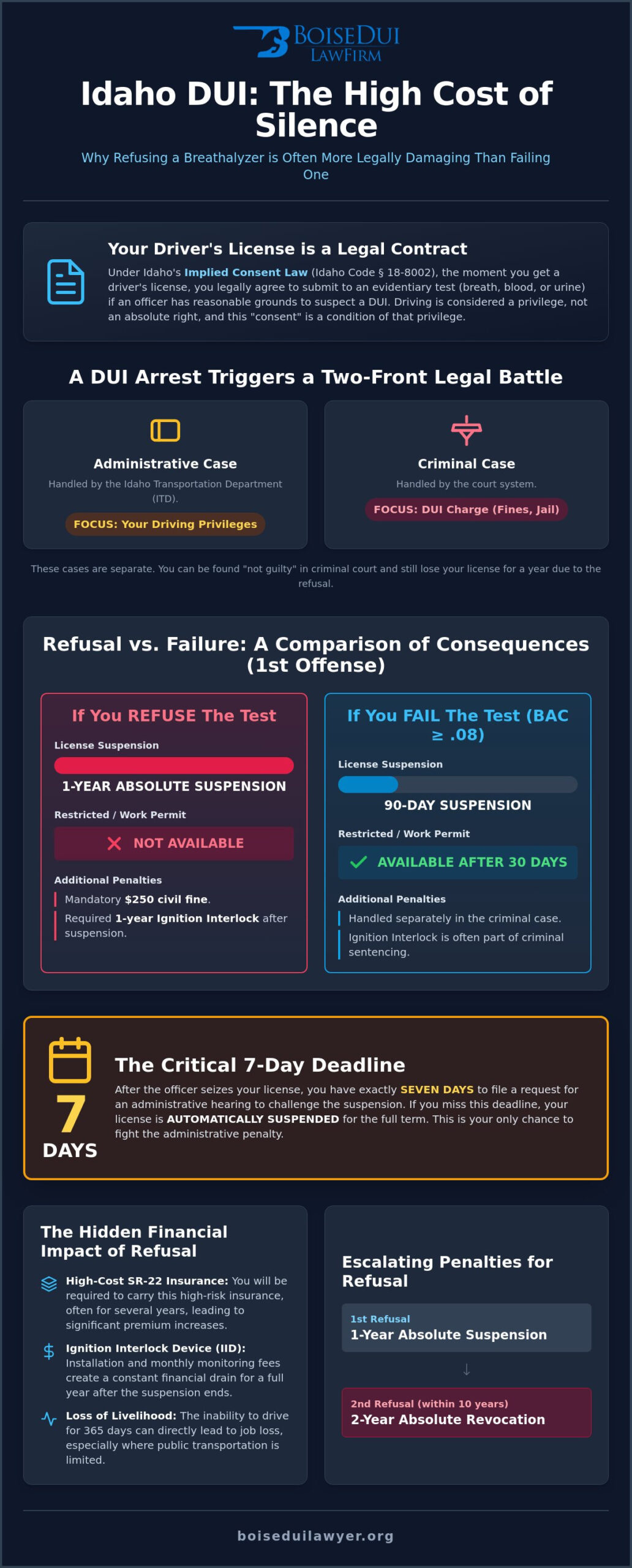
Driving in Idaho isn’t just about following the rules of the road; it’s a contractual agreement with the state. When you received your driver’s license, you entered into a legal pact under Idaho Code § 18-8002. This statute establishes that by operating a motor vehicle, you’ve already given your consent to undergo evidentiary testing for alcohol or drugs. Boise courts are very clear on this point: driving is a revocable privilege, not an inherent constitutional right. If an officer has reasonable grounds to believe you’re impaired, they don’t need your “permission” in the way you might think. They’ll read you a specific legal warning known as the Refusal Affidavit. This document isn’t a suggestion. It’s a formal notice of the immediate penalties you’ll face for declining a test. This Implied Consent Law covers breath, blood, and urine tests equally. You can’t pick and choose which method you prefer to avoid the consequences of a breathalyzer refusal Idaho. The law assumes you’ve already said yes, and the penalties for breaking that contract are designed to be swift and severe.
The Legal Fiction of ‘Choice’ in a DUI Stop
Implied consent is a mandatory agreement to submit to evidentiary testing in exchange for the privilege of using Idaho’s public roads. You might think you have a choice to say “no” during a stop, but that choice is largely a legal fiction. Refusing doesn’t stop the investigation; it just shifts the penalties. The “evidentiary test” is the primary goal of the police. If you withhold it, the state uses administrative law to punish your silence. Even if you refuse, officers can often secure a warrant for a blood draw, leaving you with both the evidence against you and the refusal penalty.
Administrative vs. Criminal: The Two-Front Battle
A DUI arrest triggers two separate legal battles. The criminal track involves a prosecutor and potential jail time. The administrative track is handled by the Idaho Transportation Department and focuses entirely on your license. These systems operate on different rules. You can be found “not guilty” of the DUI in criminal court yet still suffer a 1-year suspension for a breathalyzer refusal Idaho. The officer will seize your physical license immediately. You’re left with a temporary permit while the clock ticks toward a total loss of driving privileges. Understanding your DUI checkpoint rights Idaho and how law enforcement initiates these stops can be critical context for evaluating whether the original stop that led to your refusal was even legally valid. You must defend both fronts to stay on the road.
The Absolute 1-Year Suspension: Idaho’s Penalty for Silence
If you choose to stay silent during a DUI stop, the state reacts with immediate force. Under Idaho Code § 18-8002, a first-time breathalyzer refusal Idaho triggers a mandatory, one-year absolute suspension of your driving privileges. The term “absolute” is the most critical word in this statute. It means there’s no middle ground. You cannot apply for a restricted permit to get to work. You cannot drive your children to school or daycare. There are zero exceptions for medical emergencies or grocery runs. For 365 days, your legal right to operate a vehicle in the state of Idaho is completely extinguished.
The consequences don’t stop at the suspension. You’ll be ordered to pay a $250 civil penalty. Once that year of total suspension finally ends, you aren’t simply handed your license back. You’ll be required to install an Ignition Interlock Device (IID) in your vehicle for an additional year. If you find yourself facing a second refusal within a ten-year period, the state escalates the punishment to a two-year absolute revocation. The system is designed to make the cost of silence higher than the cost of cooperation.
The Hidden Costs of an Idaho Refusal
Losing your license is only the visible part of the damage. You’ll be forced to carry SR-22 insurance, which typically results in high-cost premium hikes that last for years. In the Treasure Valley, IID installation and monthly monitoring fees create a persistent financial drain. For residents in Meridian, Eagle, or Nampa, where public transit is limited, the inability to drive can lead to immediate job loss. The financial impact of a refusal often reaches thousands of dollars beyond the initial fine. Drivers in Canyon County facing these consequences should explore DUI defense Nampa Idaho options immediately to understand how specialized local advocacy can help mitigate these devastating costs.
Why ‘Don’t Blow’ Advice Often Backfires
You might have heard that refusing the test makes it harder for the state to prove a DUI. In reality, this advice often backfires. A standard first-time DUI failure usually results in a 90-day suspension, with the possibility of a restricted permit after just 30 days. By refusing, you’ve traded a 30-day inconvenience for a 365-day total ban. Boise prosecutors also argue your refusal shows a “consciousness of guilt” to the jury. If the officer is determined, they’ll simply obtain a telephonic warrant for a forced blood draw. You’ll end up providing the evidence anyway, but with the added penalty of the 1-year suspension. Consulting a Boise DUI Attorney is the only way to evaluate if there’s a path to challenge the Refusal Affidavit before the clock runs out.
Refusal vs. Failure: Evaluating Your Legal Risks
Choosing between a test failure and a breathalyzer refusal Idaho is a decision made in seconds with consequences that last years. Most drivers don’t realize the administrative tracks for these two outcomes are vastly different. If you blow over the legal limit of 0.08, you face a 90-day suspension. While that sounds daunting, Idaho law typically allows for a restricted driving permit after the first 30 days of “absolute” suspension. This permit keeps you employed and your life moving. A refusal, however, triggers a full 365-day absolute suspension with zero possibility of a restricted permit. You’re trading a 30-day inconvenience for a 365-day total lockout from the driver’s seat.
There is a tactical reality that Boise prosecutors don’t want you to know. In some high-stakes scenarios, refusing the test might be the only way to avoid an Aggravated DUI charge. If your BAC is likely over 0.20, you’re facing felony-level penalties, mandatory jail time, and much higher fines. By refusing, you deny the state the specific scientific evidence needed to prove that higher tier of impairment. It’s a brutal trade-off: you lose your license for a year to potentially save yourself from a felony conviction. This is why immediate professional intervention is non-negotiable. You need to know exactly which fire you’re trying to put out.
The ‘Restricted License’ Myth
Don’t fall for the myth that you can negotiate a restricted permit with the DMV after a refusal. The Idaho Transportation Department operates on a strict statutory mandate. If the Refusal Affidavit is upheld, the one-year absolute suspension is automatic. There is no judge, hearing officer, or clerk in the Treasure Valley who can grant you a work permit during this time. Contrast this with a standard DUI failure where work and school permits are common. Once you refuse, you’ve committed to a year of total reliance on others for transportation.
The Evidentiary Weight of a Refusal
Silence carries its own weight in a Boise courtroom. Under current Idaho DUI sentencing guidelines, a refusal doesn’t make the criminal case go away. In fact, the prosecution will tell the jury that you refused because you knew you were guilty. This “consciousness of guilt” argument is a powerful tool for the Ada or Canyon County Prosecutor’s office. It can make plea bargaining significantly more difficult, as prosecutors often view a breathalyzer refusal Idaho as a challenge to their authority and evidence-gathering process. You aren’t just fighting a license suspension; you’re fighting a prosecutor who now has a point to prove.
The Critical 7-Day Deadline: Contesting the Suspension
The moment you’re processed for a DUI arrest, a countdown begins that determines the next year of your life. You have exactly seven days from the date of service on your notice of suspension to request an administrative hearing. This is a hard, unforgiving deadline. If you fail to act within this window, your breathalyzer refusal Idaho results in an automatic, irreversible one-year suspension. The Idaho Transportation Department doesn’t grant extensions for late filings, regardless of your personal circumstances or work requirements. This hearing is your only opportunity to stop the state from seizing your driving privileges before your criminal case ever reaches a courtroom.
Requesting the hearing is just the first step. You must be prepared to challenge the “Refusal Affidavit” filed by the arresting officer. This document is the state’s primary evidence against you in the administrative track. It claims that the officer had reasonable grounds for the stop and that you were properly informed of the consequences of refusing. If any part of that narrative is flawed, the suspension can be vacated. However, the burden is on you to prove those flaws exist. Missing this window means you’ve conceded the fight before it even started.
Grounds for Challenging a Refusal
Winning a refusal hearing requires a precise strike against the officer’s procedure. We look for specific failures in the state’s case that can invalidate the suspension. Common points of attack include:
- Warning Errors: Was the Implied Consent warning read to you correctly and in its entirety? If the officer skipped sections or misrepresented the penalties, the refusal may be legally void.
- Lack of Probable Cause: Did the officer have a valid legal reason to stop your vehicle? If the initial stop violated your constitutional rights, the request for a breath test is often considered invalid. Knowing your DUI checkpoint rights Idaho is essential here, as Idaho’s unique constitutional protections against roadblocks can directly affect whether the officer’s grounds for stopping you were lawful.
- Physical Inability: Sometimes, what an officer labels a “refusal” is actually a medical inability to provide a sufficient breath sample. Respiratory issues or diminished lung capacity can prevent the machine from registering a result, which is not a willful refusal.
The Role of Your Boise DUI Attorney at the Hearing
This administrative hearing is more than just a fight for your license; it’s a tactical reconnaissance mission. Your attorney will cross-examine the arresting officer under oath. This allows us to lock in their testimony early, often revealing inconsistencies that can be used to dismantle the criminal DUI charge later. We treat this hearing as a vital discovery tool to build a comprehensive defense guide for your specific case. By exposing weaknesses in the breathalyzer refusal Idaho affidavit now, we position you for a stronger defense in criminal proceedings. Don’t let the 7-day clock run out without a shield; contact a Boise DUI Attorney to file your hearing request immediately.
Defending a Breathalyzer Refusal Charge in Boise
A breathalyzer refusal Idaho isn’t an automatic sentence; it’s an accusation that can be fought. Our defense strategy begins by challenging the “Reasonable Grounds” for the initial stop. If the officer lacked a valid legal reason to pull you over or lacked the necessary evidence to initiate a DUI investigation, every action that followed is legally compromised. We also scrutinize the communication during the arrest. Confusing instructions or a language barrier can easily turn a simple misunderstanding into a “refusal” in the eyes of the police. If you didn’t clearly understand the consequences or the specific mechanics of the test, we argue that no willful refusal occurred.
Medical limitations are another powerful shield in these cases. Conditions such as asthma, COPD, or significantly reduced lung capacity can make it physically impossible to provide a “valid blow” into the testing device. In these scenarios, your failure to produce a sample isn’t a choice; it’s a biological reality that the state cannot legally punish. Additionally, we look for opportunities to negotiate with the Ada or Canyon County Prosecutor’s office. It’s often possible to have a refusal “waived” or dismissed in exchange for a plea on the underlying charge, which can prevent the 1-year absolute suspension from ever taking effect. Those arrested in Canyon County should also consider how DUI defense Nampa Idaho attorneys can provide targeted local expertise when negotiating with Canyon County prosecutors specifically.
Procedural Errors that Can Sink the State’s Case
The state must follow a strict, error-free protocol to make a refusal penalty stick. If an officer fails to observe the mandatory 15-minute deprivation period before the test request, the entire process is legally invalidated. We hunt for inaccuracies in the officer’s sworn affidavit or a lack of current certification for the testing device itself. Even a minor technical lapse by the police can provide the leverage needed to dismantle the state’s case and preserve your right to drive.
Take Action Before Your Rights Expire
Time is your greatest enemy when facing these charges. You must act immediately to ensure that critical evidence like body cam footage and dash cam recordings are preserved before they’re purged from police servers. A proactive, aggressive defense often leads to reduced charges or even a total dismissal of the refusal affidavit. Don’t let the system steamroll your future without a fight. Contact Boise DUI Attorney today for a free consultation and protect your future.
Secure Your Right to Drive Before the Clock Runs Out
The state of Idaho moves with aggressive speed to punish those who remain silent during a DUI stop. A breathalyzer refusal Idaho doesn’t just put your license at risk; it threatens your ability to work and support your family for a full year. You’ve learned that the 1-year absolute suspension is mandatory without a successful hearing, and that you only have seven days to challenge the officer’s affidavit. This isn’t a situation where you can afford to wait and see what happens. You need a shield against a system that’s designed to be unforgiving.
We provide an aggressive Treasure Valley defense that’s focused on results and protection. Our firm offers free consultations and payment plans to ensure you have access to a battle-hardened advocate when you need it most. You don’t have to face the Idaho Transportation Department or the criminal courts alone. Protect Your License – Schedule Your Free Consultation Now. It’s time to stop the clock and start fighting for your future. We’re ready to stand with you.
Frequently Asked Questions
Is refusing a breathalyzer a crime in Idaho?
Refusing a breathalyzer is not a crime in Idaho; it is a civil violation under the state’s implied consent laws. While you won’t go to jail for the refusal itself, it triggers an immediate administrative process. This results in a one-year absolute license suspension that is entirely separate from any criminal DUI charges you might face. You are essentially being punished for breaking your contract with the state to provide evidence when requested.
Can I get a restricted license for work if I refused the breath test?
No, you cannot obtain a restricted license for work, school, or any other necessity if you are serving a refusal suspension. Idaho law defines this as an absolute suspension. Unlike a standard DUI failure where you might qualify for a permit after 30 days, a breathalyzer refusal Idaho locks you out of the driver’s seat for the full 365 days. There are zero exceptions for financial hardship or employment requirements.
Can the police force me to take a blood test if I refuse the breathalyzer?
Yes, Idaho law enforcement can obtain a telephonic warrant to perform a forced blood draw if you refuse the breathalyzer. In many Treasure Valley cases, officers will call a judge immediately to secure this warrant. If granted, medical personnel will take your blood even against your will. This often leads to a trifecta of penalties: the refusal suspension, the administrative failure penalty, and the criminal DUI charge based on the blood results.
What is the $250 civil penalty for refusal?
The $250 civil penalty is a mandatory fine imposed by the court for violating Idaho’s implied consent statute. This fine is separate from any criminal fines or court costs associated with a DUI charge. You must pay this penalty as part of the administrative consequences of your refusal. Failing to pay can lead to further legal complications and prevent you from ever reinstating your driving privileges in the future.
Will I have to install an ignition interlock device if I refuse?
Yes, you’ll be required to install an Ignition Interlock Device (IID) for one year following your period of absolute suspension. This requirement is mandatory for first-time refusals in Idaho. You must pay for the installation and the monthly monitoring fees out of your own pocket. The state views the IID as a necessary safety measure before you are granted full, unrestricted driving privileges again.
Can a refusal be used against me in my DUI trial?
Yes, Boise prosecutors will almost certainly use your refusal as evidence against you in a criminal DUI trial. They’ll argue to the jury that your silence is “consciousness of guilt,” suggesting you refused because you knew you were over the limit. While the refusal itself isn’t a crime, it creates a powerful negative inference that can make it much harder for your defense team to win at trial.
How long do I have to fight the license suspension after a refusal?
You have exactly seven days from the date of your arrest to request an administrative hearing to contest the suspension. This deadline is strict and unforgiving. If you miss this window, your right to challenge the breathalyzer refusal Idaho is permanently waived. The suspension becomes automatic and irreversible. You must act immediately to file the necessary paperwork with the Idaho Transportation Department to preserve your rights.
Can I win a refusal hearing if the officer didn’t read me my rights?
Winning a hearing depends on whether the officer read the specific “Refusal Affidavit” warnings, not necessarily your Miranda rights. Miranda applies to custodial interrogation, but implied consent warnings are required before the evidentiary test. If the officer failed to inform you of the exact legal consequences of refusing, or if they read the warnings incorrectly, we can use that procedural error to have your suspension vacated at the hearing.