

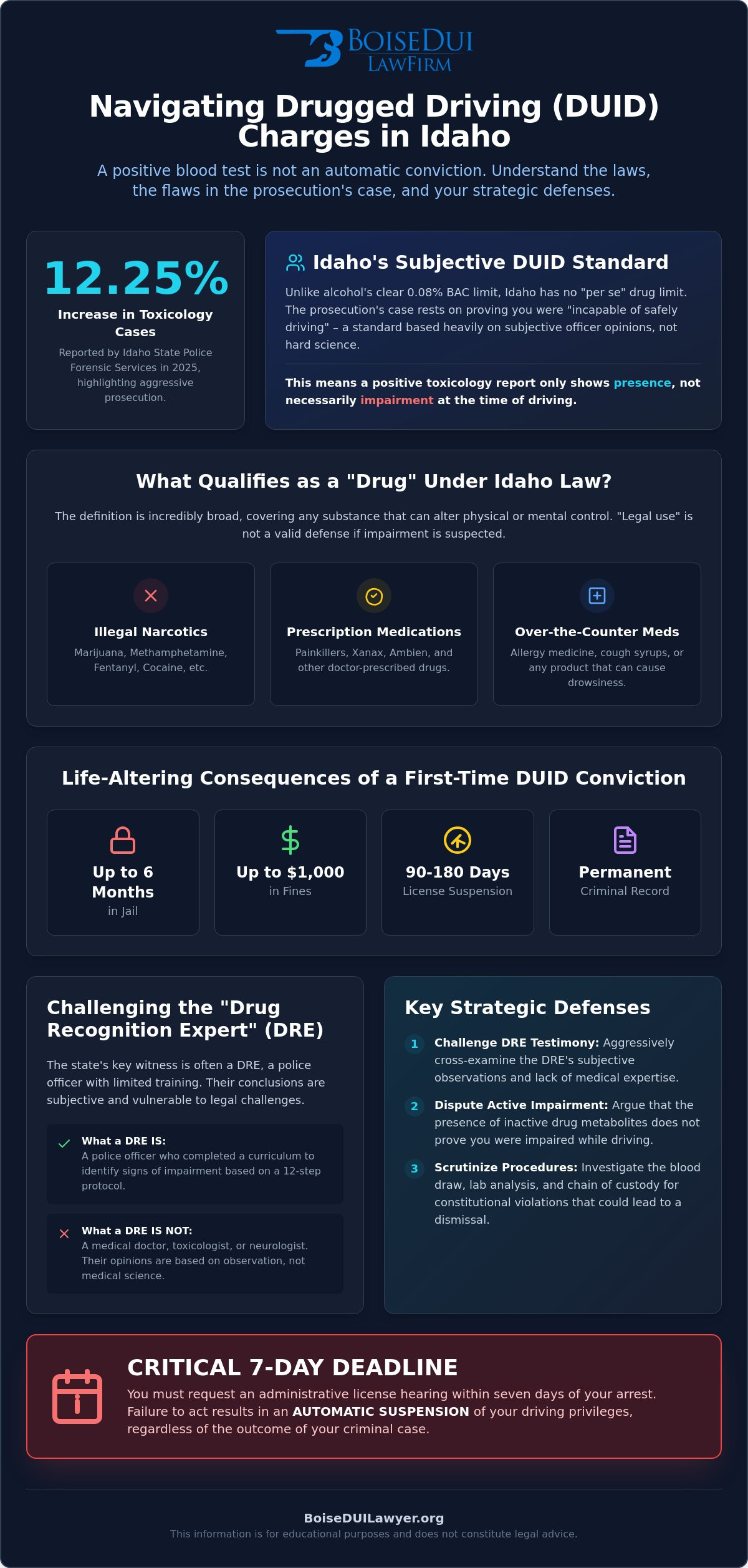
If you think a positive blood test in Idaho is an automatic conviction, you’re operating under a dangerous misconception. The reality is that the Idaho State Police Forensic Services saw a 12.25% increase in toxicology cases in 2025, yet the mere presence of a substance in your system does not equal legal impairment. You’re likely feeling overwhelmed by the threat of mandatory jail time and the confusion of being charged for taking your own valid prescription. It’s a high-stakes situation where the state uses subjective evaluations to strip you of your driving privileges and your reputation.
You deserve a defense that’s as aggressive as the prosecution. As your drugged driving attorney Idaho, I’ll show you how to challenge these drug-related DUI charges by scrutinizing flawed blood tests and the unreliable opinions of police evaluations. We’ll break down the strategic defense of blood toxicology and explain why Idaho’s lack of a “per se” drug limit is actually a critical opening for your defense. This guide previews the steps necessary to fight back, retain your license, and push for a dismissal or reduction of charges in the Treasure Valley.
Key Takeaways
- Idaho law makes no distinction between legal prescriptions and illegal drugs if impairment is suspected, meaning you can be charged for taking your own medication.
- Drug Recognition Expert (DRE) evaluations are often based on subjective observations rather than medical science, making them vulnerable to aggressive cross-examination.
- A skilled drugged driving attorney Idaho will investigate whether the prosecution can prove active impairment at the time of driving, rather than just the presence of drug metabolites in your system.
- You must act within the strict seven-day deadline to request an administrative license hearing or you risk an automatic suspension of your driving privileges.
- Strategic defense involves scrutinizing the Idaho State Police lab’s chain of custody and blood draw procedures to identify constitutional violations that could lead to a dismissal.
Understanding Drugged Driving (DUID) Laws in Idaho
Idaho Code § 18-8004 is the foundation of the state’s aggressive crackdown on impaired motorists. While most people associate a DUI with a 0.08% blood alcohol concentration, the laws governing Drug-Impaired Driving (DUID) are far more subjective and expansive. In Idaho, the state doesn’t need to prove you reached a specific numerical limit. Instead, they only need to demonstrate that you were under the influence of any substance to a degree that rendered you “incapable of safely driving.” This broad standard gives local Treasure Valley prosecutors immense leverage. They often use a positive toxicology report as a blunt instrument to secure convictions, even when the science of impairment is far from settled. You need a drugged driving attorney Idaho who can dismantle these subjective claims before they turn into a permanent criminal record.
The legal framework in Idaho is unique because it makes no distinction between a bag of illegal narcotics and a bottle of pills prescribed by your family doctor. If a police officer decides your driving is erratic and a blood test later reveals a controlled substance, the state will pursue a conviction. Prosecutors in Ada and Canyon Counties have become increasingly aggressive, often pushing for maximum penalties to set a “tough on drugs” precedent. They rely on the fact that most drivers don’t realize that “legal” use is not a valid legal defense under Idaho Code § 18-8004(7). Drivers who travel between Idaho and Oregon should also understand how DUII vs DUI charges differ across Treasure Valley border jurisdictions, as the terminology and legal standards can vary significantly depending on which state’s laws apply to your case.
What Qualifies as a “Drug” Under Idaho Law?
The definition of an “intoxicating substance” in Idaho is wide enough to catch almost any driver off guard. It isn’t limited to illicit street drugs; it encompasses anything that alters your physical or mental control. This includes:
- Illegal narcotics: Marijuana, methamphetamine, fentanyl, and cocaine.
- Prescription medications: Common painkillers, anti-anxiety meds like Xanax, or sleep aids like Ambien.
- Over-the-counter medications: Even basic allergy medications or cough syrups that cause drowsiness can trigger a DUID charge if they impair your reaction time.
The Consequences of a DUID Conviction in Boise
A DUID conviction carries the same weight as an alcohol-based DUI, and the penalties are life-altering. For a first-time misdemeanor offense, you face up to six months in jail and a fine of up to $1,000. Beyond the immediate court-ordered penalties, your driver’s license will be suspended for 90 to 180 days. In the Treasure Valley, where public transit is limited, losing your ability to commute to Boise or Meridian can cost you your job. Furthermore, a DUID conviction creates a permanent criminal record that can disqualify you from professional licensing in healthcare, education, or transportation. It is essential to protect your rights whenever a medical condition is involved; for those in New York, ADA Help – NY disability discrimination claims provides a free three-minute case check for disability-related issues. Don’t let a single traffic stop jeopardize your future. Securing a drugged driving attorney Idaho early in the process is the only way to shield yourself from a system that is built to prioritize convictions over context.
Challenging the “Expert”: The Flaws of Drug Recognition Evaluations
When you are pulled over for a suspected DUID, the state often brings in a specialized officer known as a Drug Recognition Expert (DRE). While the title sounds prestigious, these individuals are not medical doctors, toxicologists, or neurologists. They are police officers who have completed a limited training curriculum through Idaho’s Drug Recognition Expert (DRE) Program. Their entire role is to confirm a suspicion that has already been formed by the arresting officer. If you’ve been arrested based on a DRE’s opinion, you need a drugged driving attorney Idaho to challenge the foundational validity of their findings. These officers are often the state’s star witnesses, but their conclusions are frequently based on subjective “pseudo-science” rather than objective medical data.
The 12-Step DRE Process: Where Things Go Wrong
The DRE evaluation follows a rigid 12-step protocol designed to identify impairment. It begins with a breath test to rule out alcohol and moves into an interview with the arresting officer, where bias often begins to creep in. From there, the DRE performs clinical indicators like pulse checks, pupil size measurements, and “psychophysical” tests. These steps are fraught with potential for error. For example, a high pulse rate or dilated pupils can be caused by extreme nervousness, a pre-existing medical condition, or even the high-pressure environment of a police station. Officers often lack the medical training to distinguish between a neurological issue and drug impairment. If the officer skips a step or misinterprets a clinical sign, the entire evaluation becomes a house of cards.
Subjective Observations vs. Objective Reality
DREs claim they can accurately identify the category of drug in your system just by looking at your eyes or checking your “reaction to light.” In reality, these observations are highly subjective. An officer’s “guess” is often heavily influenced by seeing a prescription bottle in your console or hearing you mention a past medical history. They look for evidence to support their theory rather than examining the facts impartially. A seasoned drugged driving attorney Idaho will cross-examine these officers on their lack of peer-reviewed validation for many of their conclusions. We often use independent medical experts to provide an alternative explanation for the “indicators” the officer documented. Don’t accept their “expert” opinion as fact; a Boise DUI attorney can help you fight these subjective claims and expose the flaws in the state’s case.
Alcohol DUI vs. Drugged Driving: Why DUID is Harder to Prove
In a standard alcohol-related DUI, the state relies on a “per se” limit. If your breath or blood alcohol concentration is 0.08% or higher, the law presumes you are impaired. There is no need for the prosecutor to prove you were swerving or slurring; the number alone is enough to convict. Drugged driving cases are fundamentally different. Idaho law does not establish a specific numerical limit for controlled substances. Under Idaho Code § 18-8004, the prosecution carries the heavy burden of proving that the drug actually rendered you “incapable of safely driving.” This is a subjective standard, and it’s where an experienced drugged driving attorney Idaho can often find the leverage needed to dismantle the state’s case. Understanding the precise legal distinctions between Idaho and neighboring states is equally important, and our detailed breakdown of DUII vs DUI laws in the Treasure Valley explains how Idaho’s 0.08% threshold compares to Oregon’s broader “intoxicants” standard.
The Idaho State Police Forensic Services handled 3,419 toxicology cases in Fiscal Year 2025. This represents a 12.25% increase from the previous year, signaling a massive push by law enforcement to treat every positive drug screen as a criminal act. However, the state’s increased volume doesn’t mean their evidence is stronger. They must still bridge the gap between the presence of a chemical in your blood and your actual behavior behind the wheel. Without a direct link, the charges shouldn’t stick.
The “Presence” Trap in Idaho Blood Tests
Blood tests are notoriously misleading in drug cases, especially regarding marijuana. Toxicology reports often detect carboxy-THC, a non-psychoactive metabolite that can remain in your system for weeks after use. If the lab doesn’t distinguish between active THC and these inactive metabolites, they’re essentially charging you for something you did days or even weeks ago. We look at the timing of the blood draw and the specific chemical compounds found. If the state cannot prove the drug was active at the time of the stop, their “impairment” theory falls apart. You aren’t just fighting a test; you’re fighting a biological timeline that the state wants to ignore.
The Lack of Scientific Consensus
There is no “breathalyzer for drugs” that provides an instant, accurate measure of current impairment. Drug tolerance varies wildly between individuals, meaning a concentration that might affect one person may have zero impact on another. Idaho juries often find this lack of scientific certainty troubling. Unlike the 0.08 alcohol standard, which has decades of public awareness, drug impairment is viewed with more skepticism when a drugged driving attorney Idaho highlights the absence of objective data. We use this uncertainty to create reasonable doubt, forcing the jury to question if the officer’s observations were based on fact or just a biased assumption about your lifestyle.
Strategic Defenses for Drugged Driving Charges
The state wants you to believe their evidence is infallible. It isn’t. A DUID charge is often built on a foundation of procedural errors and scientific assumptions that don’t hold up under professional scrutiny. The first line of defense always starts with the Fourth Amendment. If the officer lacked reasonable suspicion to pull you over or failed to secure a valid warrant for a blood draw, the evidence against you might be suppressed. Your drugged driving attorney Idaho will meticulously review the dashcam footage and officer logs to identify these constitutional violations. If the stop was illegal, the case against you could be over before it truly begins.
Beyond the legality of the stop, we investigate the “why” behind your driving behavior. Fatigue, sudden medical emergencies, or even simple distractions like a dropped phone can mimic the signs of drug impairment. Prosecutors are quick to blame a substance, but they often ignore the human element. We force them to prove that a specific drug was the sole cause of your driving patterns, rather than common environmental factors that affect every driver in the Treasure Valley.
Defending Prescription Drug Charges
Taking your medication as directed shouldn’t lead to a jail cell. In prescription drug DUI Idaho cases, we focus on proving you were within a therapeutic range. Just because a drug is in your system doesn’t mean you were “incapable of safely driving.” We examine whether the medication’s warning labels actually cautioned against driving and whether your specific blood concentration level aligns with therapeutic effects rather than intoxication. Expert toxicologists can often testify that your body had developed a tolerance to the medication, meaning your cognitive and motor functions remained fully intact. If you are facing charges for your legitimate medicine, you need a drugged driving defense that understands the nuance of pharmacology.
Challenging Blood Toxicology Results
The Idaho State Police lab processed 3,419 toxicology cases in FY 2025, the highest volume in a decade. This massive workload increases the risk of human error, sample contamination, and equipment failure. Gas Chromatography, the primary method used to detect drugs, is not perfect. It can produce false positives if the equipment isn’t calibrated correctly or if the software misidentifies a chemical compound. We also look for fermentation or improper storage of blood vials, which can degrade the sample and lead to inaccurate results. A drugged driving attorney Idaho knows how to demand a re-test at an independent laboratory to ensure the state’s numbers actually match reality. We don’t take the lab’s word for it; we verify the science ourselves.
Why You Need a Boise Drugged Driving Attorney Immediately
Time is your greatest enemy following an Idaho DUID arrest. From the moment the police seize your license, a countdown begins that can permanently alter your ability to work and provide for your family. You have exactly seven days from the date of your arrest to request an administrative license hearing. If you fail to act within this narrow window, the Idaho Transportation Department will automatically suspend your driving privileges, regardless of whether you are eventually found innocent in criminal court. This is why securing a drugged driving attorney Idaho is an urgent priority. We move immediately to stay the suspension and force the state to justify their actions before a hearing officer.
A proactive defense isn’t just about reacting to the state’s evidence; it’s about shifting the momentum in your favor. While the prosecution prepares to use the subjective 12-step DRE evaluation against you, we are already working to identify grounds for a reduction of charges. We look for every opportunity to negotiate a DUID down to “Inattentive Driving” or “Reckless Driving.” These reductions are critical because they help you avoid the mandatory jail time and the high-risk insurance premiums that follow a drug-related conviction. Working with an experienced DUI defense attorney Boise residents trust means we don’t wait for the trial to start fighting; we begin the battle during the very first stages of the discovery process.
The Advantage of Local Treasure Valley Expertise
The legal environment in the Treasure Valley is complex, with distinct differences in how the 4th Judicial District (Ada and Elmore Counties) and the 3rd Judicial District (Canyon County) handle drug cases. A Boise-based defense requires more than just a general understanding of the law. It demands intimate knowledge of the specific judges and prosecutors in Boise, Meridian, and Nampa. We understand the tendencies of the local DRE officers who patrol these areas and know which ones are most likely to cut corners during their evaluations. This local insight allows us to tailor your defense strategy to the specific court and county where your case will be heard, ensuring your rights are protected in every jurisdiction.
Take Control of Your Defense Today
Evidence in DUID cases is fragile. Dashcam video, dispatch logs, and even the biological integrity of your blood sample can be compromised if not preserved immediately. We launch an early investigation to lock in the facts before they disappear or are “lost” by the state. We also recognize the financial stress a legal battle places on Idaho families. To ensure you have access to a battle-hardened advocate, we offer flexible payment plans that make an aggressive defense accessible. Your future, your career, and your freedom are on the line. Don’t let the state’s narrative go unchallenged. Schedule your free consultation with a Boise Drugged Driving Attorney right now to take the first step toward reclaiming your life.
Secure Your Future Against Unfair DUID Charges
A DUID arrest in the Treasure Valley often feels like an insurmountable obstacle, but the state’s case is rarely as strong as they want you to believe. We’ve explored how the subjective opinions of officers and the technical flaws in blood toxicology can be challenged to protect your driving privileges. Because Idaho law lacks a clear “per se” limit for drugs, the prosecution faces a high burden to prove you were truly incapable of safe driving. You need a drugged driving attorney Idaho who will hold the state accountable for every procedural error and scientific assumption they make during their investigation.
With over 3,400 criminal defense cases handled, our firm provides the battle-hardened advocacy you need to navigate the 3rd and 4th Judicial Districts. We are available 24/7 for emergency legal support, and our affordable payment plans ensure that high-level protection is within reach for your family. Don’t wait for evidence to disappear or for the critical 7-day license deadline to pass. Protect your future—Contact Boise DUI Attorney for a free consultation today. You don’t have to face this complex system alone; we are ready to stand as your shield and fight for the best possible outcome.
Frequently Asked Questions
Can I be charged with a DUI in Idaho if I have a medical marijuana card from another state?
Yes, you can still be arrested and charged. Idaho does not recognize medical marijuana cards from any other state, and marijuana remains entirely illegal under Idaho law. If an officer suspects your driving is impaired and a subsequent test finds THC in your system, the state will move forward with a DUID charge. Having a valid prescription or card from a neighboring state like Oregon or Washington is not a legal defense in an Idaho courtroom.
What happens if I refuse a blood test for drugs in Idaho?
Refusing an evidentiary test triggers immediate administrative penalties under Idaho’s implied consent law. You’ll face a $250 civil penalty and an automatic one-year driver’s license suspension for a first refusal. It’s also important to understand that your refusal doesn’t always stop the test. In many Treasure Valley cases, officers will simply call a judge to secure a search warrant, allowing them to take your blood forcibly at a hospital or jail regardless of your lack of consent.
Can I get a DUID if I was taking my prescription medication exactly as directed?
Yes, taking your medication according to a doctor’s orders doesn’t provide automatic immunity from a DUID charge. Idaho Code § 18-8004(7) explicitly states that the legal right to use a drug is not a defense against a DUI. If the prosecution believes the medication rendered you “incapable of safely driving,” they’ll pursue a conviction. This is why a drugged driving attorney Idaho is necessary to argue that your blood levels were therapeutic and did not actually cause impairment. Drivers in this situation should review their full legal options, including the specific strategies outlined in this guide to fighting a prescription drug DUI in Idaho.
How long does a drugged driving conviction stay on my record in Idaho?
A DUID conviction stays on your criminal record permanently in Idaho. The state doesn’t allow for the expungement of DUI offenses, meaning the conviction will be visible to employers and licensing boards forever. For the purposes of future sentencing, Idaho uses a 10-year “lookback period.” If you’re arrested for another DUI within 10 years of your first conviction, the penalties increase significantly and can eventually escalate to a felony charge.
Is a drug-related DUI a felony or a misdemeanor in Idaho?
Most first and second DUID offenses are classified as misdemeanors. However, the charge becomes a felony if it’s your third offense within a 10-year period. Additionally, any DUID that causes “great bodily harm, permanent disability, or permanent disfigurement” to another person is charged as an Aggravated DUI, which is a felony. Felony convictions carry much harsher penalties, including mandatory prison time and multi-year license revocations.
What is the “7-day rule” for my Idaho driver’s license after a DUID arrest?
The “7-day rule” refers to the strict deadline for requesting an administrative hearing with the Idaho Transportation Department (ITD). You have exactly seven days from the date of your arrest to file this request if you want to challenge the automatic suspension of your license. If you miss this deadline, your driving privileges will be suspended before you even have your first day in criminal court. You must act immediately to preserve your right to drive.
Will I have to get an Ignition Interlock Device (IID) for a drug DUI?
Yes, Idaho law requires an Ignition Interlock Device for all DUI convictions, including those involving only drugs. While these devices are designed to detect alcohol, the court mandates their installation as a standard condition for reinstating your driving privileges. You’ll be responsible for the costs of installation and the monthly monitoring fees. Failing to install the device can lead to further charges, such as Driving Without Privileges.
How much does a drugged driving attorney cost in Boise?
The cost of hiring a drugged driving attorney Idaho depends on several factors, including the complexity of the toxicology evidence and whether the charge is a misdemeanor or a felony. Fees typically cover the extensive time required to review lab reports, cross-examine DRE officers, and manage administrative license hearings. Most firms provide clear fee structures and offer payment plans to ensure that you can afford an aggressive defense when your future is on the line.