

A single letter in a police report is often the only thing standing between a manageable mistake and a life-altering conviction. When you are navigating the border towns of the Treasure Valley, the distinction between duii vs dui isn’t just academic; it’s a matter of which state’s hammer is coming down on your future. It’s natural to feel overwhelmed by the technical jargon and the fear of how a drug-related charge might differ from an alcohol stop. You’re facing a system designed to be complex and intimidating, and right now, you need clarity more than anything else.
We’re here to provide that clarity and act as your shield against the prosecution. This guide breaks down the legal terminology confusion between Idaho and Oregon and explains how these charges specifically impact your rights in the Boise area. You’ll gain a clear understanding of Idaho’s strict 0.08% limit versus Oregon’s broad “intoxicants” definition. Most importantly, we’ll outline the immediate steps you must take to protect your Idaho license, including how to handle the 7-day deadline for your administrative hearing. The clock is already ticking on your driving privileges. Understanding these rules is the first step in fighting back.
Key Takeaways
- Identify the critical distinction of duii vs dui to understand whether you are facing Oregon’s “intoxicant” statutes or Idaho’s standard impaired driving laws.
- Learn why Oregon’s first-time diversion programs are not an option for Idaho charges, requiring a more aggressive defense strategy from the start.
- Recognize that Idaho law treats impairment from prescription drugs and illegal substances with the same severity as alcohol under a single DUI charge.
- Discover the immediate steps you must take to challenge an administrative license suspension before Idaho’s strict seven-day deadline expires.
- Understand how the different look-back periods in the Treasure Valley can escalate a simple mistake into a felony charge with long-term consequences.
Why the Terms DUII and DUI Cause Confusion in Idaho
In the Treasure Valley, legal terminology isn’t just about semantics; it’s about geography. If you’re pulled over in Boise, the officer cites you for Driving Under the Influence (DUI). Drive thirty minutes west across the Snake River into Ontario, and the charge becomes Driving Under the Influence of Intoxicants (DUII). This subtle shift in acronyms creates a dangerous layer of confusion for residents who frequently cross state lines for work or recreation. You shouldn’t let a misunderstanding of local jargon jeopardize your defense.
Understanding the nuances of duii vs dui is essential because while the names differ, the impact on your life remains equally devastating. Idaho follows the standard terminology used by the majority of the country. Oregon, however, uses its specific DUII designation to explicitly highlight that the charge covers more than just alcohol. Regardless of the acronym on your ticket, you’re facing a serious criminal allegation that demands immediate, professional intervention.
The Treasure Valley ‘Border Factor’
Living in a border region means your news broadcasts and social media feeds are a constant mix of Idaho and Oregon updates. You might hear about Oregon’s “diversion” programs and mistakenly assume those same protections apply if you’re arrested in Nampa or Caldwell. They don’t. A charge in Ontario looks different on paper than a charge in Payette, and the procedural rules are entirely separate. You must secure an attorney intimately familiar with the specific jurisdiction where your arrest occurred. Trying to apply Oregon logic to an Idaho courtroom is a strategy that will fail you when the stakes are highest.
DUI vs. DUII: Is One Worse Than the Other?
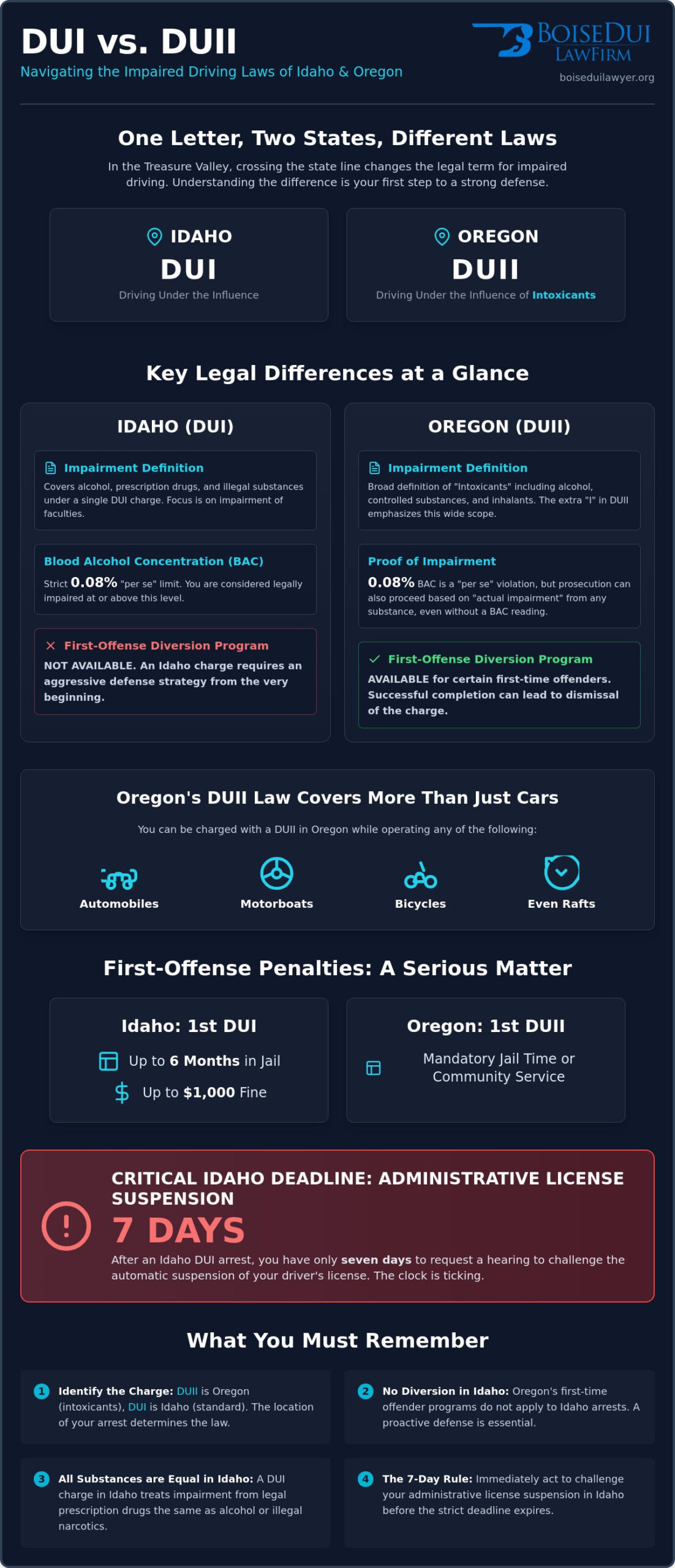
Neither charge should be taken lightly. Both are typically classified as misdemeanors for a first offense, but both can escalate quickly into life-altering felonies. In Idaho, a first-offense DUI can lead to six months in jail and a $1,000 fine. In Oregon, a DUII carries similar weight but includes mandatory community service or jail time. The primary takeaway is that both states cast a wide net when defining impairment. They aren’t just looking for high blood alcohol content; they’re looking for any sign that you’ve lost control of your faculties.
The role of “intoxicants” is central to both definitions, covering alcohol, illegal narcotics, and even legally prescribed medications. An intoxicant is any substance that impairs mental or physical faculties. Whether you’re debating duii vs dui, the prosecution’s goal is identical: they want to prove you were too impaired to safely operate a vehicle. You need a defense that recognizes these distinctions and fights to preserve your freedom before the system grinds you down.
What is DUII? The Oregon Legal Definition Explained
Oregon’s legal system uses the acronym DUII, which stands for Driving Under the Influence of Intoxicants. This isn’t just a stylistic choice in naming. The extra “I” emphasizes that the state’s reach extends far beyond alcohol. While the debate of duii vs dui often starts with terminology, the real danger lies in how Oregon defines impairment. Under Oregon law, the prosecution can convict you using a “per se” theory if your blood alcohol concentration (BAC) is 0.08% or higher. However, they don’t need a breathalyzer result to arrest you. They can prosecute based on “actual impairment,” arguing that any substance noticeably affected your mental or physical faculties.
The scope of this law is surprisingly broad. You aren’t only at risk when you’re behind the wheel of a car. In Oregon, you can be charged with a DUII while operating a bicycle, a motorboat, or even a raft on the river. Many Treasure Valley residents heading west for a weekend on the water are blindsided by this. Oregon does offer a DUII Diversion Program for certain first-time offenders. If you successfully complete the program’s requirements, the court dismisses the charge. It’s a unique opportunity for a second chance that simply does not exist in the same form under Idaho Code § 18-8004. You must act quickly to determine if you’re eligible before the window of opportunity slams shut.
What Counts as an ‘Intoxicant’ in Oregon?
Oregon’s definition of an intoxicant covers a wide spectrum of substances. This includes alcohol, controlled substances, and inhalants. With the prevalence of recreational marijuana, officers are now more aggressive in pursuing marijuana-related DUII charges. Even your legal prescription medications can land you in a jail cell if the state believes they caused impairment. If you’re facing a charge involving medication or cannabis, you need a Drugged Driving Defense expert who understands how to challenge chemical evidence. The state’s broad definitions are a trap for the unwary.
Oregon’s Implied Consent Laws
When you drive on Oregon’s roads, you’ve already given your “implied consent” to submit to chemical testing. This includes breath, blood, or urine tests if an officer has probable cause. Refusing these tests triggers immediate administrative penalties, including a mandatory license suspension that often exceeds the suspension for a failed test. Don’t think an Oregon arrest stays in Oregon. Thanks to interstate agreements, a DUII conviction or a test refusal will follow you home and likely trigger a suspension of your Idaho driver’s license. Navigating the complexities of duii vs dui requires a proactive strategy to protect your right to drive.
DUI in Idaho: How the Law Defines Impaired Driving
In Idaho, the legal system doesn’t bother with the multiple acronyms you might find across the border. Whether you are accused of drinking too much at a Boise brewery or taking a prescription pill before driving in Meridian, the charge is simply “DUI.” Under Idaho Code § 18-8004, it is unlawful for any person who is under the influence of alcohol, drugs, or any other intoxicating substance to drive or be in actual physical control of a motor vehicle. This all-encompassing definition is where many drivers get tripped up when comparing duii vs dui. While Oregon uses the “I” to signal other intoxicants, Idaho assumes those substances are already part of the problem.
One of the most severe variations in our state is the “Excessive DUI.” If your blood alcohol concentration (BAC) is measured at 0.20% or higher, you face significantly enhanced penalties, including mandatory jail time and longer license suspensions. Oregon has no direct equivalent name for this; they simply increase fines for a BAC over 0.15%. In Idaho, the “Excessive” label changes the entire trajectory of your case. If you’re facing these high-stakes allegations, you need a drugged driving attorney Idaho can trust to dissect the state’s evidence and protect your future.
Idaho’s Stance on Prescription and Illegal Drugs
Don’t fall into the trap of thinking a valid prescription is a “get out of jail free” card. Idaho law is clear: if a substance impairs your ability to drive safely, you can be arrested. This applies to everything from medical marijuana to common sleep aids or anti-anxiety medications. Our prescription drug DUI Idaho guide details how we fight these subjective charges. Idaho law does not require a specific drug concentration for a DUID conviction. The prosecutor only needs to show that your mental or physical faculties were affected, making these cases notoriously difficult to defend without expert help.
The 7-Day Deadline for Idaho Licenses
Speed is your only ally after an arrest. In Idaho, you have exactly seven days from the date of your arrest to request an administrative hearing with the Idaho Transportation Department (ITD). If you miss this window, your license will be suspended automatically, regardless of what happens in your criminal court case. This process is entirely separate from Oregon’s DMV procedures. While Oregon drivers might have more time or different notification requirements, Idaho is unforgiving. You must act immediately to save your driving privileges in Boise, Meridian, or anywhere in the Treasure Valley. Waiting even one extra day can result in a total loss of your right to drive.
Key Differences Between Oregon and Idaho Impaired Driving Laws
Crossing the Snake River changes more than just the scenery; it fundamentally shifts the legal ground beneath your feet. While the physical act of impaired driving is the same, the judicial response in Idaho is significantly more rigid than in Oregon. When analyzing duii vs dui, the most striking difference lies in how each state handles first-time offenders. Oregon frequently utilizes a “Diversion” program that allows for a dismissal of charges upon completion of specific requirements. Idaho offers no such escape hatch. If you are charged in Boise, you are entering a system that prioritizes conviction and long-term monitoring over rehabilitation-based dismissals.
The look-back periods for prior convictions also create a trap for repeat offenders. Idaho uses a 10-year window to determine if a subsequent charge is enhanced to a felony. Oregon’s system is equally aggressive, elevating a DUII to a Class C felony if you have at least two prior convictions within a 10-year period. However, the administrative fallout regarding your license is where the states truly diverge. An Idaho first-offense DUI typically triggers a 90 to 180-day license suspension. In contrast, Oregon mandates a full one-year suspension for a first-time DUII conviction. These discrepancies mean a mistake in Ontario, Oregon, will cost you your driving privileges for twice as long as a mistake in Payette, Idaho. This is especially critical for cannabis users to understand, as Idaho’s marijuana DUI Idaho laws impose a zero-tolerance standard that can trigger these suspensions even when you feel completely unimpaired.
Diversion vs. Withheld Judgment
Oregon’s DUII Diversion is a statutory program designed to help first-timers avoid a permanent criminal record. If you qualify and stay compliant, the charge is dismissed after one year. Idaho’s closest equivalent is a “Withheld Judgment.” This allows a judge to set aside a conviction after you complete probation, but it is not a true dismissal. A withheld judgment still counts as a prior conviction if you are ever arrested again. It doesn’t disappear from your record in the same way Oregon’s diversion does, making Idaho’s system objectively harsher for those seeking a clean slate. You need a DUI defense attorney Boise residents trust to navigate these unforgiving waters.
Interstate Consequences for Treasure Valley Drivers
Many drivers mistakenly believe that an out-of-state arrest won’t affect their home-state license. This is a dangerous fallacy. Both Idaho and Oregon are members of the Driver License Compact, a national agreement to share conviction data. If you receive a DUII in Oregon, the Oregon DMV notifies the Idaho Transportation Department. Under the “Home State” rule, Idaho will likely treat that out-of-state conviction as if it happened in Boise, triggering a local suspension. You cannot hide from a border-town arrest. To protect your mobility, you must coordinate a defense that addresses both the criminal court and the administrative requirements of your home state. If your license is at risk, you should contact a License Suspension Hearings expert immediately to start building your defense.
Facing Charges in Boise or Beyond? Aggressive Defense for Your Rights
The legal system isn’t concerned with your confusion over acronyms. Whether your paperwork says duii vs dui, the reality is a high-stakes battle for your freedom, your finances, and your reputation. Prosecutors in the Treasure Valley are aggressive. They have the full resources of the state behind them. You need a shield that’s just as powerful. Boise DUI Attorney provides the fierce advocacy required to stand against a system that’s often stacked against the individual. We don’t just manage cases; we fight them.
We represent residents in Boise, Meridian, Eagle, Caldwell, and Nampa who’ve been caught in the crosshairs of impaired driving laws. Our firm specializes in complex cases, including Drugged Driving Defense and Aggravated DUI. We understand the crushing stress you’re under right now. That’s why we offer free initial consultations and flexible payment plan options. We want to ensure you can afford the high-level defense necessary to protect your future without financial ruin being your only option.
Proactive Defense Strategies in Idaho
A passive approach leads to a conviction. We take a proactive stance by meticulously dissecting every piece of evidence the state claims to have. This includes challenging the reliability of field sobriety tests, which officers often administer incorrectly under stressful roadside conditions. We also scrutinize breathalyzer maintenance records and calibration logs to find technical inaccuracies. If the machine wasn’t perfect, the results shouldn’t be used against you.
Our goal is always the best possible outcome for your specific situation. This might mean fighting for a total dismissal or negotiating a reduction to a lesser charge. For those with a commercial driver’s license (CDL), the stakes are even higher. A single conviction can end your career instantly. We fight to protect your professional future and your right to earn a living in the Treasure Valley.
Take Action Before the Deadline Expires
You can’t afford to wait for the system to move at its own pace. As we’ve established, the clock is already ticking on your driving privileges and your window to request a hearing is closing fast. Immediate legal intervention is the only way to change the trajectory of your case. A battle-hardened advocate knows how to spot procedural errors and constitutional violations that others might miss. We’re here to be your guardian and your strategic force against the prosecution.
Don’t let a mistake define the rest of your life. You have rights, and they’re worth defending with everything you have. Take the first step toward reclaiming your life today. Contact Boise DUI Attorney today for your free case evaluation and let us start building your defense.
Take Control of Your Legal Defense Today
The distinction between duii vs dui is more than just a regional quirk; it’s a fundamental difference in how your rights are defended. You now know that Idaho lacks the diversion programs found in Oregon and that the ITD’s seven-day deadline is an unforgiving reality for your license. Whether you were stopped in Boise, Meridian, or Nampa, the state is already building its case against you. You shouldn’t wait for the system to show leniency that doesn’t exist.
We provide aggressive representation across the Treasure Valley to ensure a single mistake doesn’t dismantle your life or your career. Our firm offers free initial consultations and flexible payment plans to make high-level advocacy accessible when you need it most. Don’t let uncertainty lead to a permanent conviction. Secure Your Aggressive DUI Defense—Schedule a Free Consultation Now. Your future depends on the actions you take in the next few hours. We’re ready to stand in your corner and fight for your rights.
Frequently Asked Questions
Is a DUII in Oregon the same as a DUI in Idaho?
Yes, they are essentially the same criminal charge of impaired driving, but the legal framework and terminology differ between the two states. When comparing duii vs dui, remember that Oregon’s term explicitly covers any “intoxicant” while Idaho’s DUI charge serves as an umbrella for alcohol, drugs, and other substances. Both carry severe penalties including jail time, heavy fines, and mandatory license suspensions.
Can I get a DUII for taking my prescribed medication?
You can absolutely be charged with a DUII for taking legally prescribed medication if that substance impairs your ability to drive safely. Oregon law doesn’t distinguish between illegal narcotics and your doctor’s prescription. If the state believes the medication affected your mental or physical faculties, you’re at risk of arrest regardless of the prescription’s validity or your intent.
Will an Oregon DUII show up on my Idaho driving record?
Your Oregon DUII will almost certainly appear on your Idaho driving record due to the Driver License Compact. This interstate agreement ensures that member states share conviction data with one another. Idaho will treat the out-of-state offense as if it happened locally, which often leads to a reciprocal license suspension being triggered in your home state by the ITD.
Does Idaho have a diversion program for first-time DUI offenders?
Idaho does not offer a diversion program that results in the dismissal of a DUI charge for first-time offenders. While Oregon allows some drivers to complete a program to avoid a permanent conviction, Idaho’s system is much more rigid. You might qualify for a withheld judgment, but this still counts as a prior offense if you are ever arrested again in the future.
What happens if I refuse a breathalyzer test in the Treasure Valley?
Refusing a breathalyzer test triggers immediate administrative penalties under implied consent laws in both Idaho and Oregon. In Idaho, this results in a mandatory license suspension that is entirely separate from your criminal court case. You lose your driving privileges automatically unless you take immediate action to contest the suspension through an administrative hearing.
Can an Idaho DUI attorney help me with an Oregon DUII charge?
An Idaho attorney can only represent you in Oregon courts if they are also licensed to practice in that state. However, a Boise-based lawyer is essential for managing the fallout on your Idaho driver’s license following an out-of-state arrest. They can coordinate with Oregon counsel to ensure your defense strategy is consistent across both state lines.
How long does a DUI stay on your record in Idaho?
A DUI conviction stays on your criminal record permanently in Idaho and cannot be expunged. However, the state uses a 10-year “look-back” period to determine if a new arrest should be charged as a second or third offense. A third conviction within that 10-year window is automatically prosecuted as a felony, carrying a mandatory 30 days in jail.
What is the 7-day rule for Idaho driver’s licenses after a DUI?
The 7-day rule is a strict deadline for requesting an administrative hearing with the Idaho Transportation Department to challenge your license suspension. You have exactly seven days from the date of your arrest to file this request. If you miss this window, your license will be suspended automatically, and you lose the chance to fight for your driving privileges. If your arrest involved cannabis, understanding the specific penalties outlined in Idaho’s marijuana DUI Idaho laws for 2026 is essential before your hearing date arrives.